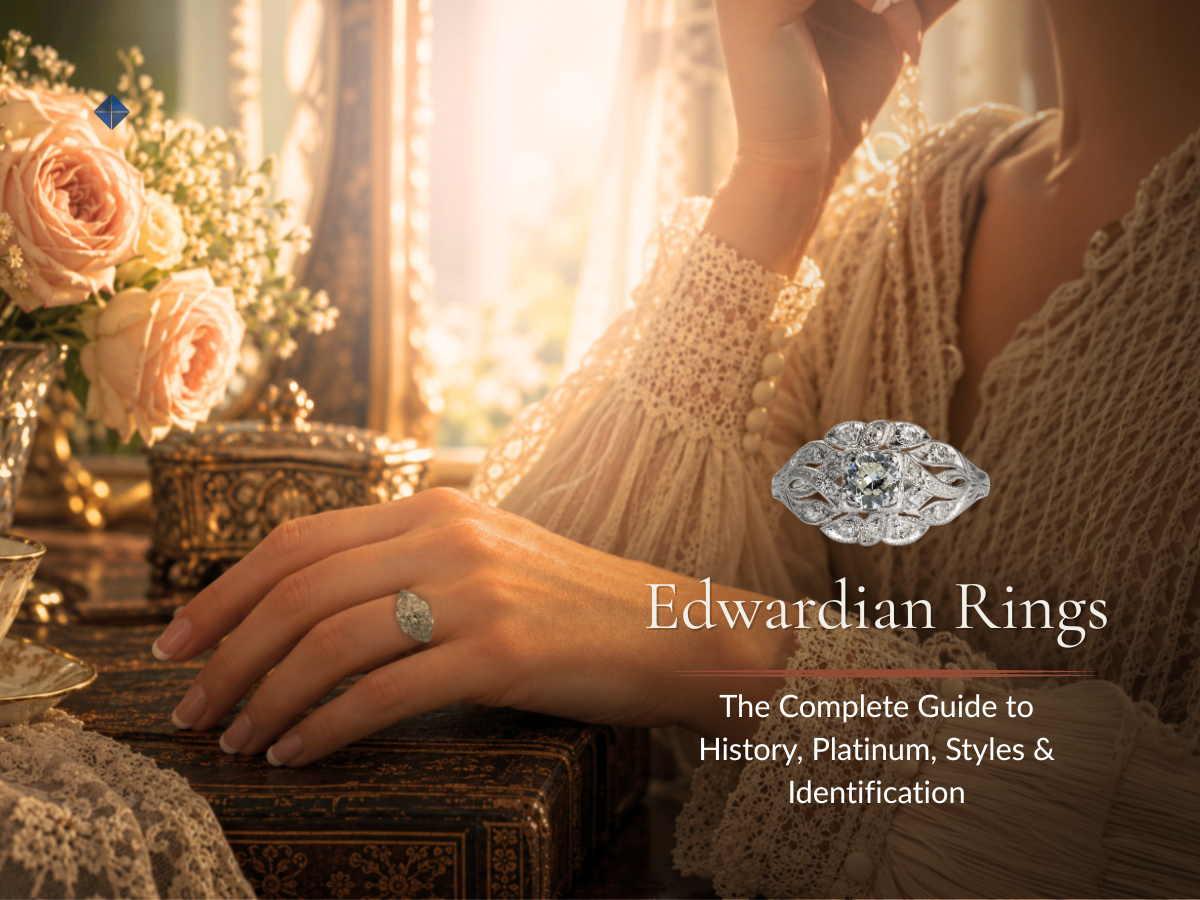
Edwardian jewelry refers to fine jewelry created from roughly 1900 through World War I, characterized by gossamer-light platinum lace, Old European cut diamonds, natural pearls, and romantic Belle Époque motifs. Defined by delicate milgrain borders and hand-pierced openwork, authentic Edwardian rings prioritize visual lightness, balance, and exceptional craftsmanship over heavy metal weight.
Contents

But dates alone don't tell the whole story. Not every ring made in 1905 looks quintessentially Edwardian, and some rings made later continued to use distinctly Edwardian design language.
That distinction becomes important when you're trying to identify the real thing.
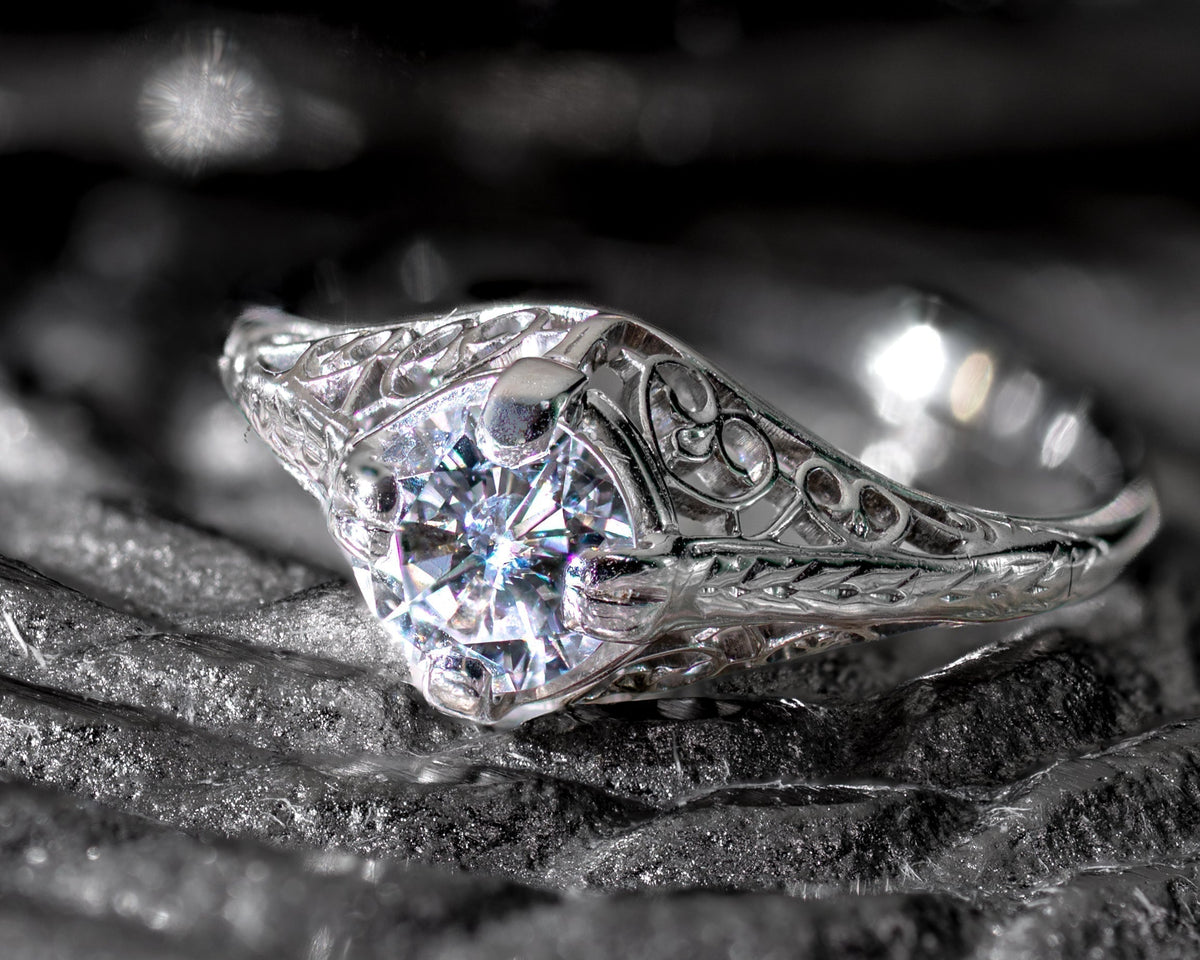
Jewelry periods rarely have hard boundaries. This piece from The TERA Collection shows the refinement and delicate detailing associated with Edwardian design while also illustrating how period styles evolved into one another.
What draws me to Edwardian jewelry is its delicacy and refinement.
That word delicacy needs some qualification. Victorian jewelry could be extraordinarily refined, but many Victorian rings have physical and visual weight. Gold is substantial. Settings can be heavier. The jewelry often announces the metal's presence.
Then something begins to change.
As you move from the late Victorian period into Edwardian design, jewelry becomes visually lighter. Metal starts disappearing. Open space becomes part of the composition. Advances in platinum working allowed jewelers to create increasingly fine structures around diamonds, producing the impression that the stones were almost floating on invisible threads.
Platinum became one of the defining materials of high-style Edwardian jewelry. Its strength allowed jewelers to reduce the amount of visible metal while creating the airy, lace-like designs for which the period became known.
But technology alone doesn't explain Edwardian jewelry.
It still required extraordinary craftsmanship.
When I examine antique jewelry under magnification, that's often what stops me. Look closely at fine piercing, tiny milgrain borders, engraving, galleries, stone settings, and the transitions between different parts of a ring, and then consider the amount of skilled bench work required to create it.
Edwardian jewelers certainly used machinery, dies, specialized tools, and evolving manufacturing technology. It would be misleading to suggest that every component was made entirely with simple hand tools. But much of the piercing, engraving, setting, finishing, and detailing still depended upon highly skilled hands.
That matters because delicacy isn't simply the absence of metal.
In the best work, it's knowing exactly where the metal needs to be—and where it doesn't.
For a broader look at how these changes fit into the evolution of fine jewelry, I've traced the progression from Georgian and Victorian jewelry through Edwardian, Art Deco, and later design periods separately.
King Edward VII reigned from 1901 until 1910, but jewelry periods don't begin and end when a monarch takes the throne or dies.
The aesthetic we now call Edwardian was already developing during the final years of Queen Victoria's reign and continued beyond Edward VII's death. For jewelry, approximately 1900–1915 is a useful working range, although individual pieces on either side can clearly show Edwardian influence.
In France and continental Europe, the overlapping Belle Époque, or “Beautiful Era,” provides another important cultural context. The related garland style drew heavily upon 18th-century court jewelry and neoclassical ornament.
After the heavier visual presence associated with much Victorian jewelry, fashionable jewelry increasingly embraced lightness, symmetry, elegance, and aristocratic references. Bows, ribbons, garlands, wreaths, swags, and other neoclassical motifs became prominent.
The result was jewelry that could be extraordinarily elaborate without appearing heavy.

This is also where our modern habit of putting jewelry into perfectly defined historical boxes starts causing problems.
Some of my favorite antique rings are transitional pieces.
A late Victorian–Edwardian ring can retain the substance and romance of Victorian jewelry while introducing the refinement and increasingly delicate metalwork we associate with Edwardian design.
Likewise, an Edwardian–Art Deco transitional ring may still have flowing or foliate decoration and fine openwork while beginning to show the stronger symmetry and geometry that would eventually dominate Art Deco.
In my own sourcing, I encounter these transitional pieces more often than rings that perfectly illustrate every textbook characteristic of an era. I've come to appreciate them precisely because you can see jewelry design changing within the object itself.
In fact, transitional pieces are often among my favorites.
The boundaries are useful for understanding jewelry. They just aren't walls.
You can explore the preceding period in my guide to Victorian rings and the period that followed in my guide to identifying Art Deco jewelry.
There isn't one feature that proves a piece is Edwardian. I look for multiple characteristics that make sense together.
But I wouldn't identify a ring by running down this list and counting check marks.
The design has to make sense as a whole.
That's harder to quantify, but once you handle enough antique jewelry, it becomes one of the most important things to look for.
A ring can belong squarely to the Edwardian period without displaying the platinum lacework that has become the era's most recognizable visual signature.
This distinction is important.
Not everything produced during the Edwardian jewelry time period was an elaborate platinum garland jewel.
Gold rings continued to be made. Older ring forms continued to be worn and produced. Some pieces were conservative, some fashionable, and some existed somewhere between established Victorian forms and the new Edwardian aesthetic.
I have an Edwardian five-stone ring that illustrates this perfectly. It belongs to the period, but I would never hold it up as the single piece that defines quintessential Edwardian design.
That doesn't make it less Edwardian.
It simply reminds us that historical date and design language aren't always identical.
The opposite is also true. A ring produced somewhat later can retain unmistakable Edwardian influence as jewelry begins moving toward Art Deco.

An antique engagement ring can be as individual as the person wearing it.
That's one of the strongest arguments I can make for choosing one.
There may be another Edwardian ring with a similar design, but finding another precisely like yours can be extraordinarily difficult. Different old-cut diamonds, subtle variations in finishing, more than a century of history, and the survival of the individual object give antique jewelry an individuality that mass production simply cannot reproduce.
And antique doesn't necessarily mean tired.
I've handled century-old rings that look remarkably fresh from normal hand-viewing distance. Their age becomes apparent when I examine them closely, but on the hand they can still look extraordinary.
Absolutely—provided the individual ring is structurally suitable for it.
At this stage of building The TERA Collection, I tend to favor antique rings that combine distinctive design with real-world wearability. I love spectacular occasion jewelry too, and I can see a place for more of it as the collection grows. But right now I'm particularly interested in pieces that can become part of someone's life rather than spending most of the year inside a jewelry box.
A century-old ring does require evaluation. Thin areas of the shank, worn prongs, previous repairs, damaged galleries, and extremely delicate surviving components need to be considered individually.
Age alone, however, doesn't make a ring unsuitable for daily wear.
Platinum is particularly important here. Its strength allowed Edwardian jewelers to create fine structures that securely hold diamonds without the visual bulk required by many earlier settings.
Unlike white gold, platinum is also naturally white and doesn't depend upon rhodium plating for its color. I discuss the differences—and the historical importance of both metals—in my guide to platinum and white gold.
Another aspect of antique engagement jewelry is increasingly important.
It already exists.
The gold or platinum has already been produced. The antique diamonds have already been mined. Choosing an existing ring doesn't create demand for a newly mined center stone.
I would stop short of automatically calling every antique diamond “ethically sourced.” We generally cannot reconstruct the mining and labor history of a diamond recovered more than a century ago.
But from a reuse standpoint, an antique engagement ring is compelling.
You're giving an existing piece another life rather than commissioning an entirely new one.
There wasn't a single Edwardian engagement ring setting.
Different forms existed alongside one another, some inherited from Victorian jewelry and others developing toward styles that would continue into Art Deco.
That's why I prefer understanding the construction and design language of a ring rather than assuming its silhouette alone determines its age.
The solitaire may sound simple, but antique jewelers often treated the center stone as the beginning of the design rather than its entirety.
A beautiful Edwardian solitaire ring might feature an Old European Cut diamond surrounded by delicate metalwork, engraved shoulders, fine milgrain, or an intricate gallery.
That difference matters to me.
I don't buy the biggest stone. I buy the entire piece.
Even when I'm looking at what is technically a solitaire, I want to see how the designer considered the shoulders, gallery, profile, proportions, transitions, and center stone together.
The diamond should be the focal point without necessarily being the entire design.
Three-stone rings are particularly well suited to antique design because the stones create a composition across the finger rather than concentrating everything around one oversized center.
An Edwardian three-stone ring can feature three diamonds or combinations of diamonds and colored gemstones.
Period-appropriate old cuts matter tremendously here.
There is little that disrupts an antique three-stone ring faster than two beautifully matched old-cut diamonds alongside an obvious modern round brilliant replacement.
The modern diamond may be perfectly attractive on its own.
It's simply the wrong diamond for that composition.
Floral cluster and daisy designs carried forward from Victorian jewelry and continued to evolve during the early 20th century.
An Edwardian halo ring or Edwardian daisy ring could use smaller surrounding diamonds to increase visual presence without requiring an enormous center stone.
Again, the point wasn't simply to add more diamonds.
The surrounding stones, center, metalwork, and negative space had to work together.
An elaborate Edwardian engagement ring doesn't necessarily need an equally elaborate Edwardian wedding ring beside it.
Engraved platinum bands can complement detailed engagement rings without competing with them. Diamond-set bands and Edwardian eternity ring styles can also work, depending upon the construction and profile of the engagement ring.
With any antique ring, however, I pay attention to how two rings physically meet.
A modern band constantly rubbing against delicate antique engraving or an exposed gallery can eventually cause damage.
Materials are among the strongest clues when identifying Edwardian jewelry, but they need to be interpreted in context.
| Material or Stone | Edwardian Significance | What I Look For |
|---|---|---|
| Platinum | The defining metal of high-style Edwardian jewelry | Fine but structurally deliberate openwork, piercing, milgrain, and white-on-white diamond settings |
| Platinum on Gold | Important in turn-of-the-century and transitional jewelry | Gold providing body with platinum used around diamonds or across the visible upper structure |
| Old European Cut Diamonds | Strongly associated with late Victorian, Edwardian, and later antique jewelry | Round outlines, smaller tables, higher crowns, broad facets, and visible culets |
| Old Mine Cut Diamonds | An earlier cut that remained present in Edwardian jewelry | Cushion-like outlines, chunky facets, high crowns, and prominent culets |
| Natural Pearls & Seed Pearls | Central to the white Edwardian palette | Pearls incorporated into delicate diamond and platinum compositions |
| Sapphires | A classic source of color against diamonds and white metal | Color integrated into the overall composition |
| Opals & Aquamarines | Softer colored gemstones found in period jewelry | Construction and setting style consistent with the proposed date |
If there is one combination most strongly associated with high-style Edwardian jewelry, it is diamonds and platinum.
Platinum allowed jewelers to create incredibly fine settings while its white color visually receded behind colorless stones. The effect could make diamonds appear to float within lace.
This is one reason an Edwardian diamond ring in platinum can have tremendous visual presence without depending upon an enormous center stone.
The architecture creates the presence.
Gold didn't disappear during the Edwardian era.
Edwardian gold jewelry absolutely exists.
Yellow gold, gold with platinum-topped sections, and other combinations can appear in genuine period pieces.
Metal is evidence, but it isn't a verdict.
This is another reason I distinguish date from design language.
Diamonds and pearls are perhaps the most recognizable Edwardian pairing, but colored gemstones certainly had a place.
An Edwardian pearl ring can reflect the period's preference for pale, luminous compositions, while an Edwardian sapphire ring introduces blue contrast beautifully against diamonds and platinum.
Opals also appear in jewelry from the period. An Edwardian opal ring may look very different from the archetypal diamond-and-platinum garland jewel, which is precisely why materials should always be evaluated alongside construction and design.
The diamond cut isn't an interchangeable specification.
It helps define the era.
Old European Cut diamonds typically have round outlines with smaller tables, relatively high crowns, broad facet patterns, and visible culets compared with modern round brilliants.
Their light behavior works beautifully with fine antique settings because the individual flashes of the diamond become part of the larger composition.
I put a lot of emphasis on performance when evaluating a gemstone.
Specifications matter, but ultimately I want to know what the stone does when the ring moves.
Jewelry isn't worn under a gemological lamp.
It's worn in restaurants, offices, sunlight, dim rooms, and ordinary life.
That's also why replacing an old-cut diamond with a modern brilliant can change the personality of an antique ring even when the replacement diamond is objectively excellent.
If a stone is missing or an inappropriate replacement has already been installed, I have no philosophical objection to replacing it with a better-matched period-appropriate cut.
Preservation doesn't always mean refusing to touch anything.
Sometimes good stewardship means restoring visual coherence.
For more on identifying these cuts, see my comparison of Old European Cut vs. Old Mine Cut. The visible open culets common to many antique diamonds are another useful clue when evaluating an original or replacement stone.
Not every ring form found between 1900 and World War I originated during the Edwardian period.
Victorian forms continued. Edwardian designers reinterpreted existing silhouettes. Other designs evolved into forms that became increasingly associated with Art Deco.
An Edwardian navette ring uses an elongated, pointed outline that stretches visually along the finger. This shape is particularly effective with openwork because it creates significant presence without requiring a huge center diamond.

Why Art Deco with heavy Edwardian influence? Clean symmetry points toward Art Deco, while the 18K gold construction, delicate foliate details, and Old European Cut diamonds preserve a strong Edwardian character.
The Edwardian boat ring and daisy cluster demonstrate the overlap between Victorian and Edwardian jewelry particularly well, refining familiar arrangements with whiter metals and finer settings.
Conversely, an Edwardian gypsy ring sits almost at the opposite end of the spectrum from platinum lace, recessing stones into a smooth, substantial ring body—proving again that historical date and quintessential aesthetic are not always identical.
The easiest way to understand Edwardian jewelry is often to look at what came immediately before and after it.
| Characteristic | Victorian | Edwardian | Art Deco |
|---|---|---|---|
| Approx. Dates | 1837–1901 | c. 1900–1915 | c. 1920–1935 |
| Primary Inspiration | Romanticism, nature, sentiment, historic revival | Belle Époque elegance, garland style, neoclassicism | Modernism, architecture, geometry, machine-age design |
| Primary Metals | Yellow/rose gold, silver, later platinum use | Platinum, platinum with gold, gold | Platinum and increasingly white gold |
| Visual Weight | Often more substantial | Light, airy, refined | Structured and architectural |
| Motifs | Flowers, serpents, stars, hearts, symbolic forms | Garlands, ribbons, bows, wreaths, flowers | Geometry, steps, fans, chevrons, repeating forms |
| Color Palette | Broad use of colored gemstones | White-on-white especially important, with restrained color | Strong contrasts and saturated gemstone accents |
| Openwork | Present, particularly later | Fine, lace-like, visually light | More geometric and structurally organized |
| Symmetry | Variable | Balanced and often flowing | Strong, deliberate geometry and repetition |
The transition around the turn of the century is particularly interesting: rings often retained a substantial gold body while incorporating increasingly delicate platinum or white-metal settings.
Moving forward, Edwardian softness, flowing lines, and foliate decoration gradually gave way to stronger symmetry, line work, and geometric organization that defined mature Art Deco.
When I'm buying antique jewelry, I never simply accept the seller's attribution. I begin with the ring: design, construction, metal, diamond cuts, wear patterns, and hallmarks.
One of the primary giveaways with reproductions is overcrowding. Good antique design has balance and breathing room. Negative space has a purpose, and decorative elements reinforce the form instead of fighting for dominance.
Under magnification, authentic hand engraving and milgrain show crispness with tiny natural human variations. Cast reproductions often display rounded, soft edges and tiny surface pits.
The face tells me what the designer wanted me to see. The underside often tells me how the ring was made.

Turn the ring over to examine the depth and dimensionality of the gallery, how components connect, the distribution of metal, the quality of piercing, and whether repairs or replacements make sense with the ring's presumed history.
Hallmarks can be extremely useful, but they aren't a magic answer. A ring has had more than a century in which to be resized, repaired, re-shanked, altered, or polished. Marks may be worn, incomplete, or lost entirely when a shank is replaced.
A missing hallmark therefore doesn't automatically make an Edwardian ring a reproduction. Likewise, a plausible hallmark doesn't override construction that makes no historical sense. The entire ring still has to tell the same story.
While King Edward VII reigned from 1901 to 1910, the jewelry era broadly spans from roughly 1890 to 1915. It emerged during the late Victorian era and continued up to the onset of World War I, overlapping significantly with the French Belle Époque.
Yes, provided the mount is structurally sound. Edwardian rings crafted in solid platinum are particularly durable because platinum holds fine prongs securely and does not wear away easily. However, rings with gossamer-thin pierced undergalleries or soft gems like opals and pearls require mindful, gentle wear.
Authentic Edwardian rings feature hand-pierced openwork (showing subtle variation under magnification), hand-rolled milgrain, and original period stones like Old European or Old Mine cuts. Modern reproductions are frequently cast rather than hand-pierced, leaving slightly rounded interior edges and overly uniform machine-stamped filigree.
Authentic Edwardian jewelry was crafted primarily in solid platinum, platinum-topped yellow gold, or yellow gold. Commercial white gold was not patented or widely adopted until the late 1910s and 1920s; therefore, a ring crafted entirely in original white gold belongs to the Art Deco era or later.
The Old European Cut is the definitive diamond cut of the Edwardian era, featuring a rounded perimeter, small table, tall crown, and an open culet at the base. Earlier pieces also incorporate surviving Old Mine cuts, rose cuts, and small single cuts set along delicate openwork channels.
The more antique jewelry I handle, the less interested I become in forcing every ring into a perfectly defined historical box.
Era matters. It helps us understand the materials, technology, diamond cuts, aesthetics, and culture that produced a piece. But jewelry evolved continuously. Victorian jewelers didn't stop working one day and Edwardian jewelers begin the next. Edwardian design didn't suddenly disappear when Art Deco emerged.
Those transitions produced some of the jewelry I find most compelling.
And across all of these periods, what attracts me most is complete design. I don't buy the biggest diamond simply because it's the biggest diamond. I look at how the stone works with the setting, how the shoulders lead into the gallery, how the proportions sit on the finger, what happens when I turn the ring over, and whether the whole piece still works from normal viewing distance.
Modern jewelry can provide extraordinary stones. What I sometimes find missing is that same attention to flow, balance, restraint, and composition. The problem isn't having a large center stone. A great gemstone deserves to be celebrated. But the stone shouldn't have to carry the entire design.
Edwardian jewelers understood that a diamond didn't have to be the design. It could be part of the design.
Perhaps that's why these rings remain so compelling more than a century later. At their best, the metal, diamonds, craftsmanship, symmetry, and empty spaces aren't separate features competing for attention.
They work as one piece.
If you are drawn to the visual lightness and romantic detailing of the early 20th century, exploring our curated antique ring collection is the best way to see how these techniques translate to the hand. For a closer look at the eras that frame this moment in design history, continue with our guides to Victorian rings and authentic Art Deco jewelry.
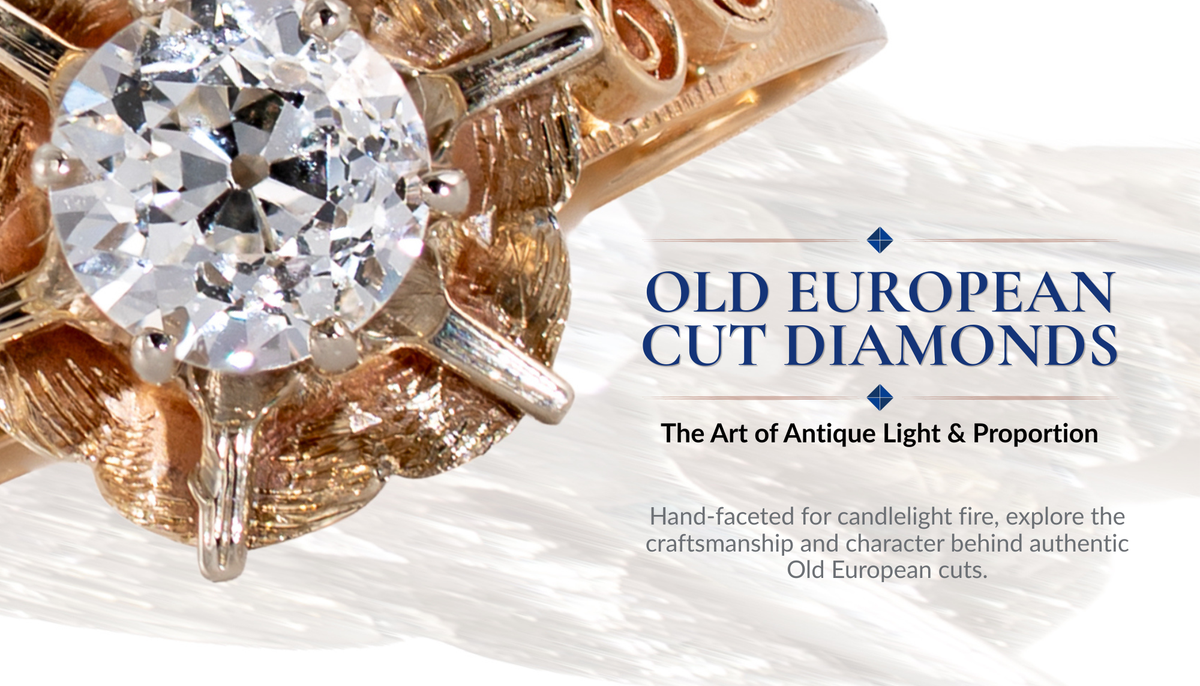
Discover the unique allure of Old European Cut diamonds—the beloved handcrafted round stones of the Victorian, Edwardian, and Art Deco eras. From open culets and steep crowns to their warm, candlelight sparkle, learn how to identify authentic antique cuts and explore curated heirloom rings from The TERA Collection.
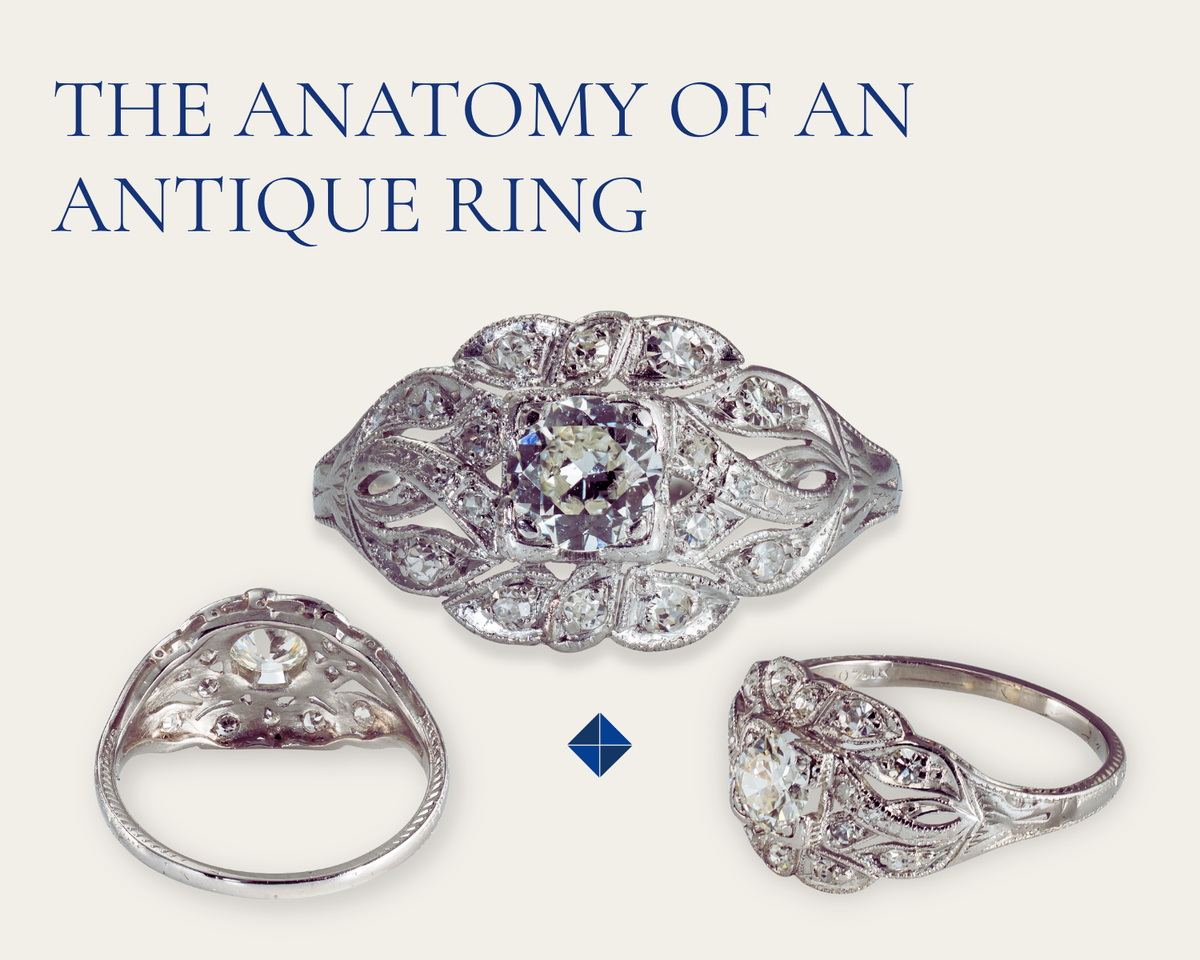
The front of an antique ring tells you why you love it; the rest tells you what it is. Learn how to read an antique ring setting like an appraiser—from center diamond cuts and prongs to galleries, pierced azures, shanks, hallmarks, and condition clues.
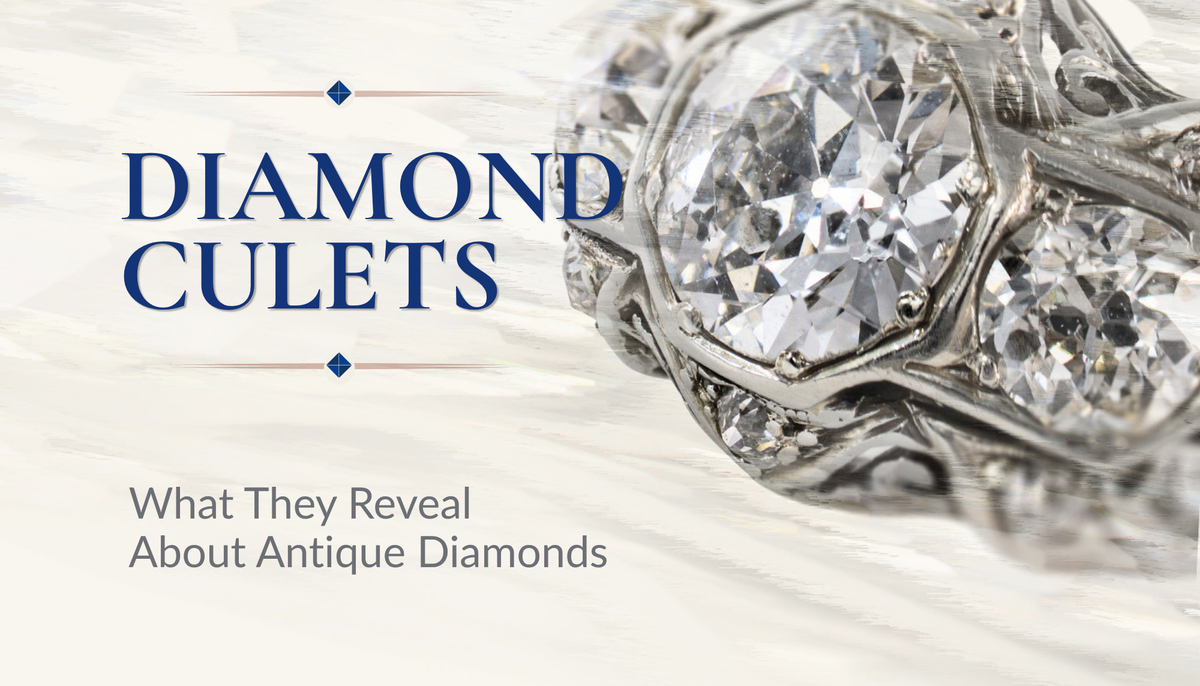
In modern diamonds, the culet is nearly invisible, sharpened down to a single point. But in antique cuts like Old Mine and Old European stones, the culet was deliberately faceted flat—leaving behind the distinctive, pillowy “window” collectors cherish today. Here is everything you need to know about the anatomy and allure of the antique culet.
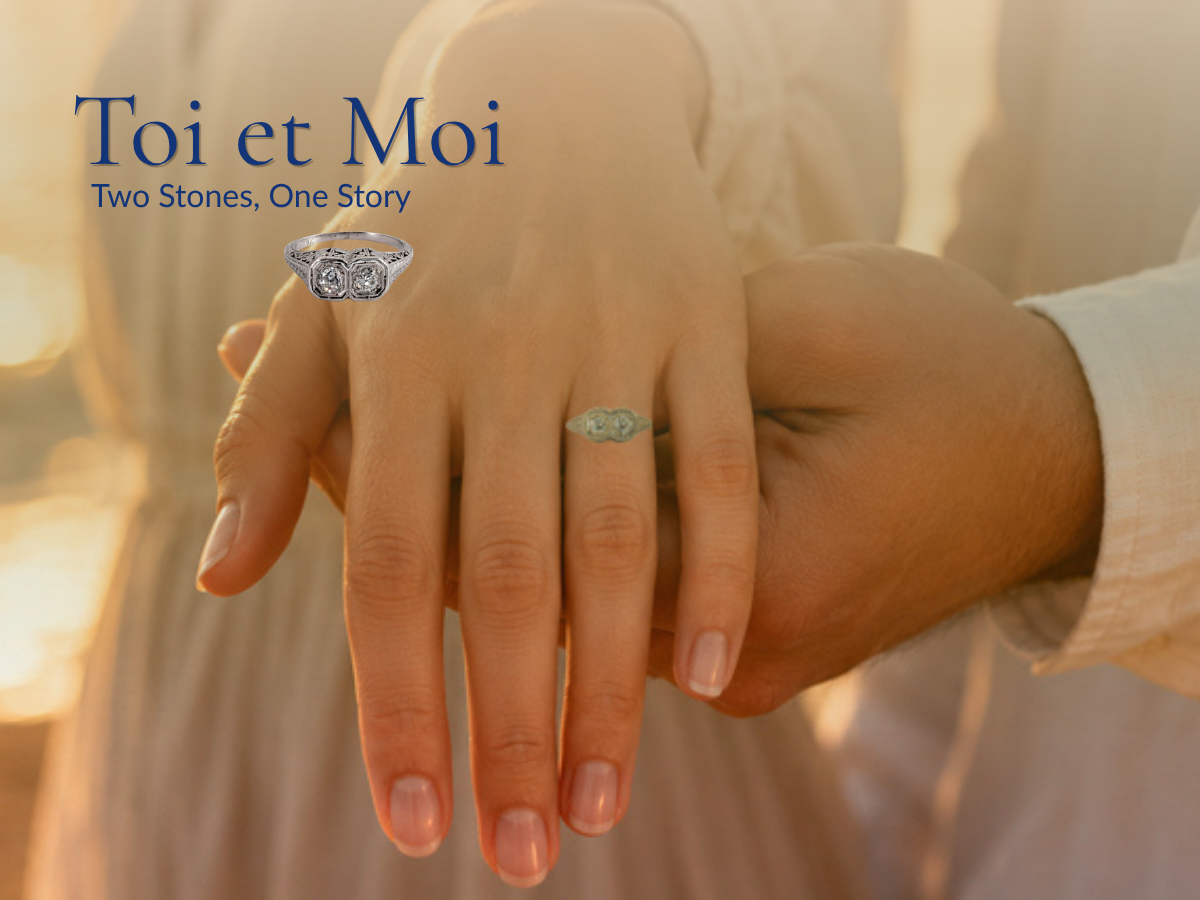
A Toi et Moi ring ("You and Me") pairs two distinct gemstones on a single band to symbolize an intimate, unbroken bond. Explore the storied history, Art Deco architectural craftsmanship, and authentic visual soul behind this timeless antique two-stone design.
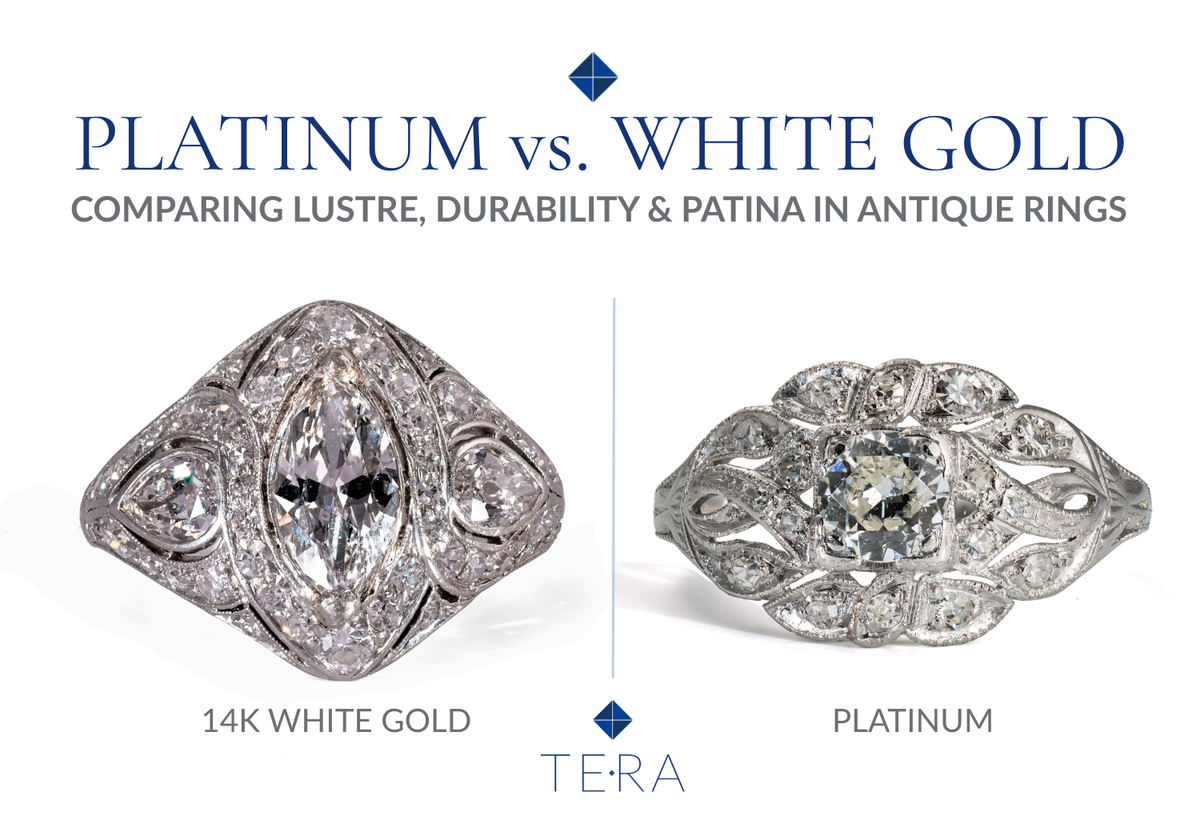
Choosing between platinum and white gold in antique jewelry is about far more than value—the metal provides essential clues about when, where, and how a piece was made. From Victorian silver-topped gold and Edwardian platinum to Art Deco white gold, discover how metal choice shapes durability, patina, and historical authenticity.
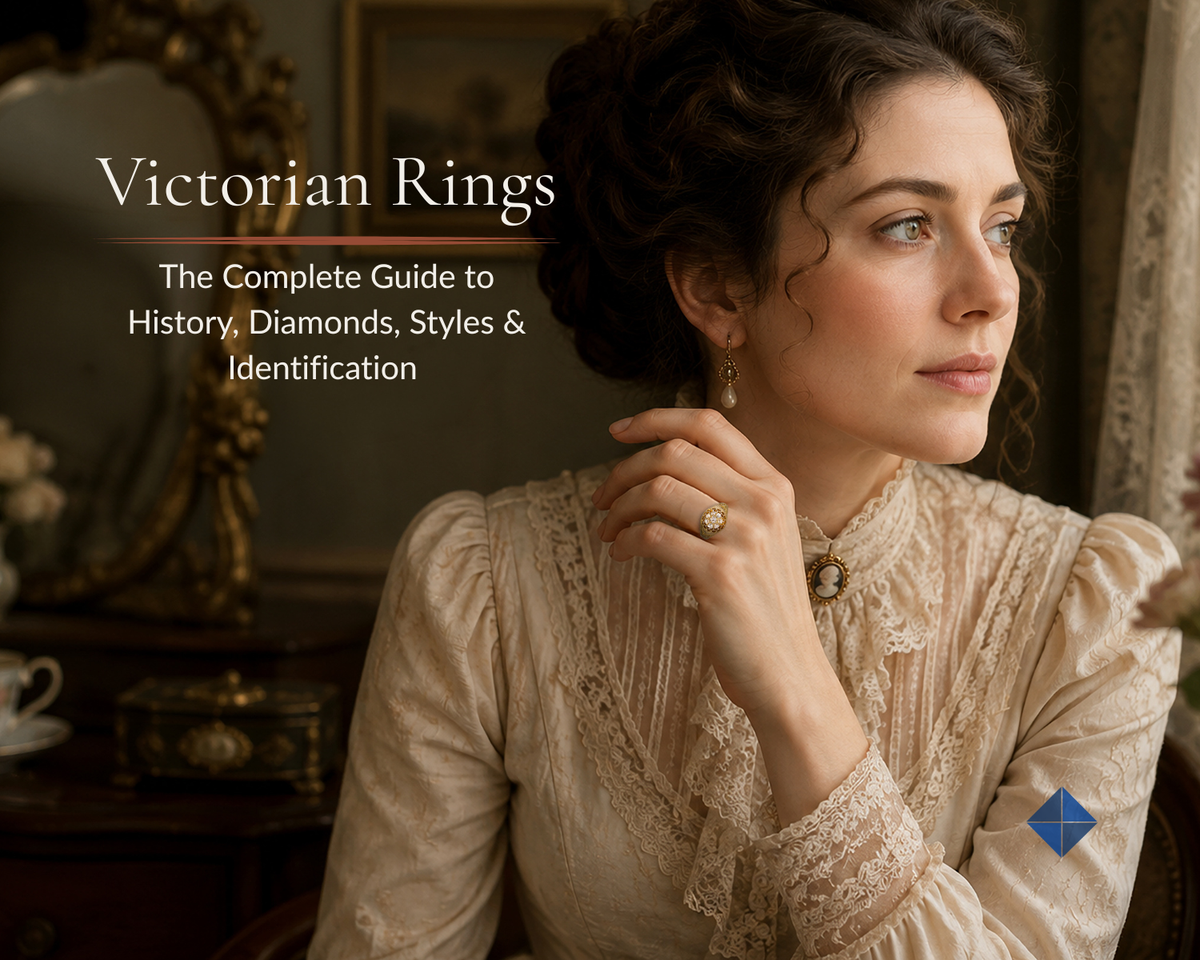
Spanning over six decades of nineteenth-century craftsmanship, authentic Victorian rings (1837–1901) are defined by hand-cut Old Mine diamonds, rich goldwork, and enduring symbolic design. Discover how to identify genuine period pieces, explore the evolution across the Romantic, Grand, and Aesthetic eras, and learn why these historic rings remain remarkably wearable today.
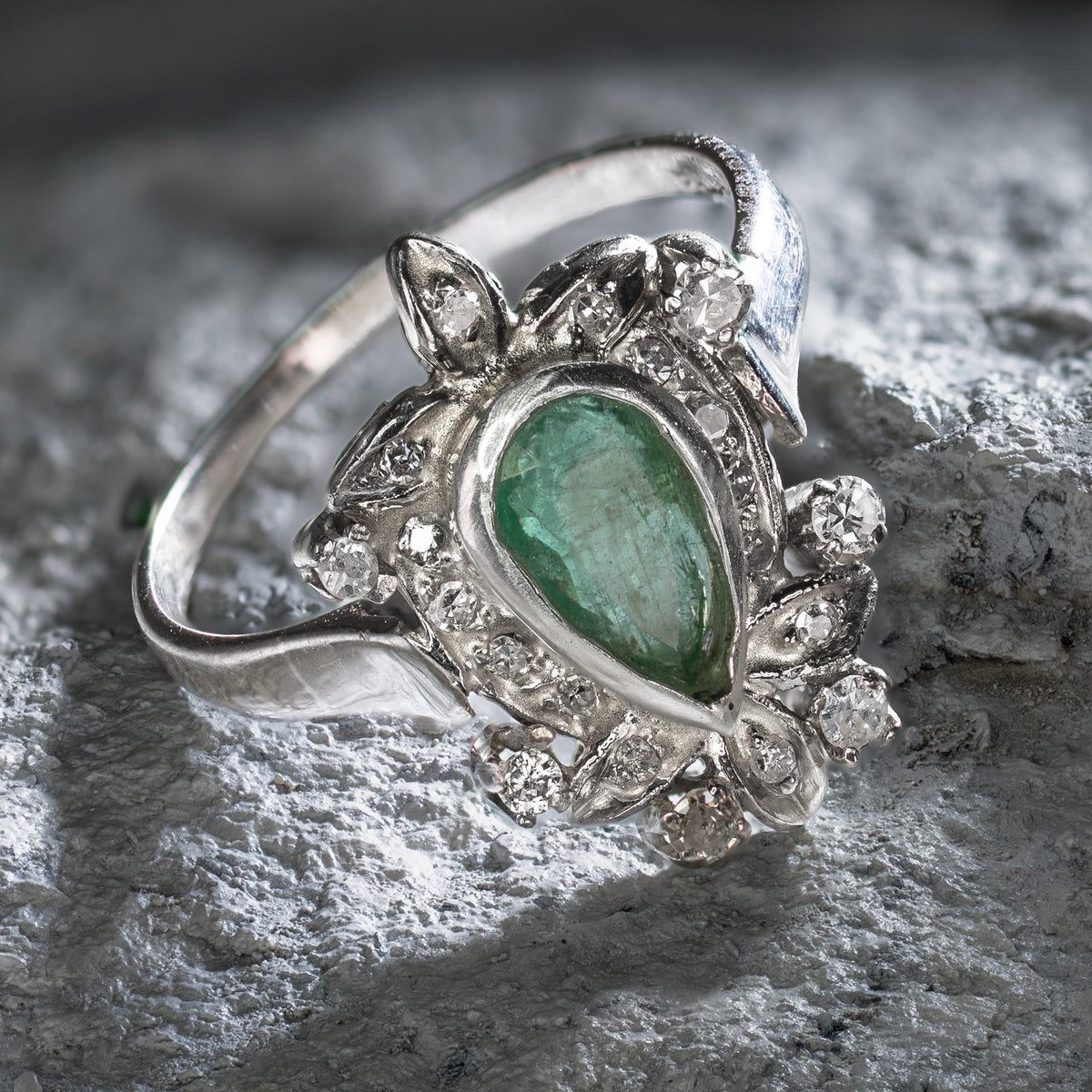
Ever encountered a vintage ring stamped PALL or 950 and wondered what it meant? Discover the fascinating history of palladium jewelry—from its rare Platinum Group origins and WWII wartime heritage to how this lightweight, naturally white noble metal compares to platinum and gold.
A Transitional Cut can retain the broad facets and higher crown of an Old European Cut while showing a smaller culet and larger table that feel surprisingly modern. Here is how to identify these 1920s–1940s diamonds, understand their value, and evaluate them in vintage jewelry.

Quick Answers
What Is an Authentic Art Deco Engagement Ring?
An authentic Art Deco engagement ring (circa 1920–1935) is defined by architectural geometry, hand-pierced filigree, fine milgrain work, and period diamond cuts such as Old European or transitional cuts. Unlike modern solitaires focused strictly on center carat weight, an authentic 1920s ring functions as a complete piece of wearable art where platinum or white gold mountings and geometric gemstone borders share equal prominence with the diamond.
Contents
In This Guide
There is nothing wrong with a classic diamond solitaire. It became a classic for a reason. But walk into almost any jewelry store today and you will see variations of the same basic idea: a relatively simple setting designed to put as much attention as possible on the center diamond.
For some people, that is exactly what they want.
For others, an engagement ring should feel more personal.
That is where antique engagement rings—and Art Deco rings in particular—offer something very different. In a genuine 1920s Art Deco engagement ring, the diamond is only part of the design. The setting, proportions, engraving, filigree, milgrain, openwork, and even the architecture beneath the diamond all contribute to the finished piece.
I often think about it this way: imagine attending a wedding with 300 guests wearing a conventional modern engagement ring. There is a reasonable chance that several other rings in the room will look remarkably similar.
Walk into that same room wearing an authentic 100-year-old Art Deco ring, and the chances of seeing another one just like it are almost nonexistent.
That individuality is one of the things that first drew me to antique jewelry.
But buying a genuine antique ring requires a different approach than buying a new engagement ring. A seller calling something “Art Deco” doesn’t necessarily make it Art Deco. Age alone doesn’t make a ring valuable. Filigree alone doesn’t make a ring authentic. And a ring being 100 years old certainly doesn’t mean it is too fragile to wear.
This guide is about what I actually look for when buying Art Deco rings for The TERA Collection—and what I think you should understand before choosing one as your engagement ring.
Why Choose an Antique Art Deco Engagement Ring?
When I look at an Art Deco ring, the first thing that gets my attention isn’t necessarily the size of the diamond.
It’s the design.
I look for symmetry, balance, and detail. I want the different elements of the ring to work together rather than compete with one another.
That is something I think many modern interpretations of Art Deco jewelry get wrong.
There are plenty of new rings described as “Art Deco style,” but too often the designer seems to have taken every recognizable Art Deco element—filigree, milgrain, geometric shapes, engraving, halos—and tried to fit all of them into a single ring.
They have the vocabulary of Art Deco without understanding its design language.
Great Art Deco jewelry can be incredibly elaborate, but the best pieces still have discipline. There is a reason for every line. Symmetry gives the eye somewhere to rest. The center stone works with the mounting rather than fighting against it.
And sometimes the most compelling antique Art Deco engagement rings aren’t particularly elaborate at all.
A beautifully proportioned 1920s filigree solitaire can have a single diamond, delicate openwork through the shoulders, and subtle hand engraving. It may look relatively simple at first glance. Look closer, however, and you begin to see why it could be difficult to reproduce properly today.
That is what I mean by design.
It isn’t about adding more.
It is about making everything belong.
What Makes an Engagement Ring Art Deco?
The Art Deco period is generally associated with the 1920s and 1930s, although jewelry design did not suddenly change when the calendar reached 1920.
There was a transition.
Classic Edwardian engagement rings could be delicate, airy, and almost lace-like. As tastes changed, those ideas increasingly met the stronger geometry, symmetry, and architectural forms we associate with Art Deco.
That transition produced some of my favorite rings.
Antique engagement rings from the 1920s can incorporate delicate pierced work inherited from Edwardian jewelry while introducing stronger geometric shoulders, structured borders, or a more architectural presentation of the center diamond.
Common characteristics can include:
But this is where buyers need to be careful.
Finding one of these characteristics does not make a ring Art Deco.
A modern reproduction can have filigree. A 1950s ring can have engraving. A modern ring can have an octagonal halo.
I never identify an antique ring from one feature.
I look at the ring in its entirety and ask whether all of its parts tell the same story.
Showcasing prominent open culets across three authentic hand-cut Old European diamonds set in pierced platinum filigree.
View Ring in Shop →How I Determine Whether an Art Deco Ring Is Really Art Deco
I buy quite a bit of jewelry through online auctions and estate sources, and I learned very quickly not to accept a seller’s description as fact.
If an auction calls a ring “Art Deco,” that is a starting point—not a conclusion.
I usually start with the diamond.
Does the stone make sense for the period?
In an original Art Deco diamond ring, I would expect to encounter Old European Cut diamonds, transitional cuts, and other period-appropriate stones depending on exactly when the ring was made.
If I see an obvious modern round brilliant sitting in what is supposed to be an untouched 1920s ring, I immediately start asking questions.
That doesn’t necessarily mean the mounting isn’t antique. Stones get lost. Engagement rings get damaged. Diamonds get replaced. Jewelry has lives.
But now the diamond and the mounting aren’t telling me the same story.
Occasionally I will buy a ring like that if I believe I can source an appropriate antique diamond and restore the integrity of the piece. Often, however, the economics simply don’t make sense.
Then I look at the design.
Does the architecture make sense for the claimed period?
I look at proportions, symmetry, shoulders, engraving, filigree, and the relationship between the center stone and mounting.
Only then do individual decorative elements become meaningful.
This is an important distinction because it is very easy to recognize filigree and think Art Deco. That same filigree could appear on a modern reproduction.
The question isn’t simply:
Does this ring have Art Deco details?
The better question is:
Does this ring make sense as a complete piece of Art Deco jewelry?
To see the full authentication checklist, hallmarks, and testing methods I use, explore our complete guide on how to identify authentic Art Deco jewelry.
Rather than letting the center stone stand alone, this 1920s Art Deco engagement rings setting makes the mounting an equal part of the jewel—balancing architectural geometry with airy, hand-pierced openwork.
Antique Jewelry Is Perfectly Imperfect
One of my favorite expressions when examining antique jewelry is perfectly imperfect.
Early jewelry required an extraordinary amount of skilled handwork. When you examine genuine period pieces closely, that human involvement often reveals itself.
Openings in pierced work may not be perfectly identical. One scroll may differ subtly from its partner. Tiny holes aren’t necessarily perfectly round. Milgrain may wander slightly. Filigree that appears beautifully symmetrical to the naked eye can reveal subtle differences from one side to the other under magnification.
Those aren’t necessarily defects.
They can be evidence of how the ring was made.
By comparison, a modern cast reproduction can sometimes be too perfect—or display the softer, rounded character that casting can impart to details that should appear crisp.
That doesn’t mean imperfection proves age, either.
This is where people can get themselves into trouble when identifying antique jewelry. No single clue authenticates a ring.
Perfectly imperfect workmanship is evidence. The diamond is evidence. The design is evidence. Construction is evidence. The undergallery is evidence. Hallmarks can be evidence.
They all have to be considered together.
Turn the Ring Over: Why the Undergallery Matters
One of the first things I do when examining an antique ring is turn it over.
The top tells you what the designer wanted you to see.
The underside can tell you how the jeweler got there.
The undergallery is one of the most revealing areas of an antique ring because it can expose details of construction that are less obvious from the face-up view.
I’m looking closely at the crispness of the work.
Hand-pierced or die-cut openings can have a different character from cast reproductions. Under magnification, I look for the same perfectly imperfect qualities I see elsewhere: openings that aren’t absolutely identical, slight variations from side to side, crisp edges, and evidence that somebody actually worked and finished the metal.
A modern reproduction may imitate the appearance of antique openwork from the top.
It is much harder for it to imitate the entire story of how an antique ring was constructed.
Again, the undergallery doesn’t date the ring by itself.
It becomes another chapter in the same story.
Art Deco Diamonds: Personality Over Perfection
The thing I love most about antique diamonds is personality.
Old diamonds weren’t laser-cut to proportions calculated by a computer. A cutter worked with an individual piece of rough and made decisions about that particular stone.
As a result, two antique diamonds of approximately the same diameter and weight can behave very differently.
You may encounter differences in:
Those variations are part of their charm.
Old European Cut Diamonds
The Old European Cut, or OEC, is one of the stones most closely associated with late antique and early 20th-century jewelry.
Rather than the splintery appearance you can see in some modern brilliant cuts, a beautiful OEC can produce broad, chunky flashes of light. Many have smaller tables, higher crowns, and visible open culets.
I particularly enjoy stones where the facet pattern develops almost a floral quality around the culet.
Transitional Cut Diamonds
Transitional diamonds are especially important when evaluating vintage engagement rings from the 1920s.
Diamond cutting didn’t move directly from Old European to modern brilliant overnight. It evolved. Cutters developed the Transitional Cut diamond as proportions evolved toward the modern brilliant.
Transitional stones occupy that fascinating territory where cutters experimented with proportions and facet relationships that would eventually lead to the modern round brilliant.
Some look OEC predominantly. Others look considerably more modern.
That variation is precisely why I don’t date a ring from the diamond alone.
Antique Diamonds and the 4Cs
The modern 4Cs still apply to antique diamonds. Color, clarity, cut, and carat weight are useful information.
But they don’t tell the entire story.
An antique diamond might have warmer color, imperfect symmetry, an off-center culet, or proportions that would not be considered ideal by modern round-brilliant standards.
That doesn’t necessarily make it a lesser diamond.
Sometimes those characteristics are exactly what give the stone its personality.
For an antique engagement ring, I am interested in what the diamond does inside the ring, not simply how impressive its specifications look on paper.
Natural Antique Diamonds in a Lab-Grown World
Lab-grown diamonds have changed the modern engagement-ring market dramatically. They allow buyers to purchase substantially more diamond for their money, and for someone whose priority is size, that can be very appealing.
But that’s almost the opposite of what attracts me to antique jewelry.
A natural antique diamond is finite.
The stone was mined, cut by an individual craftsman generations ago, set into a piece of jewelry, and survived to reach us today.
There isn’t a production line making another batch of them.
To me, an antique diamond can be as individual as the person who chooses it.
That doesn’t mean everybody should prefer an antique natural diamond. But if rarity, history, and individuality matter to you, comparing antique diamonds purely on carat size misses much of what you’re buying.
The tall, symmetrical crown of the Old European Cut made it the defining diamond of the Art Deco era. The gap between it and the modern brilliant was bridged by transitional cut diamonds, which gradually lowered the crown as cutting techniques evolved.
Sapphires, Emeralds, and Rubies in Art Deco Engagement Rings
Diamonds weren’t the only stones used to create extraordinary Art Deco jewelry.
Sapphires, emeralds, and rubies could provide dramatic contrast against platinum and diamonds. French-cut and calibré colored stones were particularly well suited to the geometric vocabulary of Art Deco design and can be found fitted into borders, channels, and other architectural elements.
You will also encounter Art Deco rings with colored gemstones as their primary stones.
An Art Deco emerald ring, for example, can make a spectacular alternative engagement ring, particularly when the emerald is integrated into a geometric platinum-and-diamond mounting.
Sapphire and ruby rings can be equally compelling, whether the colored gemstone dominates the design or provides contrast around an antique diamond.
There is another important point for antique buyers:
A synthetic colored gemstone does not automatically mean a ring is a modern reproduction.
Synthetic rubies and sapphires existed during the Art Deco period and were used in genuine period jewelry. The presence of a synthetic stone therefore has to be considered alongside the construction, design, and other evidence—just like everything else.
A striking alternative to diamonds: this 1920s Art Deco engagement ring balances a deep blue sapphire with intricate, lace-like openwork pierced through the undergallery and shoulders.
Platinum, White Gold, and the Architecture of Art Deco
Platinum was ideally suited to the fine, architectural jewelry of the Art Deco period.
Its strength allowed jewelers to create surprisingly delicate structures while securely holding diamonds and gemstones. Fine pierced galleries, narrow milgrain borders, and intricate openwork could give an Art Deco platinum diamond ring tremendous visual presence without requiring a massive amount of metal.
White gold also became increasingly important during the period and appears in many beautiful Deco rings.
While yellow gold is strongly associated with earlier Victorian jewelry, antique gold engagement rings from the early 20th century can appear in white gold as well as yellow gold, and the metal itself becomes another clue when evaluating a piece.
This is another reason I encourage buyers to look beyond carat weight.
A relatively modest center diamond can look spectacular when it is incorporated into a beautifully proportioned architectural setting.
The setting isn’t merely there to hold the diamond.
The setting is part of the jewel.
Can You Wear a 100-Year-Old Art Deco Engagement Ring Every Day?
Absolutely—if you buy the right ring in the right condition.
I have handled Victorian rings that are 150 years old or more and still look amazing on the hand.
People sometimes assume that antique automatically means fragile. I don’t think that’s a useful way to look at it.
Condition matters much more than age.
A prong can loosen on a ring made in 1925, and a prong can loosen on a ring made in 2025. A stone can shift. A ring can take a hard hit against a countertop. Metal can bend. Impact damage does not care how old the ring is.
In other words, the basic risks of wearing an engagement ring every day are not unique to antique jewelry.
What matters is whether the ring is structurally sound when you buy it, whether the stones are secure, whether previous repairs were done properly, and whether you continue to have the ring inspected over time.
A well-preserved 100-year-old ring with healthy prongs and a sound shank may be a far better everyday-wear candidate than a newer ring with poor construction or neglected maintenance.
The important thing is knowing what you’re buying—and taking care of it once it is yours.
What I Inspect Before Offering an Antique Ring for Sale
My jewelry photography is extremely detailed. I use highly focused macro photographs that can reveal imperfections you would never notice while wearing the ring.
That’s intentional.
A century of tiny scratches can look dramatic under extreme magnification while being virtually invisible on the finger.
I care much more about structural condition.
The Shank
The bottom of the shank is one of the first places I look for wear because it has spent decades rubbing against everything the wearer touched.
A thin shank isn’t necessarily fatal. A portion of the shank can sometimes be replaced properly.
Prongs and Stone Security
This is more important.
If I have any question about the prongs or security of a stone, the ring goes to my bench jeweler for inspection.
Losing an antique diamond because somebody ignored a worn prong is an avoidable problem.
Filigree and Openwork
Cracked, distorted, or previously damaged filigree can become expensive very quickly.
I once bought a ring that turned out to have cracked filigree that was out of alignment, along with two previous poor repairs that needed to be redone. The auction photographs weren’t good enough to reveal the extent of the problem.
A talented bench jeweler can perform remarkable restoration work.
But restoration has economics too.
Sometimes a ring can be saved beautifully. Sometimes previous repairs have compromised the piece enough that I would rather walk away.
Previous Alterations
A replaced head or major alteration makes me look much more carefully at a ring.
Jewelry has been repaired for centuries, so evidence of repair doesn’t automatically disqualify a piece. What matters is what was done, how well it was done, and whether the repair preserved or damaged the original architecture.
For The TERA Collection, my goal is to offer antique and vintage rings that can actually be worn. I would rather absorb the cost of an unexpected repair—even when it leaves very little profit in the ring—than knowingly pass that repair along to the buyer.
Can an Art Deco Engagement Ring Be Resized?
This is one of the questions I receive where the most accurate answer is:
It depends on both the ring and the jeweler.
Not all bench jewelers are created equal.
I work with a bench jeweler who can do things with antique jewelry that many jewelers simply wouldn’t attempt. I’ve had an elaborate platinum ring with openwork successfully increased approximately three sizes.
I’ve also purchased an extremely elaborate size 3 ring after discussing it with him first. He was confident he could bring it to approximately a size 7 while preserving the integrity of the design.
I would not assume that every jeweler could—or should—attempt that job.
One or Two Sizes?
For many antique rings, moving approximately one size should be relatively straightforward for a jeweler experienced with antique jewelry. Two sizes may also be very reasonable depending upon the construction.
Beyond that, I want an experienced bench jeweler’s opinion.
The shoulders are particularly important.
When the circumference of the ring changes substantially, the shoulders may need to be reworked so the design remains balanced. Elaborate filigree, engraving, or gemstones extending down the shoulders can make the job considerably more complicated.
Simply making the ring physically larger isn’t enough.
The ring still has to look right when the work is finished.
If you fall in love with an antique ring that isn’t your size, don’t automatically assume it can’t work. Talk to someone who understands antique jewelry.
With rings in The TERA Collection, I’m always willing to have that conversation. If necessary, I’ll get my bench jeweler’s opinion, and when appropriate, I can arrange sizing at cost.
Alternative Art Deco Engagement Rings
One of the freedoms of choosing an antique engagement ring is that you don’t have to choose something that was originally marketed as an engagement ring.
Consider a long three-stone Art Deco navette ring.
It may have been sold as a dinner ring or simply a diamond ring in its own time. Today, it can make an extraordinary alternative engagement ring.
And this is where carat weight becomes almost irrelevant to understanding the design.
Look at a beautifully executed navette and the diamonds are only part of what you’re seeing. The elongated outline, pierced filigree, engraving, milgrain, negative space, and diamonds work together to create the visual impact.
Remove those diamonds and put them into three ordinary settings and you haven’t recreated the ring.
You have removed the very thing that made it special.
That is why antique and vintage engagement-ring styles are particularly interesting for someone who doesn’t want a conventional solitaire.
Your engagement ring doesn’t have to look like everybody else’s engagement ring.
It has to look like yours.
Beyond the classic solitaire: elongated navette rings and domed cluster plaques offer striking alternatives for the Art Deco bride seeking a unique engagement ring. Instead of relying on a single towering prong setting, these 1920s silhouettes disperse diamonds across the finger in a low-profile, hand-detailed design that pairs major visual presence with effortless everyday wear.
Choosing a Wedding Band for an Art Deco Engagement Ring
Pairing an antique engagement ring with a wedding band requires a little thought.
Some Art Deco rings will sit beautifully beside a straight band. Others have low galleries, projecting shoulders, or unusual outlines that create a gap.
That isn’t necessarily a problem.
Period engraved bands, slender platinum or gold bands, curved bands, and antique wedding rings can all work depending on the engagement ring.
When creating an Art Deco wedding ring set, I wouldn’t automatically force a modern straight band against an intricate antique mounting simply because the two rings are expected to sit perfectly flush.
I prefer to consider the engagement ring’s architecture first.
Also pay attention to where the two rings make contact. A harder edge repeatedly rubbing against delicate engraving, filigree, or gemstone settings can cause unnecessary wear over time.
The goal should be the same as the goal of the engagement ring itself:
Balance.
Caring for an Antique Art Deco Engagement Ring
Antique jewelry doesn’t need to live in a safe.
It does need sensible care.
For routine home cleaning, gentle methods are generally preferable: warm water, mild dish soap, and a very soft brush, provided the gemstones themselves are appropriate for that treatment.
I would not automatically put an antique ring into an ultrasonic cleaner simply because the machine is available. The appropriate cleaning method depends on the gemstones, settings, condition, and any previous repairs.
More importantly, establish a relationship with a good bench jeweler.
Routine inspection matters whether your engagement ring is antique or brand new.
Whether your engagement ring is new or antique, have it inspected periodically. Ask the jeweler to check the prongs, stone security, and overall condition while cleaning it.
Head off problems before they become repairs.
What Are You Actually Buying for $2,000–$3,000?
This may be the most important question in this entire guide.
The modern engagement-ring market increasingly allows someone with a few thousand dollars to buy a very large diamond, particularly if they choose lab-grown.
If your priority is maximizing carat weight, that is difficult for an antique ring to compete with.
But that isn’t the competition I’m interested in.
With a genuine antique Art Deco engagement ring, you’re buying the entire piece.
You’re buying a natural diamond with its own personality.
You’re buying handwork.
You’re buying the slight variations left behind by craftsmen.
You’re buying engraving and filigree that have survived generations.
You’re buying an object from a particular moment in design history.
You’re buying something that can’t simply be ordered again in another size next Tuesday.
Most importantly, you’re buying design.
A beautiful antique ring doesn’t need a huge diamond to have presence because the jeweler wasn’t relying on the diamond to do all the work.
The stone and the setting were designed to work together.
That difference is fundamental.
How I Choose Art Deco Engagement Rings for The TERA Collection
I don’t buy a ring simply because someone tells me it’s Art Deco.
I don’t buy it simply because it has an Old European Cut diamond.
And I certainly don’t buy it simply because it has filigree.
I look at the entire piece.
Does the design have balance?
Does the stone make sense?
Does the construction support the proposed age?
What does the undergallery tell me?
Does the handwork have the character I expect?
Have there been repairs?
Are the stones secure?
Is the shank healthy?
Can the ring realistically be worn?
And finally:
Would I be excited to put this ring on someone’s hand?
That’s ultimately what The TERA Collection is about for me.
There are plenty of old rings.
I am looking for the ones that still have something to say.
Frequently Asked Questions About Art Deco Engagement Rings
What years are considered Art Deco for engagement rings?
Art Deco jewelry is primarily associated with the 1920s and 1930s, but jewelry styles evolved gradually. Transitional pieces can combine the delicacy of late Edwardian jewelry with increasingly geometric Art Deco design.
How can you tell if an Art Deco engagement ring is authentic?
Don’t rely on a single characteristic. Examine the diamond, overall design, construction, filigree, engraving, milgrain, undergallery, and evidence of hand finishing together. Hallmarks can provide useful supporting information, but I would never authenticate or date a ring from a hallmark alone.
What diamond cuts are found in Art Deco engagement rings?
Old European Cut and transitional diamonds are commonly encountered, along with other period cuts. The appropriate diamond depends on when the ring was made. An obvious modern brilliant in an otherwise antique mounting may indicate a later replacement.
Are Art Deco engagement rings durable enough for everyday wear?
Many are. Condition matters more than age alone. Prongs can loosen, stones can shift, and impact damage can happen to a brand-new ring just as it can to an antique one. Prongs, bezels, shank thickness, filigree, and previous repairs should all be inspected before an antique ring is relied upon for everyday wear.
Can Art Deco engagement rings be resized?
Many can. Approximately one size is often relatively straightforward, and two may be possible depending on the ring. More substantial changes can sometimes be accomplished by a highly skilled bench jeweler, but elaborate shoulders, filigree, engraving, and gemstone placement make resizing increasingly complex.
Are all Art Deco rings made from platinum?
No. Platinum is strongly associated with Art Deco jewelry, but beautiful period rings were also made in white gold and other precious metals.
Can an Art Deco ring contain synthetic gemstones and still be antique?
Yes. Period synthetic sapphires and rubies existed and were used in genuine antique jewelry. A synthetic colored stone alone does not prove that a ring is a modern reproduction.
Are antique Art Deco rings more expensive than modern engagement rings?
Not necessarily. Antique rings exist across a broad range of prices.
More importantly, the comparison isn’t always apples to apples. With an antique ring, a substantial portion of the value may lie in the period craftsmanship, rarity, design, and complete jewel rather than simply the center stone’s carat weight.
Find an Art Deco Engagement Ring That Doesn’t Look Like Everyone Else’s
An engagement ring is one of the few pieces of jewelry someone may wear virtually every day for the rest of her life.
I think it's worth looking at.
For some people, that will always mean a beautiful modern solitaire.
For others, it means finding a ring made generations ago—one with a natural antique diamond, hand-worked details, a little perfectly imperfect craftsmanship, and an architecture unlikely to ever be repeated exactly.
That’s what makes authentic antique engagement rings from the Art Deco era so compelling.
You aren’t choosing a reproduction of the past.
You’re choosing an original that survived it.