
Quick Answers
What Is an Authentic Art Deco Engagement Ring?
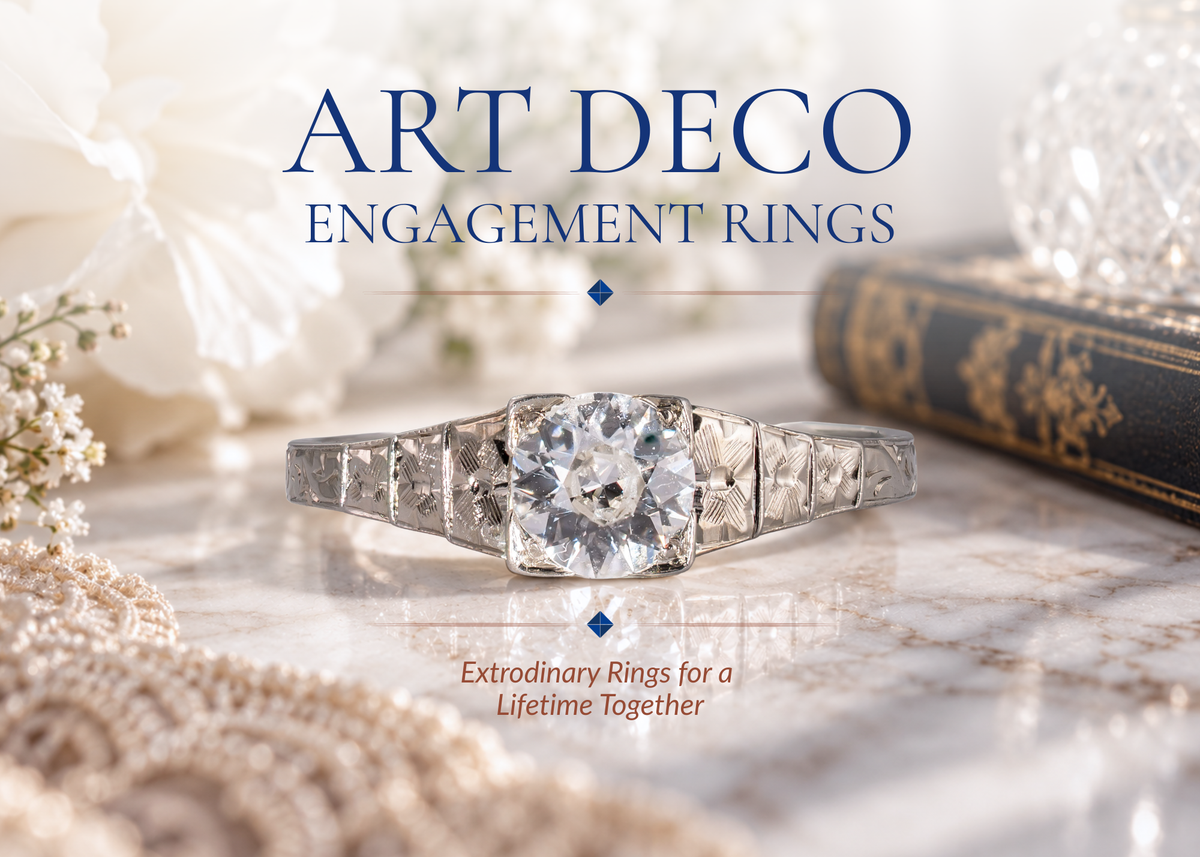
An authentic Art Deco engagement ring (circa 1920–1935) is defined by architectural geometry, hand-pierced filigree, fine milgrain work, and period diamond cuts such as Old European or transitional cuts. Unlike modern solitaires focused strictly on center carat weight, an authentic 1920s ring functions as a complete piece of wearable art where platinum or white gold mountings and geometric gemstone borders share equal prominence with the diamond.
Contents
In This Guide
- Why Choose an Antique Art Deco Engagement Ring?
- What Makes an Engagement Ring Art Deco?
- How I Determine Whether an Art Deco Ring Is Really Art Deco
- Antique Jewelry Is Perfectly Imperfect
- Turn the Ring Over: Why the Undergallery Matters
- Art Deco Diamonds: Personality Over Perfection
- Sapphires, Emeralds, and Rubies in Art Deco Engagement Rings
- Platinum, White Gold, and the Architecture of Art Deco
- Can You Wear a 100-Year-Old Art Deco Engagement Ring Every Day?
- Can an Art Deco Engagement Ring Be Resized?
- Alternative Art Deco Engagement Rings
- Choosing a Wedding Band for an Art Deco Engagement Ring
- Caring for an Antique Art Deco Engagement Ring
- What Are You Actually Buying for $2,000–$3,000?
- How I Choose Art Deco Engagement Rings for The TERA Collection
- Frequently Asked Questions About Art Deco Engagement Rings
There is nothing wrong with a classic diamond solitaire. It became a classic for a reason. But walk into almost any jewelry store today and you will see variations of the same basic idea: a relatively simple setting designed to put as much attention as possible on the center diamond.
For some people, that is exactly what they want.
For others, an engagement ring should feel more personal.
That is where antique engagement rings—and Art Deco rings in particular—offer something very different. In a genuine 1920s Art Deco engagement ring, the diamond is only part of the design. The setting, proportions, engraving, filigree, milgrain, openwork, and even the architecture beneath the diamond all contribute to the finished piece.
I often think about it this way: imagine attending a wedding with 300 guests wearing a conventional modern engagement ring. There is a reasonable chance that several other rings in the room will look remarkably similar.
Walk into that same room wearing an authentic 100-year-old Art Deco ring, and the chances of seeing another one just like it are almost nonexistent.
That individuality is one of the things that first drew me to antique jewelry.
But buying a genuine antique ring requires a different approach than buying a new engagement ring. A seller calling something “Art Deco” doesn’t necessarily make it Art Deco. Age alone doesn’t make a ring valuable. Filigree alone doesn’t make a ring authentic. And a ring being 100 years old certainly doesn’t mean it is too fragile to wear.
This guide is about what I actually look for when buying Art Deco rings for The TERA Collection—and what I think you should understand before choosing one as your engagement ring.
Why Choose an Antique Art Deco Engagement Ring?
When I look at an Art Deco ring, the first thing that gets my attention isn’t necessarily the size of the diamond.
It’s the design.
I look for symmetry, balance, and detail. I want the different elements of the ring to work together rather than compete with one another.
That is something I think many modern interpretations of Art Deco jewelry get wrong.
There are plenty of new rings described as “Art Deco style,” but too often the designer seems to have taken every recognizable Art Deco element—filigree, milgrain, geometric shapes, engraving, halos—and tried to fit all of them into a single ring.
They have the vocabulary of Art Deco without understanding its design language.
Great Art Deco jewelry can be incredibly elaborate, but the best pieces still have discipline. There is a reason for every line. Symmetry gives the eye somewhere to rest. The center stone works with the mounting rather than fighting against it.
And sometimes the most compelling antique Art Deco engagement rings aren’t particularly elaborate at all.
A beautifully proportioned 1920s filigree solitaire can have a single diamond, delicate openwork through the shoulders, and subtle hand engraving. It may look relatively simple at first glance. Look closer, however, and you begin to see why it could be difficult to reproduce properly today.
That is what I mean by design.
It isn’t about adding more.
It is about making everything belong.

What Makes an Engagement Ring Art Deco?
The Art Deco period is generally associated with the 1920s and 1930s, although jewelry design did not suddenly change when the calendar reached 1920.
There was a transition.
Classic Edwardian engagement rings could be delicate, airy, and almost lace-like. As tastes changed, those ideas increasingly met the stronger geometry, symmetry, and architectural forms we associate with Art Deco.
That transition produced some of my favorite rings.
Antique engagement rings from the 1920s can incorporate delicate pierced work inherited from Edwardian jewelry while introducing stronger geometric shoulders, structured borders, or a more architectural presentation of the center diamond.
Common characteristics can include:
- Platinum and white-gold construction
- Pierced openwork and filigree
- Fine milgrain borders
- Hand engraving
- Geometric and highly symmetrical layouts
- Octagonal, square, rectangular, shield, and navette forms
- Stepped shoulders
- Low-profile diamond settings
- Old European Cut and transitional diamonds
- French-cut or calibré colored-stone accents
But this is where buyers need to be careful.
Finding one of these characteristics does not make a ring Art Deco.
A modern reproduction can have filigree. A 1950s ring can have engraving. A modern ring can have an octagonal halo.
I never identify an antique ring from one feature.
I look at the ring in its entirety and ask whether all of its parts tell the same story.
How I Determine Whether an Art Deco Ring Is Really Art Deco
I buy quite a bit of jewelry through online auctions and estate sources, and I learned very quickly not to accept a seller’s description as fact.
If an auction calls a ring “Art Deco,” that is a starting point—not a conclusion.
I usually start with the diamond.
Does the stone make sense for the period?
In an original Art Deco diamond ring, I would expect to encounter Old European Cut diamonds, transitional cuts, and other period-appropriate stones depending on exactly when the ring was made.
If I see an obvious modern round brilliant sitting in what is supposed to be an untouched 1920s ring, I immediately start asking questions.
That doesn’t necessarily mean the mounting isn’t antique. Stones get lost. Engagement rings get damaged. Diamonds get replaced. Jewelry has lives.
But now the diamond and the mounting aren’t telling me the same story.
Occasionally I will buy a ring like that if I believe I can source an appropriate antique diamond and restore the integrity of the piece. Often, however, the economics simply don’t make sense.
Then I look at the design.
Does the architecture make sense for the claimed period?
I look at proportions, symmetry, shoulders, engraving, filigree, and the relationship between the center stone and mounting.
Only then do individual decorative elements become meaningful.
This is an important distinction because it is very easy to recognize filigree and think Art Deco. That same filigree could appear on a modern reproduction.
The question isn’t simply:
Does this ring have Art Deco details?
The better question is:
Does this ring make sense as a complete piece of Art Deco jewelry?
To see the full authentication checklist, hallmarks, and testing methods I use, explore our complete guide on how to identify authentic Art Deco jewelry.

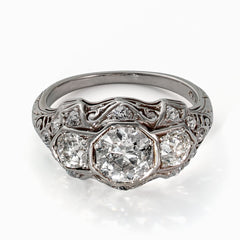
Rather than letting the center stone stand alone, this 1920s Art Deco engagement rings setting makes the mounting an equal part of the jewel—balancing architectural geometry with airy, hand-pierced openwork.
Antique Jewelry Is Perfectly Imperfect
One of my favorite expressions when examining antique jewelry is perfectly imperfect.
Early jewelry required an extraordinary amount of skilled handwork. When you examine genuine period pieces closely, that human involvement often reveals itself.
Openings in pierced work may not be perfectly identical. One scroll may differ subtly from its partner. Tiny holes aren’t necessarily perfectly round. Milgrain may wander slightly. Filigree that appears beautifully symmetrical to the naked eye can reveal subtle differences from one side to the other under magnification.
Those aren’t necessarily defects.
They can be evidence of how the ring was made.
By comparison, a modern cast reproduction can sometimes be too perfect—or display the softer, rounded character that casting can impart to details that should appear crisp.
That doesn’t mean imperfection proves age, either.
This is where people can get themselves into trouble when identifying antique jewelry. No single clue authenticates a ring.
Perfectly imperfect workmanship is evidence. The diamond is evidence. The design is evidence. Construction is evidence. The undergallery is evidence. Hallmarks can be evidence.
They all have to be considered together.
Turn the Ring Over: Why the Undergallery Matters
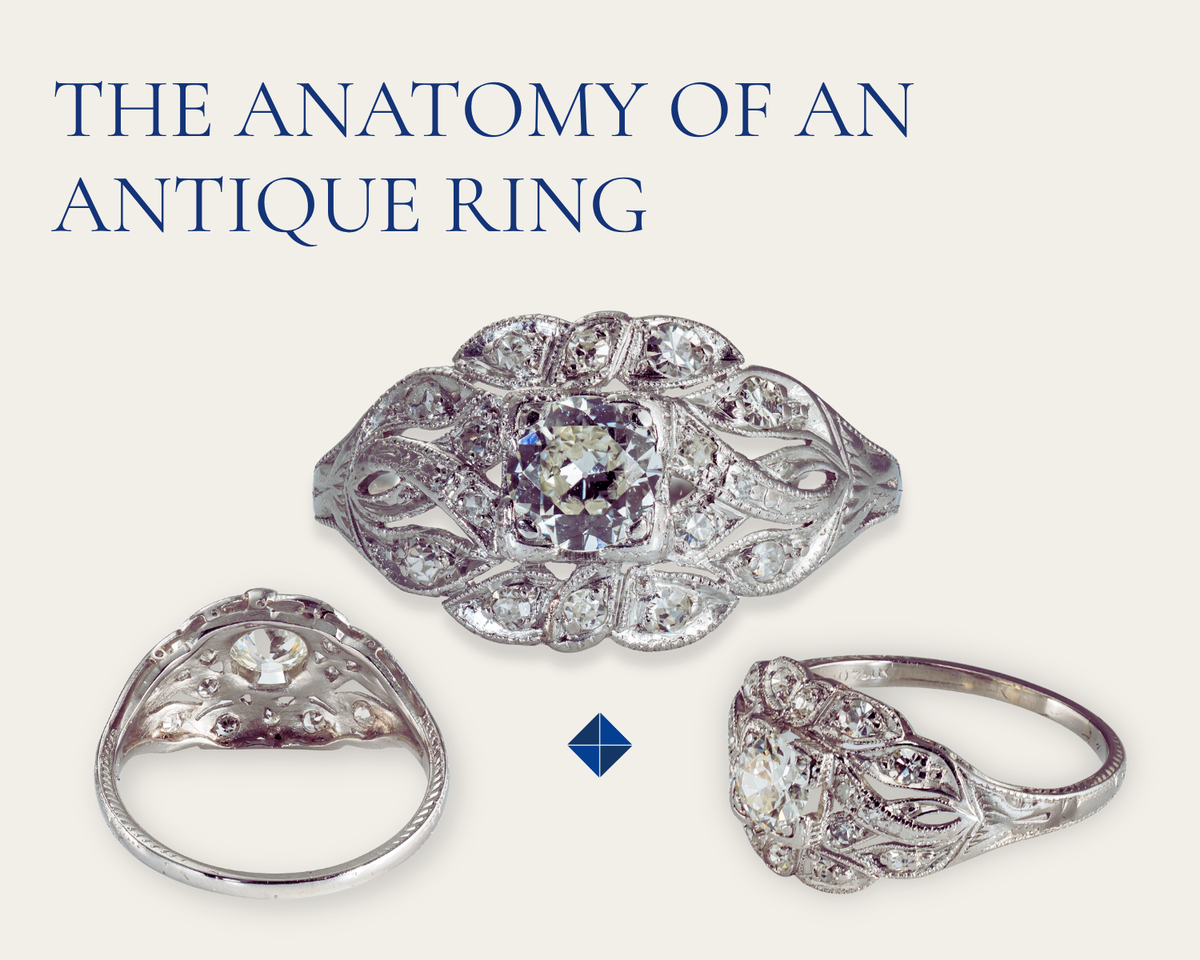
One of the first things I do when examining an antique ring is turn it over.
The top tells you what the designer wanted you to see.
The underside can tell you how the jeweler got there.
The undergallery is one of the most revealing areas of an antique ring because it can expose details of construction that are less obvious from the face-up view.
I’m looking closely at the crispness of the work.
Hand-pierced or die-cut openings can have a different character from cast reproductions. Under magnification, I look for the same perfectly imperfect qualities I see elsewhere: openings that aren’t absolutely identical, slight variations from side to side, crisp edges, and evidence that somebody actually worked and finished the metal.
A modern reproduction may imitate the appearance of antique openwork from the top.
It is much harder for it to imitate the entire story of how an antique ring was constructed.
Again, the undergallery doesn’t date the ring by itself.
It becomes another chapter in the same story.

Art Deco Diamonds: Personality Over Perfection
The thing I love most about antique diamonds is personality.
Old diamonds weren’t laser-cut to proportions calculated by a computer. A cutter worked with an individual piece of rough and made decisions about that particular stone.
As a result, two antique diamonds of approximately the same diameter and weight can behave very differently.
You may encounter differences in:
- Table size
- Crown height
- Culet size and position
- Facet shape
- Symmetry
- Depth
- Overall outline
- Light return and facet pattern
Those variations are part of their charm.
Old European Cut Diamonds
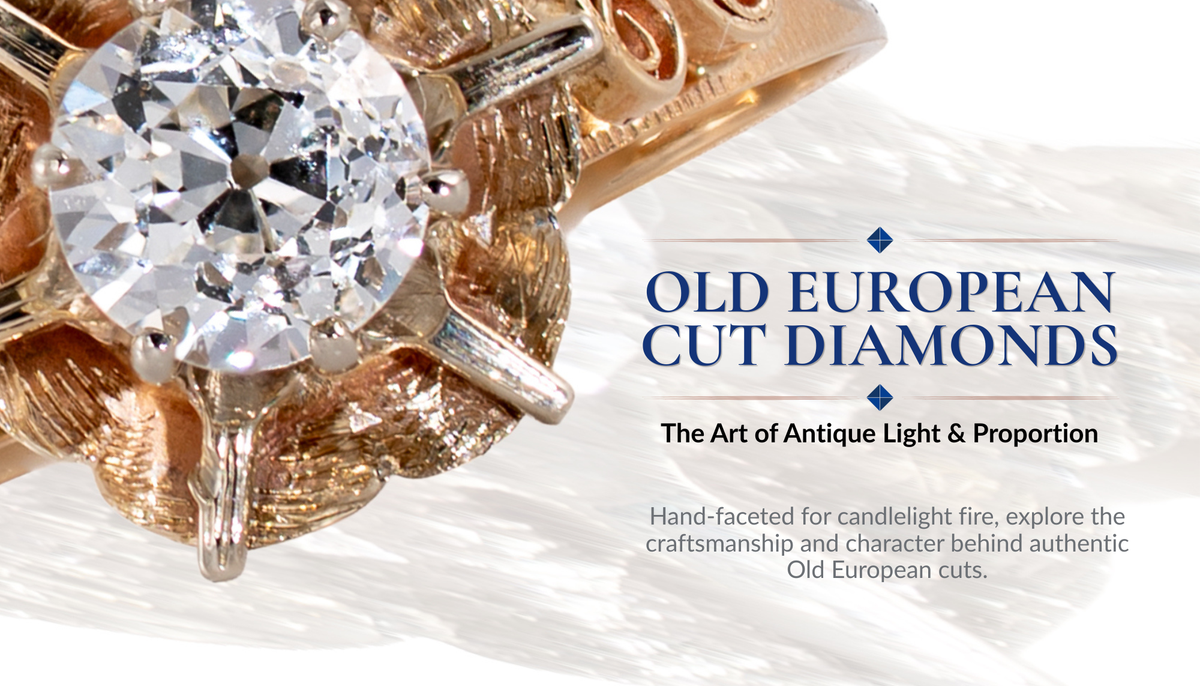
The Old European Cut, or OEC, is one of the stones most closely associated with late antique and early 20th-century jewelry.
Rather than the splintery appearance you can see in some modern brilliant cuts, a beautiful OEC can produce broad, chunky flashes of light. Many have smaller tables, higher crowns, and visible open culets.
I particularly enjoy stones where the facet pattern develops almost a floral quality around the culet.
Transitional Cut Diamonds
Transitional diamonds are especially important when evaluating vintage engagement rings from the 1920s.
Diamond cutting didn’t move directly from Old European to modern brilliant overnight. It evolved. Cutters developed the Transitional Cut diamond as proportions evolved toward the modern brilliant.
Transitional stones occupy that fascinating territory where cutters experimented with proportions and facet relationships that would eventually lead to the modern round brilliant.
Some look OEC predominantly. Others look considerably more modern.
That variation is precisely why I don’t date a ring from the diamond alone.
Antique Diamonds and the 4Cs
The modern 4Cs still apply to antique diamonds. Color, clarity, cut, and carat weight are useful information.
But they don’t tell the entire story.
An antique diamond might have warmer color, imperfect symmetry, an off-center culet, or proportions that would not be considered ideal by modern round-brilliant standards.
That doesn’t necessarily make it a lesser diamond.
Sometimes those characteristics are exactly what give the stone its personality.
For an antique engagement ring, I am interested in what the diamond does inside the ring, not simply how impressive its specifications look on paper.
Natural Antique Diamonds in a Lab-Grown World
Lab-grown diamonds have changed the modern engagement-ring market dramatically. They allow buyers to purchase substantially more diamond for their money, and for someone whose priority is size, that can be very appealing.
But that’s almost the opposite of what attracts me to antique jewelry.
A natural antique diamond is finite.
The stone was mined, cut by an individual craftsman generations ago, set into a piece of jewelry, and survived to reach us today.
There isn’t a production line making another batch of them.
To me, an antique diamond can be as individual as the person who chooses it.
That doesn’t mean everybody should prefer an antique natural diamond. But if rarity, history, and individuality matter to you, comparing antique diamonds purely on carat size misses much of what you’re buying.

The tall, symmetrical crown of the Old European Cut made it the defining diamond of the Art Deco era. The gap between it and the modern brilliant was bridged by transitional cut diamonds, which gradually lowered the crown as cutting techniques evolved.
Sapphires, Emeralds, and Rubies in Art Deco Engagement Rings
Diamonds weren’t the only stones used to create extraordinary Art Deco jewelry.
Sapphires, emeralds, and rubies could provide dramatic contrast against platinum and diamonds. French-cut and calibré colored stones were particularly well suited to the geometric vocabulary of Art Deco design and can be found fitted into borders, channels, and other architectural elements.
You will also encounter Art Deco rings with colored gemstones as their primary stones.
An Art Deco emerald ring, for example, can make a spectacular alternative engagement ring, particularly when the emerald is integrated into a geometric platinum-and-diamond mounting.
Sapphire and ruby rings can be equally compelling, whether the colored gemstone dominates the design or provides contrast around an antique diamond.
There is another important point for antique buyers:
A synthetic colored gemstone does not automatically mean a ring is a modern reproduction.
Synthetic rubies and sapphires existed during the Art Deco period and were used in genuine period jewelry. The presence of a synthetic stone therefore has to be considered alongside the construction, design, and other evidence—just like everything else.
A striking alternative to diamonds: this 1920s Art Deco engagement ring balances a deep blue sapphire with intricate, lace-like openwork pierced through the undergallery and shoulders.
Platinum, White Gold, and the Architecture of Art Deco
Platinum was ideally suited to the fine, architectural jewelry of the Art Deco period.
Its strength allowed jewelers to create surprisingly delicate structures while securely holding diamonds and gemstones. Fine pierced galleries, narrow milgrain borders, and intricate openwork could give an Art Deco platinum diamond ring tremendous visual presence without requiring a massive amount of metal.
White gold also became increasingly important during the period and appears in many beautiful Deco rings.
While yellow gold is strongly associated with earlier Victorian jewelry, antique gold engagement rings from the early 20th century can appear in white gold as well as yellow gold, and the metal itself becomes another clue when evaluating a piece.
This is another reason I encourage buyers to look beyond carat weight.
A relatively modest center diamond can look spectacular when it is incorporated into a beautifully proportioned architectural setting.
The setting isn’t merely there to hold the diamond.
The setting is part of the jewel.
Can You Wear a 100-Year-Old Art Deco Engagement Ring Every Day?
Absolutely—if you buy the right ring in the right condition.
I have handled Victorian rings that are 150 years old or more and still look amazing on the hand.
People sometimes assume that antique automatically means fragile. I don’t think that’s a useful way to look at it.
Condition matters much more than age.
A prong can loosen on a ring made in 1925, and a prong can loosen on a ring made in 2025. A stone can shift. A ring can take a hard hit against a countertop. Metal can bend. Impact damage does not care how old the ring is.
In other words, the basic risks of wearing an engagement ring every day are not unique to antique jewelry.
What matters is whether the ring is structurally sound when you buy it, whether the stones are secure, whether previous repairs were done properly, and whether you continue to have the ring inspected over time.
A well-preserved 100-year-old ring with healthy prongs and a sound shank may be a far better everyday-wear candidate than a newer ring with poor construction or neglected maintenance.
The important thing is knowing what you’re buying—and taking care of it once it is yours.
What I Inspect Before Offering an Antique Ring for Sale
My jewelry photography is extremely detailed. I use highly focused macro photographs that can reveal imperfections you would never notice while wearing the ring.
That’s intentional.
A century of tiny scratches can look dramatic under extreme magnification while being virtually invisible on the finger.
I care much more about structural condition.
The Shank
The bottom of the shank is one of the first places I look for wear because it has spent decades rubbing against everything the wearer touched.
A thin shank isn’t necessarily fatal. A portion of the shank can sometimes be replaced properly.
Prongs and Stone Security
This is more important.
If I have any question about the prongs or security of a stone, the ring goes to my bench jeweler for inspection.
Losing an antique diamond because somebody ignored a worn prong is an avoidable problem.
Filigree and Openwork
Cracked, distorted, or previously damaged filigree can become expensive very quickly.
I once bought a ring that turned out to have cracked filigree that was out of alignment, along with two previous poor repairs that needed to be redone. The auction photographs weren’t good enough to reveal the extent of the problem.
A talented bench jeweler can perform remarkable restoration work.
But restoration has economics too.
Sometimes a ring can be saved beautifully. Sometimes previous repairs have compromised the piece enough that I would rather walk away.
Previous Alterations
A replaced head or major alteration makes me look much more carefully at a ring.
Jewelry has been repaired for centuries, so evidence of repair doesn’t automatically disqualify a piece. What matters is what was done, how well it was done, and whether the repair preserved or damaged the original architecture.
For The TERA Collection, my goal is to offer antique and vintage rings that can actually be worn. I would rather absorb the cost of an unexpected repair—even when it leaves very little profit in the ring—than knowingly pass that repair along to the buyer.
Can an Art Deco Engagement Ring Be Resized?
This is one of the questions I receive where the most accurate answer is:
It depends on both the ring and the jeweler.
Not all bench jewelers are created equal.
I work with a bench jeweler who can do things with antique jewelry that many jewelers simply wouldn’t attempt. I’ve had an elaborate platinum ring with openwork successfully increased approximately three sizes.
I’ve also purchased an extremely elaborate size 3 ring after discussing it with him first. He was confident he could bring it to approximately a size 7 while preserving the integrity of the design.
I would not assume that every jeweler could—or should—attempt that job.
One or Two Sizes?
For many antique rings, moving approximately one size should be relatively straightforward for a jeweler experienced with antique jewelry. Two sizes may also be very reasonable depending upon the construction.
Beyond that, I want an experienced bench jeweler’s opinion.
The shoulders are particularly important.
When the circumference of the ring changes substantially, the shoulders may need to be reworked so the design remains balanced. Elaborate filigree, engraving, or gemstones extending down the shoulders can make the job considerably more complicated.
Simply making the ring physically larger isn’t enough.
The ring still has to look right when the work is finished.
If you fall in love with an antique ring that isn’t your size, don’t automatically assume it can’t work. Talk to someone who understands antique jewelry.
With rings in The TERA Collection, I’m always willing to have that conversation. If necessary, I’ll get my bench jeweler’s opinion, and when appropriate, I can arrange sizing at cost.
Alternative Art Deco Engagement Rings
One of the freedoms of choosing an antique engagement ring is that you don’t have to choose something that was originally marketed as an engagement ring.
Consider a long three-stone Art Deco navette ring.
It may have been sold as a dinner ring or simply a diamond ring in its own time. Today, it can make an extraordinary alternative engagement ring.
And this is where carat weight becomes almost irrelevant to understanding the design.
Look at a beautifully executed navette and the diamonds are only part of what you’re seeing. The elongated outline, pierced filigree, engraving, milgrain, negative space, and diamonds work together to create the visual impact.
Remove those diamonds and put them into three ordinary settings and you haven’t recreated the ring.
You have removed the very thing that made it special.
That is why antique and vintage engagement-ring styles are particularly interesting for someone who doesn’t want a conventional solitaire.
Your engagement ring doesn’t have to look like everybody else’s engagement ring.
It has to look like yours.
 |
 |
Beyond the classic solitaire: elongated navette rings and domed cluster plaques offer striking alternatives for the Art Deco bride seeking a unique engagement ring. Instead of relying on a single towering prong setting, these 1920s silhouettes disperse diamonds across the finger in a low-profile, hand-detailed design that pairs major visual presence with effortless everyday wear.
Choosing a Wedding Band for an Art Deco Engagement Ring
Pairing an antique engagement ring with a wedding band requires a little thought.
Some Art Deco rings will sit beautifully beside a straight band. Others have low galleries, projecting shoulders, or unusual outlines that create a gap.
That isn’t necessarily a problem.
Period engraved bands, slender platinum or gold bands, curved bands, and antique wedding rings can all work depending on the engagement ring.
When creating an Art Deco wedding ring set, I wouldn’t automatically force a modern straight band against an intricate antique mounting simply because the two rings are expected to sit perfectly flush.
I prefer to consider the engagement ring’s architecture first.
Also pay attention to where the two rings make contact. A harder edge repeatedly rubbing against delicate engraving, filigree, or gemstone settings can cause unnecessary wear over time.
The goal should be the same as the goal of the engagement ring itself:
Balance.
Caring for an Antique Art Deco Engagement Ring
Antique jewelry doesn’t need to live in a safe.
It does need sensible care.
For routine home cleaning, gentle methods are generally preferable: warm water, mild dish soap, and a very soft brush, provided the gemstones themselves are appropriate for that treatment.
I would not automatically put an antique ring into an ultrasonic cleaner simply because the machine is available. The appropriate cleaning method depends on the gemstones, settings, condition, and any previous repairs.
More importantly, establish a relationship with a good bench jeweler.
Routine inspection matters whether your engagement ring is antique or brand new.
Whether your engagement ring is new or antique, have it inspected periodically. Ask the jeweler to check the prongs, stone security, and overall condition while cleaning it.
Head off problems before they become repairs.
What Are You Actually Buying for $2,000–$3,000?
This may be the most important question in this entire guide.
The modern engagement-ring market increasingly allows someone with a few thousand dollars to buy a very large diamond, particularly if they choose lab-grown.
If your priority is maximizing carat weight, that is difficult for an antique ring to compete with.
But that isn’t the competition I’m interested in.
With a genuine antique Art Deco engagement ring, you’re buying the entire piece.
You’re buying a natural diamond with its own personality.
You’re buying handwork.
You’re buying the slight variations left behind by craftsmen.
You’re buying engraving and filigree that have survived generations.
You’re buying an object from a particular moment in design history.
You’re buying something that can’t simply be ordered again in another size next Tuesday.
Most importantly, you’re buying design.
A beautiful antique ring doesn’t need a huge diamond to have presence because the jeweler wasn’t relying on the diamond to do all the work.
The stone and the setting were designed to work together.
That difference is fundamental.
How I Choose Art Deco Engagement Rings for The TERA Collection
I don’t buy a ring simply because someone tells me it’s Art Deco.
I don’t buy it simply because it has an Old European Cut diamond.
And I certainly don’t buy it simply because it has filigree.
I look at the entire piece.
Does the design have balance?
Does the stone make sense?
Does the construction support the proposed age?
What does the undergallery tell me?
Does the handwork have the character I expect?
Have there been repairs?
Are the stones secure?
Is the shank healthy?
Can the ring realistically be worn?
And finally:
Would I be excited to put this ring on someone’s hand?
That’s ultimately what The TERA Collection is about for me.
There are plenty of old rings.
I am looking for the ones that still have something to say.
Frequently Asked Questions About Art Deco Engagement Rings
What years are considered Art Deco for engagement rings?
Art Deco jewelry is primarily associated with the 1920s and 1930s, but jewelry styles evolved gradually. Transitional pieces can combine the delicacy of late Edwardian jewelry with increasingly geometric Art Deco design.
How can you tell if an Art Deco engagement ring is authentic?
Don’t rely on a single characteristic. Examine the diamond, overall design, construction, filigree, engraving, milgrain, undergallery, and evidence of hand finishing together. Hallmarks can provide useful supporting information, but I would never authenticate or date a ring from a hallmark alone.
What diamond cuts are found in Art Deco engagement rings?
Old European Cut and transitional diamonds are commonly encountered, along with other period cuts. The appropriate diamond depends on when the ring was made. An obvious modern brilliant in an otherwise antique mounting may indicate a later replacement.
Are Art Deco engagement rings durable enough for everyday wear?
Many are. Condition matters more than age alone. Prongs can loosen, stones can shift, and impact damage can happen to a brand-new ring just as it can to an antique one. Prongs, bezels, shank thickness, filigree, and previous repairs should all be inspected before an antique ring is relied upon for everyday wear.
Can Art Deco engagement rings be resized?
Many can. Approximately one size is often relatively straightforward, and two may be possible depending on the ring. More substantial changes can sometimes be accomplished by a highly skilled bench jeweler, but elaborate shoulders, filigree, engraving, and gemstone placement make resizing increasingly complex.
Are all Art Deco rings made from platinum?
No. Platinum is strongly associated with Art Deco jewelry, but beautiful period rings were also made in white gold and other precious metals.
Can an Art Deco ring contain synthetic gemstones and still be antique?
Yes. Period synthetic sapphires and rubies existed and were used in genuine antique jewelry. A synthetic colored stone alone does not prove that a ring is a modern reproduction.
Are antique Art Deco rings more expensive than modern engagement rings?
Not necessarily. Antique rings exist across a broad range of prices.
More importantly, the comparison isn’t always apples to apples. With an antique ring, a substantial portion of the value may lie in the period craftsmanship, rarity, design, and complete jewel rather than simply the center stone’s carat weight.
Find an Art Deco Engagement Ring That Doesn’t Look Like Everyone Else’s
An engagement ring is one of the few pieces of jewelry someone may wear virtually every day for the rest of her life.
I think it's worth looking at.
For some people, that will always mean a beautiful modern solitaire.
For others, it means finding a ring made generations ago—one with a natural antique diamond, hand-worked details, a little perfectly imperfect craftsmanship, and an architecture unlikely to ever be repeated exactly.
That’s what makes authentic antique engagement rings from the Art Deco era so compelling.
You aren’t choosing a reproduction of the past.
You’re choosing an original that survived it.
Quick Answer
What Do Gold Hallmarks Mean on Antique Jewelry?
Gold hallmarks and markings identify a piece’s metal fineness, assay origin, and maker:
Gold jewelry markings can tell us quite a bit about a ring, from its gold content to its manufacturer and sometimes its country of origin. A stamp reading 585, for example, identifies the commonly recognized 14K gold standard, while a manufacturer's mark may provide clues about who made the piece and when.
I buy most of my antique and vintage rings through online auctions and eBay, where I often work with limited descriptions and less-than-ideal photos. Sometimes the seller provides excellent information, but other times a tiny marking inside the band offers the only useful clue not mentioned in the listing. Understanding those markings can make a real difference when deciding whether a ring is worth pursuing—a key part of learning how to choose antique jewelry
There's also an important distinction in terminology. Although we commonly refer to almost any marking on jewelry as a hallmark, a simple 14K or 585 stamp is technically a purity or fineness mark or stamp. An official hallmark is part of a recognized assay system, while a maker's mark identifies the manufacturer or sponsor. In everyday conversation, these terms are often used interchangeably, but they don't necessarily tell us the same things.
When examining a ring, gold purity is usually one of the first things I want to establish because it helps determine the underlying metal value. Beyond that, markings can reinforce what the construction, design, and materials are already telling me about the ring's history. I wouldn't date an antique ring solely by its stamp, and I certainly wouldn't determine its retail value that way.
Understanding Gold Purity: What Do 375, 585, and 750 Mean?
Gold purity describes how much actual gold is present in an alloy. Pure gold is designated 24 karats, while 18K gold contains 75% gold and 14K contains approximately 58.3%. The remaining metal consists of other elements, commonly including copper, silver, zinc, nickel, or palladium, which influence the alloy's color and physical properties.
Gold content can also be expressed as millesimal fineness, which measures purity in parts per thousand. This is why 750 represents 75% gold, while 585 represents 58.5%. These numerical markings are particularly common on European jewelry, although they appear elsewhere as well.
Gold Purity Conversion Chart
The slight differences between certain karat percentages and their three-digit equivalents are worth understanding. Fourteen-karat gold mathematically contains approximately 58.33% pure gold, while a 585 marking specifies 58.5%. Both are associated with the familiar 14K standard.
One less familiar marking is 583, which appears on Russian and Soviet jewelry. It represents 58.3% gold and is close to the modern 585 standard. Soviet-era pieces may also carry a star containing a hammer and sickle, while earlier Russian hallmark systems used other symbols, including the kokoshnik, a woman's profile. These additional marks can be useful when researching the jewelry's origin and period.
The Gold Stamps You're Most Likely to Encounter
The important distinction is that a purity stamp describes the metal, not the quality of the craftsmanship. Yellow, rose, and white gold can also carry identical purity markings because their colors depend on the other metals used in the alloy.
Gold Plated, Gold Filled, and Other Jewelry Markings
Not everything that looks like gold is made from solid gold. This becomes particularly important when buying jewelry online because photographs may not reveal whether a piece is solid gold, plated, or gold filled.
Gold plating generally consists of a relatively thin layer of gold applied over another metal. Gold-filled jewelry is different, using a substantially thicker layer of karat gold alloy mechanically bonded to a base-metal core. Both have long histories in jewelry manufacturing, but neither should be confused with solid gold.
A marking such as 1/20 12K GF is frequently misunderstood. It means the 12K gold alloy represents one-twentieth of the designated metal weight, not that the piece contains 5% pure gold. Because 12K gold itself contains 50% gold, the actual pure gold contribution is approximately 2.5% of that weight.
One mistake buyers should avoid is focusing on the karat number while overlooking the letters that follow it. A ring marked 18K HGE is not solid 18K gold; the marking describes an electroplated finish. Likewise, 14K GF identifies gold-filled construction rather than solid 14K gold.
Gold vermeil is another term you may encounter. In the United States, it refers to sterling silver coated with gold that meets specific standards for purity and thickness. A piece marked 925 identifies sterling silver, even if the exterior appears gold.
For The TERA Collection, my focus is primarily antique and vintage rings made from solid gold and platinum—two metals with very different historical applications, as explored in our guide on platinum vs. white gold in antique jewelry[cite: 1]. Nevertheless, these other markings appear frequently in estate jewelry lots and are worth recognizing before placing a bid.
Antique Gold Hallmarks: Can They Help Date a Ring?
This is where jewelry markings become particularly interesting to me. Identifying gold purity is relatively straightforward when a stamp is legible, but determining when and where a ring was manufactured can require considerably more investigation.
In the United States, a karat marking generally represents the manufacturer's declaration of gold purity rather than certification by a government assay office. Federal stamping legislation established requirements governing these representations, including the use of an identifying trademark when a manufacturer applies a quality mark. The National Gold and Silver Stamping Act dates to 1906, with subsequent amendments changing certain requirements and tolerances.
These laws provide useful historical context, but I wouldn't use the presence or absence of a particular American stamp to assign an exact manufacturing date. Antique rings may have been resized, repaired, or altered, and some were never marked in the first place—critical factors to weigh when learning how to tell if antique jewelry is real.
European hallmarking traditions can provide more specific information, particularly where official assay systems were established across the evolution of fine jewelry
Britain has one of the longest-established systems of precious-metal hallmarking. A traditional British hallmark may include a sponsor's mark, a fineness mark, an assay office symbol, and a date letter identifying the year of assay.
Some of the most recognizable assay office symbols include:
These symbols can be useful when examining antique rings because they may help identify where the jewelry was officially tested. Date letters can narrow the period further, although they must be interpreted using the correct assay office and historical date-letter cycle. A date letter identifies the year of assay, which isn't necessarily the exact year the jewelry was manufactured.
Historical gold standards provide additional clues. Britain introduced 9K, 12K, and 15K hallmarking standards in 1854. The 12K and 15K standards were discontinued in 1932, making a properly identified British 15K hallmark particularly interesting when dating older jewelry.
A simple 15K stamp, however, isn't enough to establish British origin or a precise date. As with most antique jewelry, the complete marking and the ring's construction need to be considered together.
The French Eagle's Head Hallmark
One hallmark I particularly appreciate is the French eagle's head, associated with French 18K gold hallmarking since 1838. It's a small but recognizable mark, and finding one on an antique ring can provide useful evidence of its French origin and gold fineness.
Unlike many American purity stamps, which are usually found inside the band, French eagle's head marks may appear on the exterior of the shank. That makes them easy to overlook, especially in auction photographs where the underside of the ring is rarely given much attention.
Their placement also creates a problem when a ring needs repair. The lower portion of the shank is frequently where wear occurs, and replacing that section may remove an original exterior hallmark. Before sizing or replacing a shank, I think it's worth examining both the inside and outside carefully under magnification. Once an original hallmark is removed, an important piece of the ring's history may be lost.
A close-up view of the historic French eagle’s head mark stamped into gold, an official assay hallmark used since 1838 to guarantee 18K gold fineness (750 purity).
Can the Way a Hallmark Was Applied Help Date a Ring?
One often-overlooked detail is how a marking was applied to the metal. Traditional struck marks were impressed using punches, and under magnification you may notice variations in depth, alignment, or displaced metal around the impression. Modern laser engraving can produce exceptionally fine, consistent markings without the same physical displacement.
That doesn't mean an uneven mark is necessarily antique or that a precise one must be modern. Machine-assisted stamping existed long before modern jewelry manufacturing, and some antique hallmarks are remarkably clean. Traditional hand punches are also still used today.
I consider the method of application another clue rather than a dating method in itself. If the construction, materials, and design suggest a particular period—such as knowing how to identify authentic Art Deco jewelry—the marking may help reinforce that assessment. The complete ring always comes first.
Maker's Marks: When a Manufacturer's Name Adds Value
A gold purity stamp tells me something about the metal, but a manufacturer's mark can tell me considerably more about the jewelry itself. Certain manufacturers were recognized for their craftsmanship, distinctive designs, or innovations, and their names still carry significance among collectors.
Two that I particularly appreciate are Belais and Traub Orange Blossom. Both have important places in American jewelry history, and their marks can add another dimension to a ring's appeal.
Belais White Gold
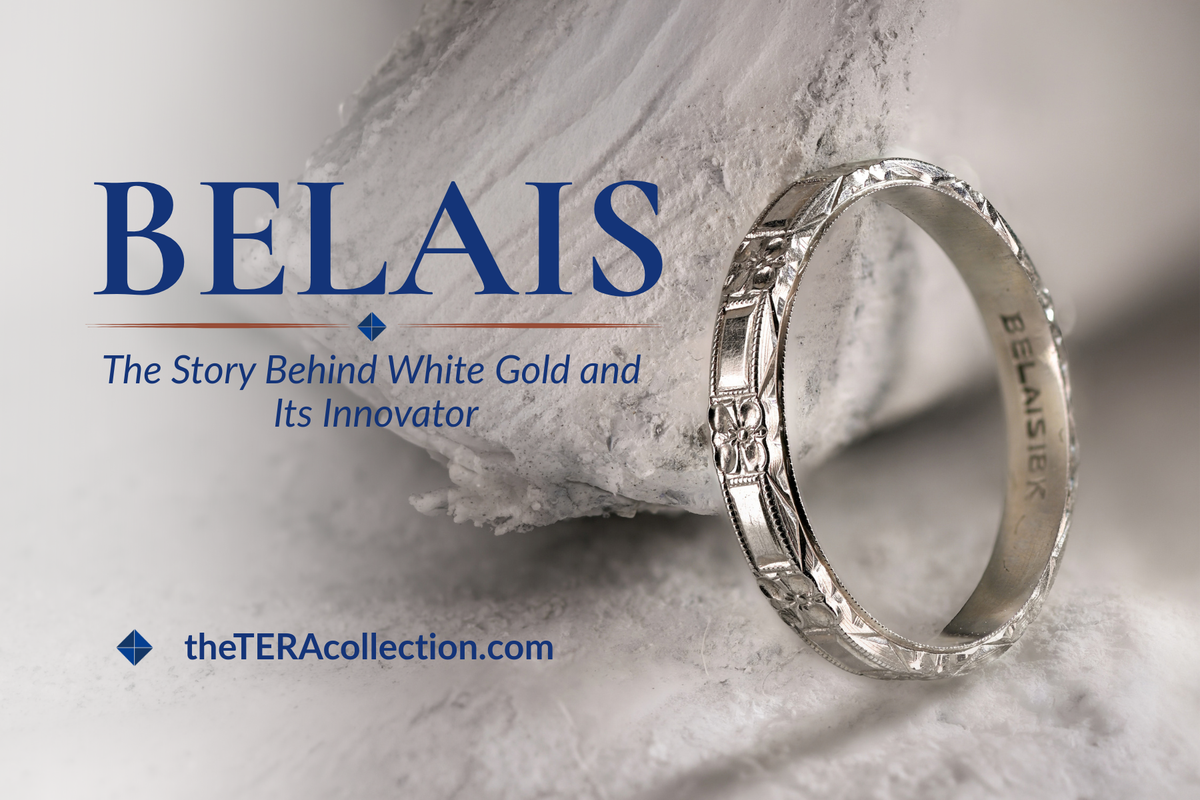
David Belais played an important role in the early development and commercial promotion of white gold in the United States. Belais-marked jewelry is especially interesting when researching early twentieth-century American jewelry and the growing popularity of white metals.
Finding a Belais mark matters to me because it links the piece to a recognized manufacturer and an important period in jewelry production. But the name doesn't replace an examination of the ring itself. I still want to see quality construction, an appealing design, and good overall condition.
Traub Orange Blossom
Traub Orange Blossom is another name I look for, particularly on vintage wedding bands. These rings often feature decorative engraving and carefully arranged patterns that reflect a period when even relatively simple wedding jewelry received considerable attention to design.
A recognized manufacturer's mark can also influence retail value. As a general example from my own pricing experience, a generic engraved gold band might retail for $500 or $600, while a comparable example signed by Traub or Belais could command an additional $100 or $200, depending on condition, design, and collector interest.
That isn't a universal pricing formula, but it illustrates why identifying the maker matters. Two rings can contain essentially the same amount of gold, yet one may be more desirable because of its manufacturer and historical significance.
Other American manufacturers worth researching include Jabel, Krementz, and Ostby & Barton. Not every signed ring is rare, and many lesser-known manufacturers produced excellent jewelry, but a recognizable mark can provide useful historical context.
Researching Unfamiliar Maker's Marks
Thousands of jewelry manufacturer's marks exist, and many remain difficult to identify. I've encountered markings that required considerable research, including a recent 14K band stamped Bristol. It wasn't a name I immediately recognized, and investigating it was another reminder that even a relatively simple gold band can have a history worth exploring.
Resources such as 925-1000.com, historical jewelry directories, assay office references, and collector groups can be valuable starting points. Sometimes the research produces a convincing identification, while other times the information remains incomplete.
I don't believe every unidentified mark needs a manufacturer or date. If the evidence isn't there, I'd rather acknowledge the uncertainty than create a history that can't be supported.
Why Some Genuine Antique Rings Have No Hallmarks
Finding an antique gold ring without a hallmark doesn't particularly surprise me. Some pieces were custom-made, markings may have worn away over time, and previous repairs can remove them entirely. Understanding why antique jewelry was never meant to be perfect helps put these quirks into perspective[cite: 1]. A missing stamp doesn't automatically make a ring suspicious, although it does mean the metal may need additional verification.
I understand why some collectors prefer jewelry that remains completely untouched, and I agree that preserving original craftsmanship is important. But I also believe there's little point in owning a beautiful antique ring if you can't wear it. My goal is to offer rings that customers can feel confident wearing regularly, which sometimes means repairing prongs, replacing part of a shank, or addressing structural cracks.
I'm fortunate to work with a bench jeweler who understands that philosophy. A well-executed repair should strengthen the ring without unnecessarily changing the design, proportions, or details that made it worth preserving in the first place.
When a Gold Marking Isn't Enough: Testing Antique Jewelry
A purity stamp is useful, but it isn't absolute proof of gold content. Markings can be incorrect or counterfeit, and some antique rings combine different metals. When a marking is missing or questionable, further examination becomes important.
I generally begin with magnification, looking for solder joints, changes in metal color, wear patterns, and evidence of previous repairs. A magnet can provide a preliminary clue, but it cannot authenticate gold because many non-gold metals are also nonmagnetic.
For additional verification, I use a Mizar RS-24 electronic gold tester. It's a useful instrument, but its readings are estimates rather than precise chemical analyses. Alloy composition, surface condition, and testing technique can all influence the results. A minor discrepancy between an electronic reading and an antique ring's stamped fineness doesn't automatically concern me, although a substantial difference deserves further investigation.
Acid testing offers another way to estimate gold purity, while professional X-ray fluorescence (XRF) analysis can identify the elements present near the metal's surface. Both methods have limitations, particularly with plated jewelry, solder, and mixed-metal construction. When a valuable piece raises questions, professional verification may be the most sensible approach.
Why Gold Purity Is Only Part of an Antique Ring's Value
This is probably where my perspective differs most from the way jewelry is commonly marketed today. Modern jewelry is frequently evaluated around gold weight and gemstone size, with comparatively less attention given to the overall design and quality of construction. Those measurable characteristics certainly matter, but they don't begin to tell the whole story of an antique ring.
If I were evaluating a ring strictly for its gold content, I could weigh it, determine its purity, and calculate an approximate scrap value. But that tells me very little about what the ring is worth as antique jewelry. A lightweight filigree ring with beautifully executed metalwork—such as those highlighted in our Art Deco engagement rings buyer's guide[cite: 1]—may be considerably more desirable than a heavy gold band with little distinction.
When I examine an antique ring, I'm looking at its proportions, symmetry, and the relationship between the stones and their setting. I pay attention to how the decorative elements flow together and whether the design feels balanced. A modest antique cut—like an old European cut or an old mine cut diamond set in a beautifully constructed Edwardian piece—can be much more interesting to me than a larger stone in an ordinary setting [cite: 1].
The method of construction also matters. Die-struck components, carefully pierced galleries, fine engraving, and crisp milgrain can reveal the skill and attention that went into producing a piece. These details are especially important when evaluating antique jewelry because they can be difficult to reproduce convincingly, and they often contribute more to a ring's appeal than its gold weight alone.
Rarity is another consideration. Although production jewelry certainly existed, many surviving nineteenth- and early twentieth-century rings are difficult to find in precisely the same design. Variations in handwork, proportions, and decorative details can make individual examples quite distinctive.
A purity stamp may tell me what gold was used, but it can't tell me whether the ring is beautifully designed. That's something I have to determine by looking at the entire piece.
Frequently Asked Questions About Gold Jewelry Markings
What Does 585 Mean on a Gold Ring?
A 585 stamp indicates 58.5% pure gold, commonly associated with the 14K gold standard. It identifies the claimed metal fineness but doesn't establish the ring's age or manufacturer.
What Does 750 Mean on Jewelry?
A 750 stamp indicates 18K gold, containing 75% pure gold. It's commonly encountered on European jewelry and many antique pieces.
Can a Real Gold Ring Have No Stamp?
Absolutely. Genuine antique and vintage rings may have no surviving marking because of wear, custom manufacture, resizing, or previous repairs. An unmarked ring should be examined and tested rather than automatically dismissed as counterfeit.
What Does 14KP Mean?
The P stands for plumb, meaning the gold is represented as meeting the full stated karat fineness. It doesn't mean plated. Although the marking is associated with stricter purity representations, I wouldn't use it alone to date a ring.
Does 14K Italy Mean Real Gold?
The marking represents a claim that the jewelry is 14K gold and of Italian origin. It can provide useful information, but the stamp alone doesn't authenticate the metal or establish when the piece was made.
Can a Hallmark Tell You Exactly How Old a Ring Is?
Sometimes. Certain official hallmark systems, particularly British hallmarks with date letters, can provide a specific year of assay. Most simple karat stamps cannot. The ring's construction, design, materials, and any evidence of later alterations must also be considered.
Understanding the Ring Beyond Its Markings
For someone buying antique jewelry online, learning to recognize gold purity stamps, official hallmarks, and maker's marks can make a real difference. A small marking may identify the gold content, point toward an important manufacturer, or provide clues about when and where a ring was made. Even when the information is incomplete, understanding what you're looking at can help you make a more informed purchasing decision.
But after examining and researching antique and vintage rings, I've learned that the marking is rarely the most interesting part of the jewelry. Some beautifully constructed pieces have no surviving stamps, while others carry recognizable names that add another layer to their history. What ultimately interests me is the complete ring: its design, construction, symmetry, craftsmanship, and the qualities that make it distinctive—a philosophy central to antique and vintage jewelry for the modern collector.
That's the perspective I bring to selecting jewelry for The TERA Collection. I'm drawn to rings that reflect the artistry and individuality of their period, whether they carry a famous manufacturer's mark or no hallmark at all. These are pieces that have already survived generations, and with thoughtful care and restoration—as well as knowing how to clean antique and vintage jewelry properly they can continue to be worn and appreciated for many more.
Explore our collection of antique and vintage rings at The TERA Collection.