Antique vs. Vintage Jewelry: What's the Difference?

If you've been shopping for jewelry online, you've probably seen the words antique, vintage, and estate used almost interchangeably.

One seller may call a ring antique. Another calls a similar ring vintage. A third simply labels it estate jewelry. So...which one is right?


Whats the difference between Antique, Vintage and Estate Jewelry?


The answer is that they all can be right—but they don't mean the same thing.

Once you understand the differences, you'll have a much easier time shopping for jewelry, comparing pieces, and knowing exactly what you're buying.

As someone who spends a lot of time evaluating antique rings, I can also tell you this: these terms are often used incorrectly. Sometimes it's an honest mistake. Other times, "antique" simply sounds more exciting than "vintage."

Let's clear up the confusion.


What Is Antique Jewelry?

Antique jewelry is jewelry that's at least 100 years old. That's the accepted standard throughout the jewelry industry.

Today, that generally means pieces made in the mid-1920s or earlier.

One thing many people don't realize is that the definition changes every year. A ring made in 1927 isn't considered antique today—but eventually it will be. Time keeps moving, and the antique category moves with it.

What makes antique jewelry so appealing isn't just its age. It's the craftsmanship.

Most antique jewelry was created long before computers, CAD software, laser welders, and mass production. Skilled jewelers shaped metal by hand, engraved tiny details one cut at a time, and built settings that still amaze me more than a century later.

When I pick up a well-made Edwardian or early Art Deco ring, it's hard not to appreciate the amount of work that went into it.

Some of the most popular antique jewelry comes from eras like:

  • Victorian jewelry — Romantic designs, colored gemstones, yellow gold, rose gold, and sentimental details.
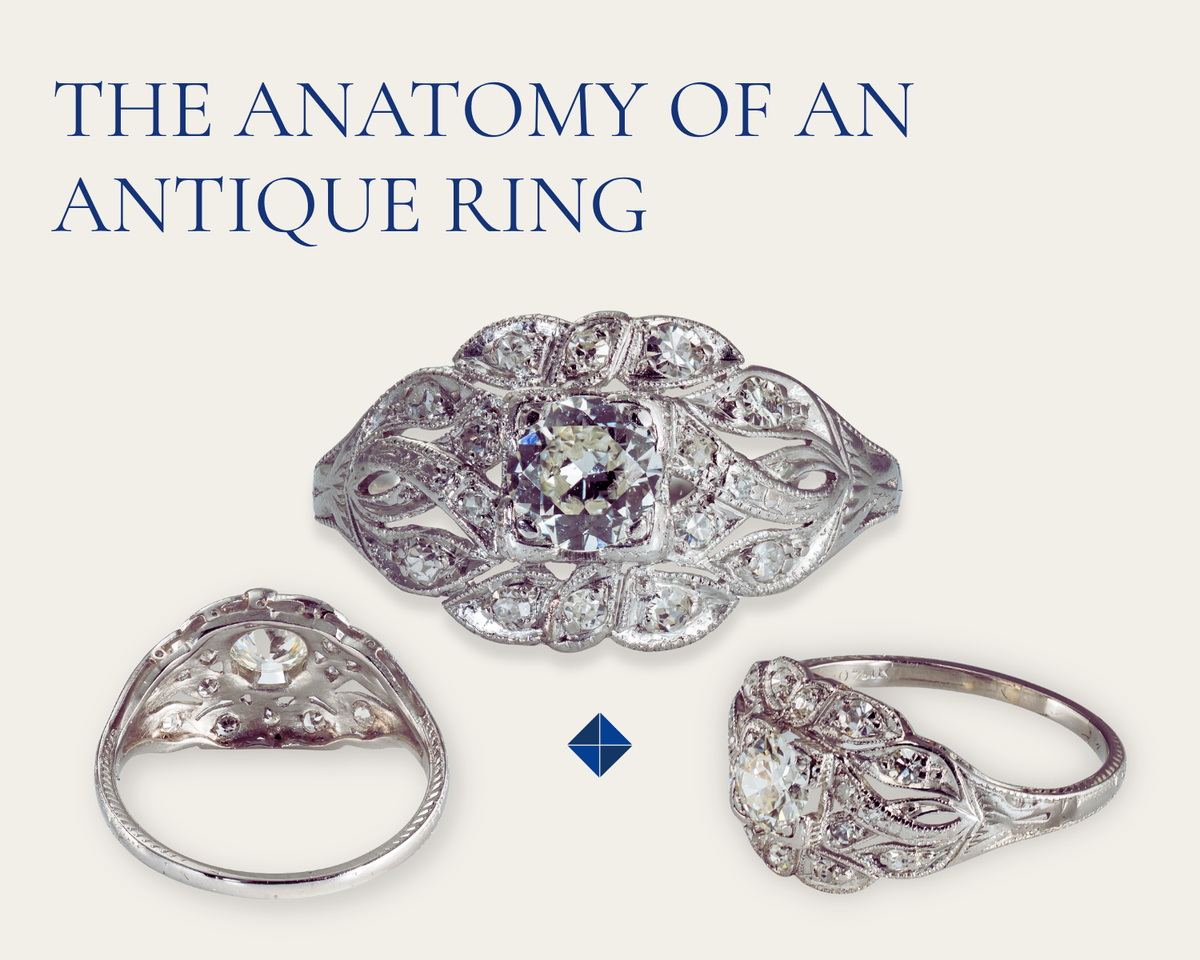
  • Edwardian jewelry — Delicate platinum work, lace-like filigree, fine milgrain, and elegant diamonds.
  • Art Nouveau jewelry — Flowing lines inspired by nature, flowers, and the female form.
  • Early Art Deco jewelry — Bold geometry, symmetry, and the beginning of modern design.

Each era has its own personality, which is one of the reasons collecting antique jewelry never gets boring.

Antique Edwardian Ruby Ring

What Is Vintage Jewelry?

Vintage jewelry is older jewelry that isn't old enough to be antique. Most collectors and jewelers consider vintage jewelry to be between 20 and 99 years old.

That covers a surprisingly wide range of styles, including Mid-Century Modern designs, Retro jewelry from the 1940s and 1950s, bold styles from the 1960s and 1970s, yellow gold jewelry from the 1980s, and even some pieces from the early 2000s that are beginning to enter the vintage category.

Unlike antique jewelry, which often shares similar handcrafted techniques, vintage jewelry reflects changing fashion trends and advances in manufacturing. Some vintage pieces were still handcrafted, while others were produced in much larger quantities as jewelry manufacturing became more efficient.

Some were designed for everyday wear, while others were bold statement pieces that instantly tell you what decade they came from. That's one of the fun things about vintage jewelry—it covers a huge variety of styles.


What Is Estate Jewelry?

This is probably the easiest term to understand. Estate jewelry simply means previously owned jewelry.

That's it.

It doesn't describe the age. It doesn't describe the style. It only tells you that someone owned it before you.

For example:

  • A 1923 Art Deco engagement ring is estate jewelry.
  • A diamond ring from 1978 is estate jewelry.
  • A wedding band purchased five years ago and traded in is also estate jewelry.

Think of estate jewelry as a category based on ownership—not age.

Here's the easiest way to remember it:

  • Every antique ring is estate jewelry.
  • Every vintage ring is estate jewelry.
  • But not every estate ring is antique or vintage.

It's a simple distinction, but it's one that causes a lot of confusion when shopping online.


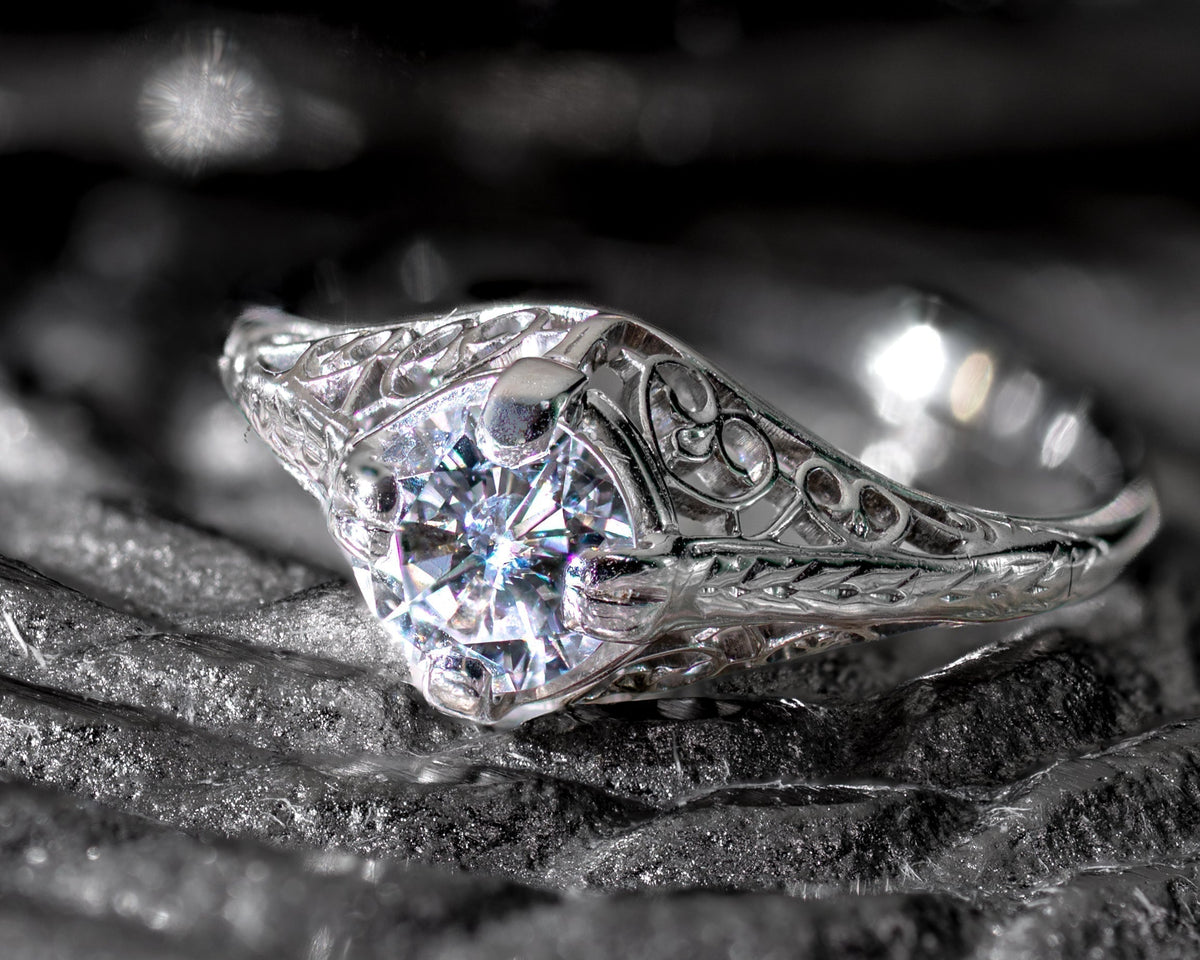
Vintage Diamond Star Ring

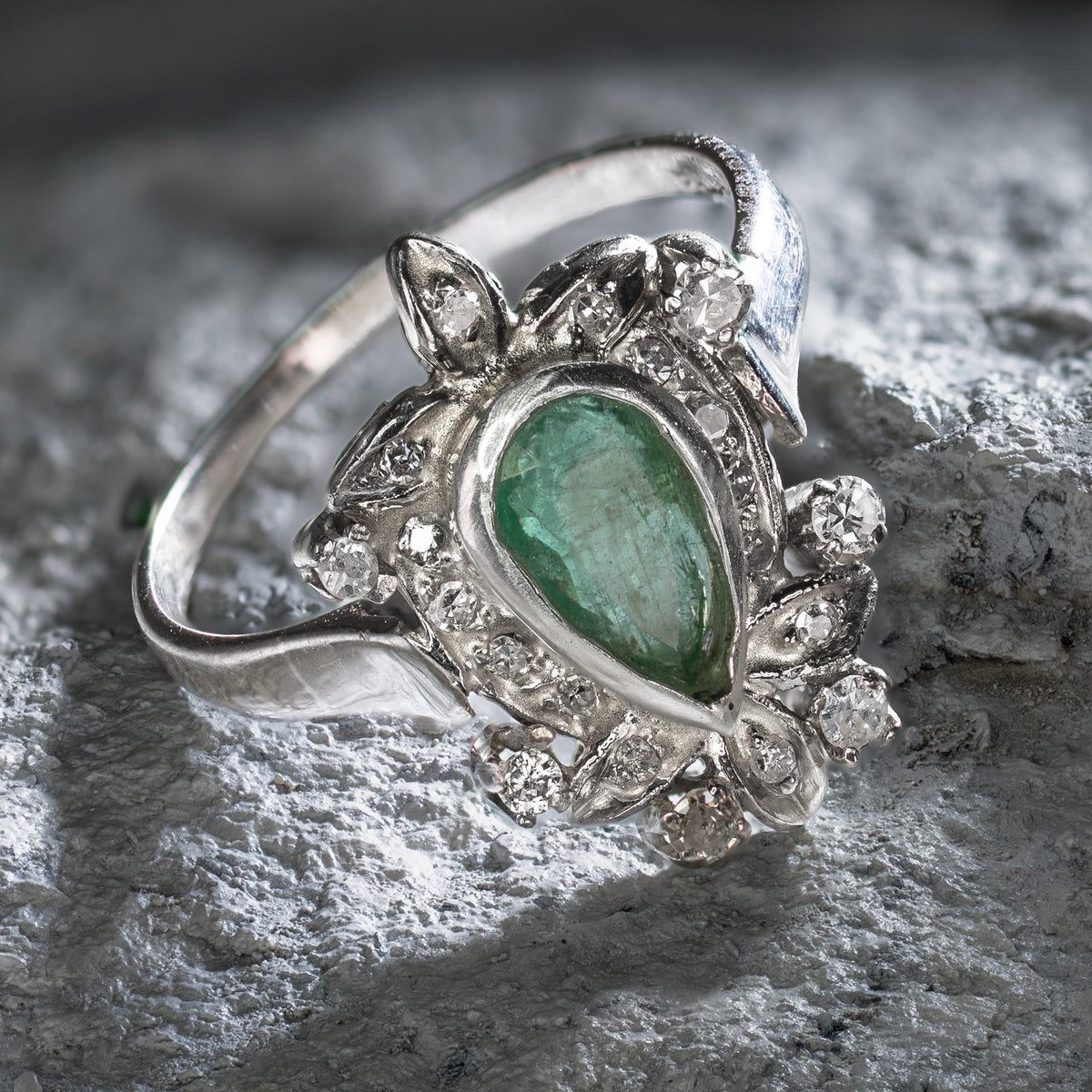
Vintage Ring from the late 30's.


What's the Difference Between Antique, Vintage, and Estate Jewelry?

If you're still wondering how these terms compare, this table makes it easy.

Type What It Means Typical Age
Antique Jewelry At least 100 years old 100+ years
Vintage Jewelry Older jewelry that isn't yet antique About 20–99 years
Estate Jewelry Previously owned jewelry of any age Any age

If you remember nothing else from this article, remember this chart. It's the simplest way to tell the three categories apart.

Can Jewelry Be Both Antique and Estate?

Absolutely. In fact, most antique jewelry is also estate jewelry.

Here's an easy example. Imagine you're looking at a diamond ring made in 1918. Because it's more than 100 years old, it's antique. Because someone owned it before you, it's also estate jewelry.

Now imagine a ring made in 1985. It's not old enough to be antique, but because it's previously owned, it's still estate jewelry.

The two terms aren't competing with each other. They describe different things:

  • Antique describes age.
  • Estate describes ownership.

Once you think of it that way, the confusion usually disappears.


How Old Does Jewelry Have to Be to Be Antique?

This is one of the most common questions buyers ask.

The answer is simple: a piece of jewelry generally becomes antique once it's 100 years old.

That might sound like a fixed date, but it's actually a moving target.

  • A ring made in 1915 has been antique for years.
  • A ring made in 1925 recently crossed the 100-year mark.
  • A ring made in 1930 isn't antique yet—but one day it will be.

That's why you'll sometimes hear jewelers describe pieces from the late 1920s or early 1930s as "approaching antique." They're not quite there yet, but they're getting close.


Why Do So Many Sellers Use the Wrong Terms?

Honestly, there are a few reasons.

Sometimes it's intentional. More often, it's simply because dating jewelry isn't easy. Many sellers inherit jewelry without knowing its history. Others buy estate collections and list hundreds of pieces every month. Not everyone has the time—or the experience—to research every ring in detail.

And then there's the marketing side. Let's be honest: the word antique tends to attract more attention than vintage.

So it's not unusual to see jewelry described as antique even when it's only 60 or 70 years old.

That's why I always encourage buyers to look beyond the title. Instead, pay attention to things like:

  • The style of the setting
  • The craftsmanship
  • Hallmarks
  • Diamond or gemstone cuts
  • The overall construction
  • Whether the seller explains why they believe it's antique

A good seller should be able to explain how they arrived at their estimate. No one gets every piece exactly right, but thoughtful research and honest descriptions go a long way.

As you spend more time looking at antique jewelry, you'll start spotting the differences yourself—and that's when shopping becomes a lot more fun.


How Can You Tell If Jewelry Is Really Antique?

This is where things get interesting.

Identifying antique jewelry requires looking at the piece in its entirety. There isn't one magic clue that tells you a ring is antique. It's more like putting together a puzzle. The more pieces that fit, the more confident you can be about its age.

When I'm evaluating a ring, I'm looking at the whole picture—not just one detail.

Some of the things I pay attention to include:

  • The overall design
  • How the ring was constructed
  • The type of metal
  • Hand engraving or milgrain
  • Filigree work
  • Hallmarks
  • Diamond and gemstone cuts
  • Signs of age and wear
  • Whether repairs or replacements have been made over the years

Rarely does one feature tell the whole story. It's usually several clues working together.


Are Hallmarks Enough to Date Jewelry?

Hallmarks are helpful—but they don't tell the whole story.

A hallmark may identify:

  • The metal purity
  • The manufacturer
  • The country of origin
  • Sometimes the year the piece was made

That sounds great, but there's a catch. Many antique rings have hallmarks that are partially worn away after a century of wear. Some never had detailed hallmarks to begin with. Others have been resized over the years, removing part of the stamp entirely.

That's why experienced dealers don't rely on hallmarks alone. They're simply one piece of the puzzle.


What Jewelry Eras Are Considered Antique?

Understanding the major antique jewelry eras can make shopping a lot easier.

Here's a simple guide.

Era Approximate Years What You'll Often See
Georgian 1714–1837 Rare handmade jewelry, foil-backed stones, closed-back settings
Victorian 1837–1901 Romantic designs, colored gemstones, yellow gold, rose gold
Art Nouveau 1890–1910 Nature-inspired designs, flowing curves, enamel work
Edwardian 1901–1915 Platinum, lace-like filigree, delicate engraving
Early Art Deco 1920s Geometric patterns, symmetry, bold architectural styling

One thing to remember is that jewelry doesn't follow a calendar. Styles overlap.

A ring made in 1918 may have strong Edwardian influence, while another from the same year may already show early Art Deco design. Jewelry that straddles two design periods is often called transitional jewelry.

That can make dating a piece to a specific year difficult—and that's completely normal.

Some of my favorite pieces I have acquired for The TERA Collection are transitional. I love when a ring shows some of the design and craftsmanship of a Victorian piece but the delicacy of Edwardian jewelry. The same goes for transitional pieces that still hold on to the fine, delicate details of the Edwardian era but start displaying the geometry and symmetry of Art Deco design.

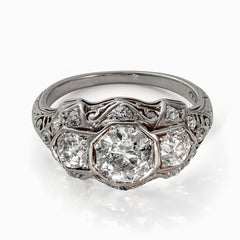
Transitional rings beautifully bridge two design eras. This stunning ring blends the delicate handcraftsmanship of the Edwardian period with the bold symmetry that would soon define Art Deco.  See the ring here.


Why Do Antique Diamonds Look So Different?

One of the biggest reasons people fall in love with antique jewelry is the diamonds.

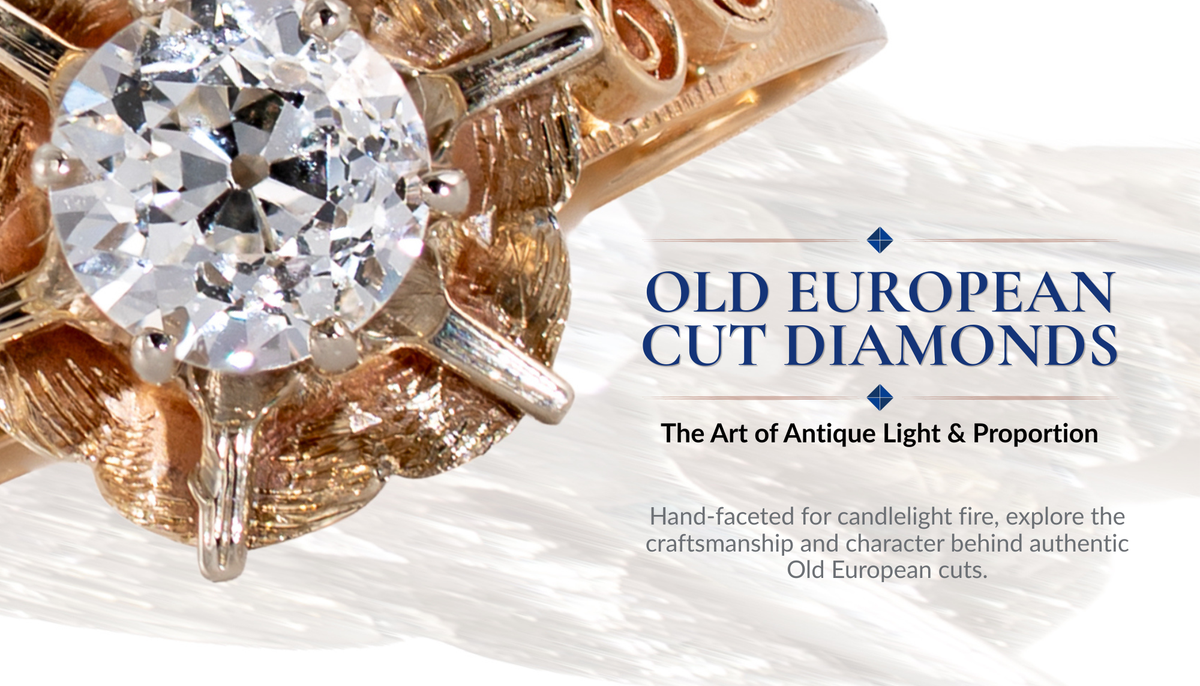
They simply don't look like modern diamonds. That's because they weren't cut with computers or precision lasers. They were cut by hand.

Some of the most popular antique diamond cuts include:

  • Old Mine Cut diamonds
  • Old European Cut diamonds
  • Rose Cut diamonds
  • Early Single Cut accent diamonds

Compared to today's round brilliant diamonds, antique cuts often have:

  • Larger, chunkier facets
  • Higher crowns
  • Smaller tables
  • Open culets
  • Softer flashes of light instead of tiny sparkles

Some people describe them as having a candlelight glow. I think that's a pretty good description.

Modern diamonds tend to produce a brighter, more consistent sparkle. Antique diamonds have a little more personality. Neither is better. They're just different—and that's exactly why many collectors prefer them.

If you'd like to learn more, be sure to read my guide on Old European Cut Diamonds and my comparison of Old Mine Cut vs. Old European Cut Diamonds.


Is Antique Jewelry Better Than Vintage Jewelry?

I get asked this a lot.

The truth is, neither is automatically better. It really comes down to what you enjoy wearing.

You might prefer antique jewelry if you appreciate:

  • Handcrafted details
  • Historic craftsmanship
  • Older diamond cuts
  • One-of-a-kind designs
  • Fine engraving and filigree

Vintage jewelry may be a better fit if you enjoy:

  • Larger gemstones
  • Mid-century styles
  • Bolder designs
  • More variety
  • Often more affordable prices

Personally, I'm drawn to antique rings because I love the craftsmanship. Many of the details are so fine that recreating them today would be incredibly expensive. That's part of what makes these pieces feel special.


What Should You Look for Before Buying Antique Jewelry?

Buying antique jewelry doesn't have to be intimidating. A few simple questions can tell you a lot about a piece.

Before purchasing, I always recommend checking:

  • Is the ring structurally sound?
  • Are the prongs secure?
  • Has the shank been replaced?
  • Are the stones original?
  • Are there chips or noticeable damage?
  • Has the ring been heavily polished?
  • Are repairs visible?

None of these things automatically make a ring a bad purchase. Many antique rings have been repaired over the years. In fact, careful restoration is often what allows them to be worn for another hundred years.

The important thing is knowing what you're buying.


What Are Some Red Flags When Shopping Online?

Buying antique jewelry online has never been easier, but it also means you need to know what to watch for.

Here are a few things that make me slow down before buying:

  • Blurry or low-quality photos
  • No close-up images of the stones
  • Missing photos of the inside of the band
  • No mention of condition
  • No explanation of repairs
  • Descriptions that only say "old" without explaining why
  • Sellers who won't answer questions

I also like to see multiple angles of the ring. The more a seller is willing to show, the more confidence I usually have. That doesn't mean every listing needs professional photography. It just needs to be honest.

Remember, antique jewelry is perfectly imperfect. After a century of wear, you should expect to see signs of age. Handcrafted jewelry may not be perfectly symmetrical or balanced the way modern machine-made jewelry is—and that's part of its charm.


Is It Okay If an Antique Ring Has Been Repaired?

Absolutely. In fact, many antique rings have undergone some form of repair during their lifetimes. That's completely normal.

Think about it. A ring that's been loved for over 100 years has probably been worn by multiple generations. It would actually be unusual if it had never needed attention.

Common repairs include:

  • Resizing
  • Re-tipping worn prongs
  • Replacing a shank
  • Tightening stones
  • Professional cleaning and polishing

The goal isn't to find an untouched ring. The goal is to find one that's been properly cared for.

A well-executed repair can help preserve a piece for decades to come.


Can You Wear Antique Jewelry Every Day?

In many cases, yes.

I wear antique jewelry the same way I treat a classic car. It's meant to be enjoyed—but it's also worth respecting.

If you plan to wear an antique engagement ring every day, a few simple habits will help keep it looking its best:

  • Remove it before heavy lifting.
  • Avoid harsh chemicals.
  • Have the prongs inspected occasionally.
  • Clean it gently.
  • Store it separately from other jewelry.

With proper care, many antique rings will easily outlast all of us. That's part of what makes them so remarkable.


Is Antique Jewelry a Good Investment?

This is probably one of the most searched questions online, and honestly, I think it's the wrong place to start.

I've never bought an antique ring because I thought it was going to make me rich. I buy pieces because I appreciate the craftsmanship, the history, and the fact that I'm holding something that can't be reproduced today without enormous effort and cost.

The best antique jewelry tends to hold its value because it's built on things that never really go out of style:

  • Beautiful craftsmanship
  • Quality materials
  • Interesting design
  • Strong condition
  • Genuine rarity

Of course, some pieces appreciate over time. Others don't. Just like any collectible, value depends on supply, demand, condition, and desirability.

My advice is simple: buy the piece you'd still be happy to own even if it never increased in value. If it does appreciate, that's wonderful—but that shouldn't be the only reason you bought it.


Why Are More People Choosing Antique Jewelry Today?

This is something I've noticed over the last few years. More buyers are looking for jewelry that feels different.

Instead of buying the same ring everyone else has, they're looking for something with character and history. People are drawn to antique jewelry because it offers things that are becoming harder to find:

  • Handcrafted details
  • Unique designs
  • Older diamond cuts
  • Individuality
  • A connection to the past

There's also something satisfying about giving an old piece of jewelry a new life. Instead of sitting in a drawer, it gets to be worn and appreciated again.

I think that's pretty special.


Antique and Vintage engagement rings are a popular choice for today's brides. View the ring in the photo.


Is Antique Jewelry More Sustainable?

For many buyers, the answer is yes.

Every antique ring that finds a new owner is one less ring that needs to be newly manufactured. No new mining. No new production. No new resources required to create the piece itself.

While sustainability means different things to different people, buying existing jewelry is often considered one of the most environmentally friendly ways to purchase fine jewelry.

It's a benefit that many people appreciate in addition to the beauty and craftsmanship.

What's the Biggest Mistake Buyers Make?

If I had to pick just one, it would be focusing only on age.

Older doesn't automatically mean better. I've seen beautiful vintage rings I'd choose over mediocre antique ones every single time.

Instead of asking, "How old is it?" I think better questions are:

  • Is it well made?
  • Is it in good condition?
  • Does it have character?
  • Has it been cared for?
  • Would I still love it ten years from now?

Those answers matter much more than the date alone.


Why I Started The TERA Collection

The TERA Collection grew out of a very simple idea: I wanted to find antique and vintage jewelry with character, craftsmanship, and a sense of history.

After evaluating hundreds of rings, I realized I wasn't only looking for the biggest diamond or the flashiest piece. I was looking for rings that felt intentional. Pieces with hand engraving, delicate filigree, Old European Cut diamonds, crisp design, and the kind of small details that show the hand of the jeweler who made them.

I'm especially drawn to transitional pieces—rings that sit between periods and carry a little bit of design elements of each era. A Victorian-inspired ring with Edwardian delicacy. An Edwardian-style ring beginning to show Art Deco geometry. Those are the pieces that feel the most alive to me.

That's what eventually became The TERA Collection: a carefully chosen group of antique and vintage pieces selected for craftsmanship, presence, and individuality.

Not every old ring belongs here. The pieces I choose have to have something to say.


Frequently Asked Questions About Antique and Vintage Jewelry

Is antique jewelry always worth more than vintage jewelry?

No. Some vintage jewelry sells for significantly more than certain antique pieces. Value depends on craftsmanship, rarity, gemstones, condition, brand, and demand—not just age.

Can a vintage ring eventually become antique?

Yes. Once a piece reaches 100 years of age, it generally becomes antique. Time eventually moves every vintage piece into the antique category.

Is estate jewelry the same as antique jewelry?

No. Estate jewelry simply means previously owned. It can be antique, vintage, or even only a few years old.

Can antique jewelry be resized?

Usually, yes. Most antique rings can be resized by an experienced jeweler, although some designs require extra care because of engraving, filigree, or stones along the band.

How do I know if an antique diamond is real?

The best way is to have it evaluated by a qualified jeweler or gemologist. Old diamond cuts often look different from modern diamonds, but that doesn't make them less valuable. In fact, many collectors specifically seek them out.

Is it okay if an antique ring has repairs?

Absolutely. Many antique rings have been professionally repaired over the past century. Well-executed repairs are usually part of preserving the ring for future generations.

Why are antique diamonds less sparkly than modern diamonds?

They're not necessarily less sparkly—they sparkle differently. Modern diamonds are designed for maximum brilliance under today's lighting. Older hand-cut diamonds often produce broader flashes of light and what many collectors describe as a softer, warmer glow.


Final Thoughts

The terms antique, vintage, and estate are often used interchangeably, but now you know they're describing three different things.

Here's the quick version:

  • Antique jewelry is at least 100 years old.
  • Vintage jewelry is generally between 20 and 99 years old.
  • Estate jewelry is simply previously owned jewelry, regardless of age.

Understanding those differences makes shopping a whole lot easier. But here's something I've learned after looking at hundreds of antique rings: the date is only part of the story.

Some pieces immediately grab your attention because of the craftsmanship. Others because of the diamond. Others because you can't stop looking at them, even if they're a little imperfect.

That's one of the reasons I love antique jewelry. It wasn't made to be identical. It was made by people, one piece at a time. And more than a century later, those little differences are exactly what give these rings their personality.

Whether you're buying your first antique engagement ring or adding another piece to your collection, I hope this guide helps you shop with a little more confidence—and maybe inspires you to look more closely at the details.

Sometimes the smallest details tell the best stories.

More articles from this blog

|
Identifying characterstics of an old mine cut diamond.
Kevin Vitali July 28, 2026

What Is an Old Mine Cut Diamond? The Complete Guide to History, Identification, Value, and Buying

Before diamond cutting became a science, it was an art. Every Old Mine Cut diamond is a surviving example of that craftsmanship.

An Old Mine Cut diamond is a hand-cut antique diamond developed in the late 18th century and remained one of the most popular diamond cuts throughout much of the 19th century. It is recognized by its cushion-shaped outline, high crown, small table, deep pavilion, large open culet, and broad, chunky facets. As one of the earliest brilliant-style diamond cuts, it represents an important milestone in the evolution of diamond cutting.


A late Victorian Ring featuring an Old Mine Cut Diamond


Unlike modern diamonds, which are cut to mathematically precise proportions using advanced technology, every authentic Old Mine Cut was fashioned entirely by hand. Diamond cutters worked with the natural shape of each rough crystal, balancing beauty, durability, and weight retention rather than pursuing perfect symmetry. The result was a diamond with remarkable individuality—no two authentic Old Mine Cut diamonds are exactly alike.

Those subtle differences in symmetry, proportions, and facet arrangement are not imperfections. They are evidence of the individual craftsman who shaped the stone, giving each diamond a character that modern precision cutting cannot reproduce. More than two centuries later, that handcrafted quality continues to attract collectors, antique jewelry enthusiasts, and anyone who appreciates the artistry of historic jewelry.

Authentic Old Mine Cut diamonds have also become increasingly scarce. During the late 19th and 20th centuries, many were recut into Old European Cuts and, later, modern round brilliant diamonds to satisfy changing tastes and improve light performance. While modern cutters continue to produce diamonds inspired by the Old Mine Cut, every authentic antique example represents a finite piece of jewelry history.


Old Mine Cut Diamonds at a Glance

Before exploring the history and identifying characteristics in greater detail, here's a quick overview of the features that define an Old Mine Cut diamond. While every authentic example is unique, most share these recognizable characteristics.


key characteristics of an old mine cut diamond

Defining characteristics of an Old Mine Cut Diamond include a small table and a large irregular culet.


Characteristic Details
Introduced Late 18th century
Most Popular Late Georgian and Victorian eras
Shape Cushion to softly rounded square
Crown High
Table Small
Pavilion Deep
Culet Large, open culet
Facets Large, hand-cut facets
Sparkle Broad flashes of light and colorful fire
Lighting Environment Candlelight and early gas lighting
Commonly Found In Georgian and Victorian jewelry
Still Produced Today? Yes, modern cutters produce Old Mine-style diamonds
Authentic Antique Examples Finite—every antique Old Mine Cut was fashioned by hand more than a century ago


While no two Old Mine Cut diamonds are identical, these characteristics provide a useful starting point for identification. Because each stone was cut by hand rather than to standardized proportions, slight variations in shape, symmetry, and facet arrangement are expected. Those subtle differences are part of what gives authentic Old Mine Cut diamonds their enduring charm and individuality.


Why Is It Called an Old Mine Cut?

Interestingly, the jewelers who originally fashioned these diamonds never referred to them as Old Mine Cuts. The name became popular much later, after major diamond discoveries in South Africa transformed the jewelry industry during the late 19th century.

Before those discoveries, most of the world's diamonds came from the historic mines of India and, later, Brazil. As newer sources of rough diamonds entered the market and cutting styles continued to evolve, jewelers needed a way to distinguish the older hand-cut stones from the more modern brilliant cuts that were beginning to appear.

The term Old Mine Cut simply referred to diamonds cut from material that originated from the "old mines." Over time, the name became associated not with the source of the rough diamond, but with the distinctive cutting style itself. Today, it describes one of the most recognizable and historically important antique diamond cuts.


When Were Old Mine Cut Diamonds Popular?

Old Mine Cut diamonds rose to prominence during the late Georgian period in the late 18th century and remained the dominant diamond cut throughout much of the Victorian era. Their popularity lasted for well over a century, making them one of the defining features of antique jewelry from this period.

During the late 19th century, advances in diamond-cutting techniques produced stones with greater symmetry and improved light performance. This gradual evolution led to the development of the Old European Cut, which became the preferred style during the Edwardian and Art Deco periods before eventually evolving into the modern round brilliant.

Many Old Mine Cut diamonds did not survive this transition. As fashions changed, countless stones were recut into newer shapes to increase their brilliance, often sacrificing carat weight and permanently erasing the features that made them unique. That is why well-preserved Old Mine Cut diamonds—especially those that remain in their original period mountings—have become increasingly desirable among collectors and lovers of antique jewelry.

Time Period Dominant Diamond Cut
16th–18th Century Rose Cut
Late 18th Century–Late 19th Century Old Mine Cut
Late 19th Century–1930s Old European Cut
Modern Era Round Brilliant


How Can You Identify an Old Mine Cut Diamond?

Identifying an Old Mine Cut diamond becomes much easier once you know what to look for. While no two examples are identical, authentic Old Mine Cuts share several defining characteristics that separate them from modern diamonds and even other antique cuts. Being able to identify an Old Mine Cut stone is also a strong indicator of authentic antique jewelry.

inforgraphic showing the key characteristics of an old mine cut diamond


Unlike today's precision-cut diamonds, Old Mine Cuts were fashioned entirely by hand. Diamond cutters relied on experience rather than mathematical formulas, working with the natural shape of the rough crystal instead of forcing it into perfect proportions. The result is a diamond with individuality and character—qualities that collectors often value just as much as brilliance.

The easiest way to identify an Old Mine Cut is to look at its overall shape and proportions. Most examples feature a softly rounded cushion outline, a noticeably high crown, a small table, a deep pavilion, and a large open culet that is often visible when looking straight through the stone. Combined with broad, chunky facets, these features produce the bold flashes of light that have made Old Mine Cuts favorites among antique jewelry enthusiasts for generations.

Rather than relying on just one characteristic, it's best to evaluate the diamond as a whole. The more of these features you find, the more likely you are looking at a genuine Old Mine Cut.

The Defining Characteristics of an Old Mine Cut Diamond

Characteristic What to Look For
Shape Cushion or softly rounded square
Crown High and steep
Table Small compared to modern diamonds
Pavilion Deep
Culet Large, open culet visible through the table
Facets Large, chunky hand-cut facets
Symmetry Slight irregularities are normal
Sparkle Broad flashes of light rather than pinfire scintillation


The Cushion Shape

Perhaps the easiest feature to recognize is the overall outline of the diamond.

Unlike a modern round brilliant, an Old Mine Cut is typically cushion-shaped, with softly rounded corners and gently curved sides. Some examples appear almost square, while others are slightly rectangular, but perfectly round stones are uncommon.

This shape wasn't chosen for fashion alone. Early diamond cutters tried to preserve as much of the original crystal as possible, removing only enough material to create a pleasing appearance while retaining valuable carat weight. As a result, the finished diamond often reflected the natural shape of the rough crystal rather than an idealized geometric form.

Because every diamond was cut individually, you'll rarely find two Old Mine Cuts with exactly the same outline. That subtle variation is one of the qualities many collectors appreciate most.

The High Crown

Old Mine Cut diamonds are known for their noticeably high crowns.

The crown is the upper portion of the diamond that sits above the girdle. Compared to most modern diamonds, the crown of an Old Mine Cut rises much higher, giving the stone greater depth and a more dramatic profile when viewed from the side.

This high crown contributes significantly to the diamond's personality. It creates larger flashes of light and helps produce the colorful fire that antique diamonds are known for. It also gives Old Mine Cuts a sense of depth that many people find difficult to capture in photographs but striking when viewed in person.

The Small Table

The table is the large flat facet at the top of a diamond.

One of the defining characteristics of an Old Mine Cut is its relatively small table. While modern round brilliant diamonds typically feature much larger tables to maximize light return, Old Mine Cuts retain a smaller opening that emphasizes the height of the crown.

A small table changes the way light enters and exits the diamond. Rather than producing countless tiny flashes of brilliance, it encourages broader reflections and more noticeable fire, especially in lower, warmer lighting conditions.

When comparing an Old Mine Cut to a modern diamond side by side, the smaller table is often one of the first differences you'll notice.

The Deep Pavilion

Beneath the girdle lies the pavilion, the lower portion of the diamond.

Old Mine Cut diamonds typically have a much deeper pavilion than modern diamonds. This greater depth was partly a result of early cutting methods and partly a practical way to retain weight from the original rough crystal.

The deep pavilion also influences the diamond's appearance. Instead of the bright, evenly distributed brilliance of a modern round brilliant, an Old Mine Cut produces larger, slower flashes of light that many collectors describe as warm and romantic.

The Large Open Culet

Perhaps no feature is more closely associated with an Old Mine Cut than its large open culet.

The culet is the tiny facet—or point—at the very bottom of the diamond. Modern diamonds usually have either a microscopic culet or none at all, making the point appear sharp.

Old Mine Cuts are different.

To reduce the risk of chipping during hand cutting and everyday wear, lapidaries often polished a flat facet at the tip of the pavilion. When viewed through the table, this open culet can appear as a small circle or octagonal shape near the center of the stone.

Many first-time buyers mistake the culet for a flaw or even a hole drilled through the diamond. In reality, it is one of the strongest indicators that you're looking at an authentic antique cut.

Large, Chunky Facets

Unlike the many small facets found on a modern round brilliant, an Old Mine Cut features fewer but much larger facets.

These broad facets don't create the rapid "pinfire" sparkle that modern diamonds are famous for. Instead, they produce slower, bolder flashes of white light and colorful fire as the diamond moves.

This type of light performance is one of the defining characteristics of antique diamonds and one of the reasons many enthusiasts prefer them over their modern counterparts.

Hand-Cut Symmetry

If you're accustomed to modern diamonds, an Old Mine Cut may initially appear imperfect.

The outline may not be perfectly symmetrical. The culet may be slightly off-center. Individual facets may vary in size or alignment.

These characteristics are not signs of poor workmanship.

They are evidence that the diamond was fashioned entirely by hand, often using simple tools and natural light. Long before lasers and computer-guided polishing machines existed, every decision was made by an individual craftsman working to reveal the beauty hidden within the rough crystal.

For many collectors, these subtle irregularities are among the most appealing features of an authentic Old Mine Cut.

The Kozibe Effect

One of the most fascinating optical characteristics found in many Old Mine Cut diamonds is something collectors call the Kozibe effect.

When viewed face-up under magnification—or sometimes even with the naked eye—you may notice a repeating pattern of reflections surrounding the open culet. Rather than seeing a single culet, the pavilion facets create multiple mirrored images that appear to radiate around the center of the stone.

Far from being a defect, the Kozibe effect is a hallmark of many antique brilliant cuts with large open culets. Some collectors actively seek it because it highlights the unique optical character of hand-cut diamonds and cannot be replicated in the same way by modern precision-cut stones with tiny or nonexistent culets.

Once you learn to recognize it, the Kozibe effect becomes one of the most charming and distinctive features of an Old Mine Cut.

How to Tell if an Old Mine Cut Diamond Is Authentic

While no single characteristic proves a diamond is an authentic Old Mine Cut, examining several features together can provide a strong indication.

Look for this checklist:

  • Cushion-shaped outline with softly rounded corners.
  • High crown.
  • Small table.
  • Deep pavilion.
  • Large open culet visible through the table.
  • Broad, chunky facets.
  • Slight asymmetry consistent with hand cutting.
  • Broad flashes of light rather than modern pinfire sparkle.
  • Found in a Georgian or Victorian setting, when possible.

If a diamond displays most or all of these characteristics, there's a good chance you're looking at a genuine Old Mine Cut. In the next section, we'll compare Old Mine Cuts to Rose Cuts, Old European Cuts, modern cushion cuts, and round brilliant diamonds so you can easily distinguish one from another.

How Does an Old Mine Cut Compare to Other Diamond Cuts?

Why Do Old Mine Cut Diamonds Sparkle Differently?

One of the first things people notice about an Old Mine Cut diamond is that it doesn't sparkle like a modern round brilliant. Instead of producing countless tiny flashes of white light, an Old Mine Cut creates larger, slower flashes that many collectors describe as warm, bold, and full of personality.

That difference isn't the result of poor cutting—it's the result of a completely different approach to diamond cutting.

Modern round brilliant diamonds are engineered using precise mathematical formulas that maximize light return. Every facet is carefully positioned to bounce light back toward the viewer, creating the intense brilliance most people associate with today's diamonds.

Old Mine Cut diamonds were developed more than a century before those calculations existed. Each diamond was shaped entirely by hand, with cutters balancing beauty, durability, and weight retention rather than chasing perfect optical performance.

The result is a diamond that interacts with light in a unique way. Instead of pinfire scintillation, an Old Mine Cut produces broad flashes of white light and colorful fire that many antique jewelry enthusiasts find more natural and expressive than the highly uniform sparkle of modern diamonds.

Were Old Mine Cut Diamonds Designed for Candlelight?

Yes—but not exclusively.

Unlike Rose Cut diamonds, which were developed specifically for a world illuminated by candles, Old Mine Cut diamonds appeared during a period when lighting itself was beginning to change.

Throughout the late Georgian period, candles remained the primary source of indoor light. During the Victorian era, however, gas lighting became increasingly common in homes, businesses, and public buildings. These brighter interiors encouraged diamond cutters to experiment with deeper pavilions, higher crowns, and facet arrangements that reflected more light than earlier cuts.

The Old Mine Cut represents an important step in that evolution.

It offered noticeably greater brilliance than the Rose Cut while retaining the handcrafted character of earlier diamonds. Rather than replacing one lighting environment with another overnight, it bridged two eras, performing beautifully in both candlelight and the brighter gas lighting that became common during the 19th century.

How Diamond Cutting Evolved

Each major antique diamond cut reflects the technology and lighting of its time. As cutting techniques improved and homes became brighter, lapidaries continually refined the way diamonds interacted with light.

Diamond Cut Primary Era Lighting Environment Defining Characteristic
Rose Cut 16th–Late 18th Century Candlelight Flat base with soft glow
Old Mine Cut Late 18th–Late 19th Century Candlelight & Gas Lighting Cushion shape with broad flashes
Old European Cut Late 19th Century–1930s Electric Lighting Rounder outline with increased brilliance
Round Brilliant Modern Electric & LED Lighting Maximum brilliance and scintillation


Rather than viewing antique diamond cuts as primitive versions of modern diamonds, it's more accurate to see them as milestones in the evolution of diamond cutting. Each reflects the tools, lighting, and aesthetic preferences of its own time.


Comparisons of Rose, Mine Cut, Old European Cut and Modern Brillian Cut Diamonds


Old Mine Cut vs. Rose Cut

Although both are antique diamond cuts, the Rose Cut and Old Mine Cut are remarkably different.

A Rose Cut diamond has a flat base and no pavilion. Its triangular facets rise to a single point, producing a soft, romantic glow that was perfectly suited to candlelight.

An Old Mine Cut introduced a deep pavilion, a high crown, and a small table. These changes dramatically increased the amount of light reflected back through the top of the diamond, creating greater brilliance while preserving the handcrafted appearance that defines antique jewelry.

The Old Mine Cut wasn't intended to replace the beauty of the Rose Cut. It represented the next stage in the evolution of diamond cutting.

Feature Rose Cut Old Mine Cut
Shape Round or irregular Cushion
Bottom Flat Deep pavilion
Table None Small
Culet None Large open culet
Sparkle Soft glow Broad flashes and fire
Most Popular Renaissance to Georgian Georgian to Victorian


Old Mine Cut vs. Old European Cut

The Old European Cut evolved directly from the Old Mine Cut during the late 19th century.

While both cuts feature high crowns, small tables, deep pavilions, and open culets, the Old European Cut became noticeably rounder and more symmetrical as cutting techniques improved.

This increased symmetry allowed for more consistent light return and marked another important step toward the modern round brilliant.

If an Old Mine Cut feels organic and handcrafted, an Old European Cut feels more refined while still retaining the charm of an antique diamond.

Feature Old Mine Cut Old European Cut
Shape Cushion Round
Symmetry Slightly irregular More symmetrical
Crown High High
Table Small Small
Culet Large Open, often smaller
Sparkle Bold flashes Greater brilliance with broad flashes


Old Mine Cut vs. Modern Cushion Cut

Because they share a cushion-shaped outline, Old Mine Cuts are often confused with modern cushion-cut diamonds.

The similarities, however, are mostly limited to their overall shape.

Modern cushion cuts are produced using computer-guided technology and precise mathematical proportions. They typically feature smaller culets—or none at all—and many contain additional facets designed to increase brilliance. Depending on the style, modern cushions may also display a "crushed ice" appearance created by numerous small facets.

An authentic Old Mine Cut is much easier to recognize once you know what to look for. Its higher crown, smaller table, larger open culet, chunky facet pattern, and subtle asymmetry immediately distinguish it from modern cushion cuts.

Feature Old Mine Cut Modern Cushion Cut
Cut By Hand Computer-guided precision
Shape Cushion Cushion
Culet Large and open Usually none
Facets Large and chunky Numerous, highly symmetrical
Symmetry Slight variations Highly precise
Sparkle Broad flashes Intense brilliance


Old Mine Cut vs. Modern Round Brilliant

Comparing an Old Mine Cut to a modern round brilliant is a comparison of two completely different philosophies of diamond cutting.

Modern round brilliants are designed to maximize brilliance above all else. Every angle and proportion has been optimized to produce the greatest possible light return.

Old Mine Cuts tell a different story.

Rather than pursuing optical perfection, the craftsmen who shaped these diamonds worked with simple tools, natural rough crystals, and the lighting available at the time. Their goal was to create a beautiful diamond while preserving valuable carat weight and respecting the limitations of hand cutting.

For collectors of antique jewelry, those differences are part of the appeal. An Old Mine Cut carries visible evidence of the person who fashioned it centuries ago, something no modern diamond—no matter how perfectly cut—can replicate.


top view comparision of old mine cut, old european cut and modern brilliant cut diamonds


Feature Old Mine Cut Modern Round Brilliant
Era Late 18th–Late 19th Century Modern
Shape Cushion Round
Culet Large, open Usually none
Symmetry Hand cut Precision cut
Sparkle Broad flashes Intense brilliance
Personality Individual and handcrafted Highly standardized


Why Antique Jewelry Enthusiasts Love Old Mine Cut Diamonds

For many people, the appeal of an Old Mine Cut diamond extends far beyond its sparkle.

Each stone was cut by hand at a time when every facet reflected the judgment and skill of an individual craftsman. Slight differences in shape, symmetry, and proportions are reminders that these diamonds were created long before lasers, computer modeling, or standardized cutting formulas existed.

When I evaluate an antique ring, I rarely focus on the diamond by itself. I look at how the entire piece comes together. The handcrafted setting, the engraving, the metalwork, and the Old Mine Cut diamond were designed as a complete work of art. Appreciating one without the others misses much of what makes antique jewelry so special.

That is why I believe an Old Mine Cut should never be compared to a modern diamond solely on brilliance. Its greatest value lies in its craftsmanship, individuality, and history. Every authentic example has survived changing fashions, evolving technology, and generations of recutting to remain exactly what it was intended to be—a remarkable piece of jewelry history.


Value, Buying, and Frequently Asked Questions

Are Old Mine Cut Diamonds Rare?

Yes, authentic antique Old Mine Cut diamonds have become increasingly rare.

While modern diamond cutters continue to produce diamonds inspired by the Old Mine Cut, no new antique Old Mine Cut diamonds are being created. Every authentic example available today was fashioned by hand more than a century ago, making them a finite part of jewelry history.

Their numbers have declined steadily over the years. As diamond-cutting techniques improved during the late 19th and 20th centuries, countless Old Mine Cut diamonds were recut into Old European Cuts and, later, modern round brilliant diamonds. Although these recuts often increased brilliance, they permanently removed carat weight and erased the characteristics that made the original stones unique.

For collectors, originality is especially important. An Old Mine Cut that remains in its original Georgian or Victorian setting is often more desirable than a loose stone or one that has been heavily altered, preserving both the craftsmanship of the diamond and the history of the jewelry itself.

Are Old Mine Cut Diamonds Valuable?

Yes, but they are valued somewhat differently than modern diamonds.

Traditional factors such as carat weight, color, clarity, and condition remain important, but collectors frequently place just as much emphasis on originality, craftsmanship, rarity, and historical significance.

Several factors influence the value of an Old Mine Cut diamond.

Factor Why It Matters
Carat Weight Larger antique diamonds are significantly rarer.
Original Condition Minimal wear or damage generally increases desirability.
Original Setting Period mountings often add historical and collector value.
Cut Quality Attractive proportions and pleasing light performance are highly sought after.
Color & Clarity Higher quality stones typically command stronger prices.
Provenance Documented history or notable origin may increase value.


Unlike modern diamonds, Old Mine Cuts are rarely judged by laboratory specifications alone. Their individuality and historical integrity often contribute just as much to their appeal.

Antique Old Mine Cut vs. Modern Old Mine Cut

One of the biggest misconceptions today is that every Old Mine Cut diamond is an antique.

That's no longer the case.

As interest in antique jewelry has grown, modern diamond cutters have begun producing newly cut diamonds that intentionally recreate the appearance of historic Old Mine Cuts. These diamonds feature many of the same characteristics—high crowns, small tables, cushion outlines, chunky facets, and open culets—but they are fashioned using modern cutting equipment and contemporary techniques.

Both have their place in today's market.

Modern Old Mine Cuts appeal to buyers who love the antique aesthetic but prefer a newly cut diamond. Authentic antique Old Mine Cuts offer something modern diamonds cannot: genuine history. Every antique example was cut by hand during the Georgian or Victorian era and has survived generations of changing fashion and evolving technology.

Neither is inherently better. The right choice depends on what you value most.

Feature Antique Old Mine Cut Modern Old Mine Cut
Age More than 100 years old Newly cut
Cut By Hand Modern precision equipment
Symmetry Naturally varied More precise and consistent
Historical Value Yes No
Availability Finite Can still be produced
Character Individual craftsmanship Inspired by antique cutting styles


If you're searching for a piece of history, an authentic antique Old Mine Cut is irreplaceable. If you're drawn primarily to the appearance of the cut, a modern interpretation may be an excellent alternative.

Do Old Mine Cut Diamonds Look Larger Than Modern Diamonds?

Often, they do.

Old Mine Cuts typically have high crowns and deep pavilions, so they don't always maximize face-up size the way some modern cuts do. However, their cushion-shaped outline, broad facets, and distinctive pattern of light can create the impression of a larger stone, particularly in handcrafted antique settings.

More importantly, they attract attention differently. Rather than producing countless tiny flashes of light, Old Mine Cuts create bold, colorful flashes that many people find more dramatic and expressive.

Are Old Mine Cut Diamonds Good for Engagement Rings?

Absolutely, provided you appreciate them for what they are.

An Old Mine Cut engagement ring offers something few modern rings can: individuality. Every authentic antique stone was shaped by hand, and no two are exactly alike. Combined with a handcrafted Georgian or Victorian setting, the result is a ring with character, history, and craftsmanship that cannot be mass-produced.

They are also practical for everyday wear when properly set and cared for. Many have already survived well over a century of regular use, demonstrating both the durability of diamonds and the quality of the jewelers who created them.

Choosing an Old Mine Cut engagement ring isn't simply about owning an antique diamond. It's about becoming the next steward of a remarkable piece of jewelry history.

Should You Buy an Antique or Modern Old Mine Cut?

This ultimately comes down to what you value most.

If your priority is owning a diamond with genuine historical significance, an authentic antique Old Mine Cut is difficult to surpass. Every stone was fashioned by hand, carries the subtle marks of its maker, and represents an important chapter in the evolution of diamond cutting.

If, however, you love the appearance of an Old Mine Cut but prefer the consistency of a newly cut diamond, modern Old Mine-style diamonds can be an excellent choice. They capture much of the antique aesthetic while offering the precision and predictability of contemporary cutting.

Personally, if given the choice, I'll almost always gravitate toward the antique example. I appreciate the craftsmanship and history as much as I appreciate the diamond itself. To me, an authentic Old Mine Cut is more than a beautiful gemstone—it's a survivor that has passed through generations while retaining the character its original craftsman intended.

Can GIA Grade an Old Mine Cut Diamond?

Yes.

The Gemological Institute of America (GIA) issues grading reports for Old Mine Cut diamonds. These reports evaluate important characteristics such as carat weight, color, clarity, and measurements. However, antique diamonds are not assigned the same cut grades used for modern round brilliant diamonds because they were never designed to conform to today's mathematical cutting standards.

For many collectors, authenticity, craftsmanship, and historical significance are every bit as important as laboratory grading.


Frequently Asked Questions About Old Mine Cut Diamonds

Are Old Mine Cut diamonds real diamonds?

Yes. An Old Mine Cut refers to the style in which a natural diamond has been cut. It is not a different type of gemstone.

Are all Old Mine Cut diamonds antique?

No. Authentic Old Mine Cut diamonds were cut by hand during the late Georgian and Victorian eras. Today, modern cutters also produce diamonds inspired by the Old Mine Cut style, so not every Old Mine Cut on the market is an antique.

Why do Old Mine Cut diamonds have a large culet?

The open culet helped protect the point of the diamond from chipping during hand cutting and everyday wear. Today, it is one of the defining characteristics of an authentic Old Mine Cut.

Why aren't Old Mine Cut diamonds perfectly symmetrical?

Because they were cut entirely by hand. Slight variations in shape and facet placement are expected and are considered part of their charm.

Can Old Mine Cut diamonds be GIA certified?

Yes. GIA grades Old Mine Cut diamonds, although they are not assigned modern cut grades.

Are Old Mine Cut diamonds more valuable than modern diamonds?

Not necessarily. Value depends on many factors, including size, condition, rarity, color, clarity, craftsmanship, and whether the diamond remains in its original period setting.

Can Old Mine Cut diamonds sparkle as much as modern diamonds?

They sparkle differently. Rather than producing countless tiny flashes of light, they create larger, broader flashes and colorful fire that many collectors find equally beautiful.

How can I tell if my diamond is an Old Mine Cut?

Look for a cushion-shaped outline, a high crown, a small table, a deep pavilion, a large open culet, and broad hand-cut facets. While no single feature confirms the identification, these characteristics together strongly suggest an authentic Old Mine Cut.

Are Old Mine Cut diamonds still being made?

Yes. Modern cutters continue to produce diamonds inspired by the Old Mine Cut style. However, no new antique Old Mine Cut diamonds are being created. Every authentic antique example was fashioned by hand more than a century ago.


The Enduring Appeal of Old Mine Cut Diamonds

More than two centuries after they first appeared, Old Mine Cut diamonds continue to captivate collectors, antique jewelry enthusiasts, and anyone who appreciates craftsmanship over perfection.

They were created during a time when every facet reflected the skill of an individual lapidary, not the calculations of a computer. Their broad flashes of light, distinctive cushion shape, and visible hand craftsmanship remind us that beauty is not always found in perfect symmetry. Sometimes it is found in character, individuality, and the marks of the human hand.

When I evaluate an antique ring, I don't begin with the diamond alone. I look at the entire piece—the setting, the engraving, the proportions, and the craftsmanship that brought everything together. An Old Mine Cut was never intended to stand apart from the ring that surrounds it. It was created to complement the artistry of the jeweler who designed the piece as a whole.

While modern cutters continue to produce diamonds inspired by the Old Mine Cut, every authentic antique Old Mine Cut represents a finite piece of jewelry history. Each one has survived changing fashions, recutting, and generations of ownership to preserve the character envisioned by the craftsman who first shaped it by hand.

Owning an authentic antique Old Mine Cut diamond isn't simply about wearing a beautiful gemstone. It's about preserving a remarkable chapter in the history of jewelry and becoming the next steward of a piece that has already inspired generations.

Read more
Example of a 10 year old Rose Cut Diamond
Kevin Vitali July 18, 2026

What Is a Rose Cut Diamond? History, Identification, Value & Buying Guide

Discover the history and defining characteristics of the rose cut diamond, the world's most popular diamond cut for more than 300 years. Learn how to identify its distinctive domed crown, flat base, and large triangular facets—and why this historic cut paved the way for the modern brilliant diamond.

Read more
The French Eagle Head Hallmark (Tête d'Aigle)
Kevin Vitali July 16, 2026

The French Eagle Head Hallmark (Tête d'Aigle): How to Identify Antique Vintage French Gold Jewelry

Discover the history of the French Eagle Head hallmark (Tête d'Aigle), how to identify authentic 18K French gold, and why this tiny mark has fascinated antique jewelry lovers since 1838.

Read more
Classic Art Deco Platinum Ring
Kevin Vitali July 13, 2026

How to Identify Authentic Art Deco Jewelry

Discover how to identify authentic Art Deco jewelry using design, craftsmanship, gemstone cuts, hallmarks, and the key differences between Edwardian and Retro jewelry.

Read more
Old European Cut vs. Old Mine Cut: What's the Difference?
Kevin Vitali June 26, 2026

Old European Cut vs. Old Mine Cut: What's the Difference?

Old European Cut vs. Old Mine Cut: The Quick Answer

The primary difference between an Old Mine Cut and an Old European Cut diamond is their shape. Old Mine Cuts are cushion-shaped or softly square, while Old European Cuts are predominantly round. Both are hand-cut antique diamonds known for their high crowns, small tables, visible open culets, and broad flashes of colorful light. Together, they represent two important stages in the evolution of diamond cutting.

Old Mine Cuts were popular during the Georgian and Victorian eras, while Old European Cuts became the dominant round diamond from the late Victorian period through the Art Deco era. The Old European Cut is widely considered the direct ancestor of today's Modern Round Brilliant.

Old Mine Cut Diamond vs Old European Cut Diamond
An Old Mine Cut (top) compared with an Old European Cut (bottom).


Old Mine Cut vs. Old European Cut at a Glance

Feature Old Mine Cut Old European Cut
Popular Era Early 1700s - Late 1800s Late 1800s - 1930s
Shape Cushion or softly square Mostly round
Crown Often higher and steeper High, but generally more balanced
Table Very small Small
Culet Large and open Large and open, often slightly smaller
Facets Larger, broader facets More symmetrical facet arrangement
Sparkle Broad, chunky flashes Balanced, lively flashes
Cut By Hand Hand with improved cutting technology
Direct Ancestor - Modern Round Brilliant


Key Differences Between Old Mine Cut and Old European Cut Diamonds

If you're trying to identify an antique diamond, these are the easiest characteristics to recognize.

  • Old Mine Cuts are cushion-shaped.
  • Old European Cuts are predominantly round.
  • Old Mine Cuts were popular earlier.
  • Old European Cuts evolved from the Old Mine Cut.
  • Old Mine Cuts often feature slightly steeper crowns.
  • Old European Cuts generally display improved symmetry.
  • Both have small tables and visible open culets.
  • Both were cut entirely by hand.

For most collectors, shape is the quickest and most reliable clue. And, when it comes to identifying antique and vintage diamond jewelry, starting with the stone is the first step.


The Evolution of Antique Diamond Cuts

What I find particularly interesting about antique diamonds is that their evolution wasn't driven solely by improvements in cutting technology-it was also influenced by the way people illuminated their homes.

From Rose Cut to Old Mine Cut

The Old Mine Cut didn't appear in isolation. It evolved from even earlier diamond cuts, most notably the Rose Cut. While Rose Cuts dominated jewelry for centuries, cutters gradually began experimenting with deeper pavilion designs that produced greater fire and light return. We'll explore the fascinating history of Rose Cut diamonds in a future article, but understanding that progression helps explain how antique diamond cutting developed over the centuries.

From the Georgian era to the Victorian period, the Old Mine Cut dominated diamond jewelry. Every stone was shaped entirely by hand using simple tools and the skill of the individual cutter. Rather than chasing perfect symmetry, cutters worked with the natural shape of the rough diamond, preserving as much weight as possible while creating a stone that glowed beautifully under the warm, flickering light of candles.


Photograph of A Rose Cut Diamond, the predecessor to the Old Mine Cut
A Rose Cut diamond, the predecessor to an Old Mine Cut and Old European Cut Diamond. Notice the lack of a flat table on top.

How the Old European Cut Evolved

As the nineteenth century progressed, gas lighting became more common, producing a brighter and steadier light than candles. At the same time, cutting techniques continued to improve. These changes encouraged cutters to refine their work, producing rounder, more symmetrical diamonds that returned light more evenly in brighter environments.

That gradual refinement led to the Old European Cut, which became the defining round diamond of the Edwardian and Art Deco periods and eventually inspired today's Modern Round Brilliant.

Watching History Through a Diamond

One of the things I enjoy most about antique diamonds is that you can actually see this evolution unfold. As I evaluate rings from different periods, it's almost like turning the pages of a history book. Early Old Mine Cuts often have softly cushion-shaped outlines and bold, chunky facets, while later Old European Cuts feel more refined and balanced without losing the warmth and individuality that make antique diamonds so captivating.

Rather than viewing these as two completely different cuts, I think of them as milestones in the same journey. Advances in cutting technology certainly played a major role, but so did the changing world around them. As homes transitioned from candlelight to gaslight-and eventually to electric lighting-diamond cutting evolved alongside it, creating stones that reflected the way people experienced light in each new era.


How to Identify an Old Mine Cut vs. an Old European Cut

When I'm evaluating an antique or vintage ring for The TERA Collection, I don't start by counting facets.

I look at three things:

  • The overall shape.
  • The size of the table.
  • Whether I can spot an open culet.

Those three clues usually tell me far more than a specification sheet ever could.

Old Mine Cuts usually have a softly rounded cushion shape. Depending on the original crystal, they may appear slightly rectangular or almost square.

Old European Cuts were intentionally fashioned to appear round. They're rarely as perfectly symmetrical as a modern diamond, but the circular outline is usually obvious.

If I'm scrolling through estate jewelry online, shape is almost always the first thing I notice.

How Diamond Cut Helps Identify Authenticity

For me, identifying the diamond is usually the first step in evaluating an antique ring.

Hallmarks, craftsmanship, wear patterns, and the style of the setting all contribute to the story, but the diamond itself often provides some of the strongest clues. A genuine Old Mine Cut or Old European Cut can reinforce the period suggested by the setting, while a modern replacement diamond may completely change how a ring should be understood, dated, and valued.

That's why I almost always begin by studying the diamond before moving on to the setting, hallmarks, and construction. It establishes a foundation that helps the rest of the evaluation make sense.

If you'd like to learn more about evaluating antique jewelry as a whole, I invite you to read our guide on How to Identify Authentic Antique Jewelry, where we explore the many clues that help distinguish genuine period pieces from later reproductions, restored rings, and modern replacements.


Crown Height, Facets, and Sparkle

Another noticeable difference is the crown.

Old Mine Cuts often feature slightly higher and steeper crowns than Old European Cuts, although there is considerable variation because every antique diamond was cut by hand. Some Old European Cuts have remarkably high crowns as well, so this characteristic should never be used by itself to identify a stone.

One misconception I often see is that Old Mine Cuts simply have fewer facets.

That's usually not true.

Many Old Mine Cuts have approximately the same number of facets as an Old European Cut. The difference isn't necessarily the number of facets-it's how those facets were arranged.

Old Mine Cuts typically feature larger, broader facets that create bold flashes of colored light.

Old European Cuts retain those chunky flashes but arrange the facets more symmetrically, creating a livelier and more evenly distributed pattern of brilliance.


Can an Old Mine Cut Look Like an Old European Cut?

Absolutely.

This was one of the biggest surprises I encountered when I began sourcing antique jewelry.

I expected every diamond to fit neatly into one category.

The more rings I examined, the more I realized that many antique diamonds exist somewhere between the two.

Diamond cutting evolved gradually.

Many stones cut around the turn of the twentieth century display characteristics of both cuts. You might find a nearly round diamond with an unusually large culet or a cushion-shaped stone that already exhibits the improved symmetry associated with the Old European Cut.

Those transitional diamonds are often some of my favorite pieces because they capture a moment when diamond cutting was changing.


Shared Characteristics of Old Mine Cut and Old European Cut Diamonds

Despite their differences, Old Mine Cuts and Old European Cuts share many defining characteristics.

Both typically feature:

  • High crowns
  • Small tables
  • Visible open culets
  • Hand-cut facet patterns
  • Broad flashes of colored light
  • Individual proportions unique to each stone

These are the characteristics that immediately separate antique diamonds from modern precision-cut stones.


Should You Choose an Old Mine Cut or an Old European Cut?

If you're drawn to romantic, one-of-a-kind diamonds with unmistakable antique charm, an Old Mine Cut may be the perfect choice.

If you appreciate the classic round outline of a traditional diamond but still want the warmth and personality of an antique stone, an Old European Cut offers an excellent balance.

There's no wrong answer.

The right choice is the one that makes you pause every time you catch it in the light.


Why Collectors Still Love Antique Diamond Cuts

Modern diamonds are remarkable examples of engineering.

Antique diamonds tell a different story.

Every Old Mine Cut and Old European Cut was shaped by hand, long before lasers, computer modeling, or precision cutting equipment existed. Their high crowns, open culets, subtle asymmetry, and unique proportions remind us that another craftsman sat at a polishing wheel more than a century ago and created something that still catches the light today.

That's what continues to draw me toward antique jewelry.

I'm not looking for perfect symmetry.

I'm looking for character.

Some of my favorite diamonds wouldn't earn perfect marks by today's cutting standards. They may have a larger culet than expected, slightly uneven facets, or proportions that modern cutters would never intentionally create.

Yet when they catch the light, they possess a warmth and personality that's difficult to describe until you've seen one in person.

For many collectors and buyers, including myself, that individuality is exactly what makes antique diamonds so captivating.

Macro image of Old European Cut diamonds showing visible culets, high crowns, and antique faceting

Late Edwardian Early Art Deco Ring featuring 15 Old European Cut Diamonds. Notice the culet in both the larger diamonds


Final Thoughts

Old Mine Cuts and Old European Cuts represent two of the most important milestones in the history of diamond cutting. One reflects the romance of early hand craftsmanship, while the other marks the transition toward the modern round diamond.

Understanding the differences helps you appreciate more than just a diamond's appearance. It allows you to recognize the artistry, history, and individuality preserved within every antique stone.

Whether you're drawn to the cushion-shaped charm of an Old Mine Cut or the balanced brilliance of an Old European Cut, both represent a time when every diamond was individually crafted by hand. More than a century later, that's still what makes these historic diamonds so compelling.

If you'd like to explore this fascinating chapter of diamond history further, be sure to read our complete guide to Old European Cut diamonds, which takes a deeper look at their history, defining characteristics, and why collectors continue to seek them out today.

Read more
From Georgian Elegance to Modern Design: The Evolution of Fine Jewelry
Kevin Vitali June 24, 2026

From Georgian Elegance to Modern Design: The Evolution of Fine Jewelry

Jewelry Through the Ages

How centuries of craftsmanship shaped the jewelry we collect today.

Jewelry design through the eras

More Than Beautiful Jewelry

If you've spent any time looking at antique jewelry, you've probably noticed that a Georgian ring looks nothing like an Art Deco ring, and an Edwardian piece has a completely different feel than something made in the 1950s. Those differences aren't accidental—they're a reflection of the people, technology, and culture of their time.

Every era left its mark on jewelry. Changes in fashion, advances in metalworking, world events, and even the discovery of new gemstones influenced the way jewelry was designed and worn.

Why Does Understanding Jewelry History Matter?

One of the things I've come to appreciate while building The TERA Collection is that every piece of jewelry tells two stories. The first is personal—the person who wore it, celebrated with it, or passed it down through generations. The second is historical. Every ring, brooch, or pendant reflects the time in which it was created. Understanding the era and what was produced helps me identify antique and vintage jewelry.

The more I study antique jewelry, the more I realize that understanding history makes identifying a piece much easier. Once you recognize the characteristics of each era, you'll begin to notice patterns that help determine when a piece was made and why it looks the way it does.

Georgian Jewelry

Before Machines, Everything Was Made by Hand

The Georgian era, spanning from 1714 to 1837, represents the earliest period most collectors encounter in antique jewelry. What makes these pieces so remarkable isn't just their age—it's the fact that every ring, brooch, and pendant was crafted entirely by hand. There were no casting machines, laser welders, or computer-aided design. Every detail was crafted by the jeweler's skill, making each surviving piece a small work of art.

Designed for Candlelight

One of the things I found most fascinating while learning about Georgian jewelry was that it wasn't designed for the lighting we live with today. There was no electricity, so jewelry had to come alive under the soft glow of candles.

That influenced almost every design decision. Diamonds were cut with fewer facets than modern stones, colored gemstones were often backed with reflective foil to enhance their appearance, and many settings were closed at the back to help maximize the light returning through the stone. Under candlelight, these techniques created a warm, romantic glow that modern lighting simply can't replicate.

Why Georgian Jewelry Is So Rare

Authentic Georgian jewelry has become increasingly scarce. Over the past two centuries, countless pieces were melted down for their precious metals, redesigned to suit changing fashions, or simply lost to history.

That's one of the reasons collectors value Georgian jewelry so highly today. When you hold a genuine Georgian ring, you're looking at craftsmanship that has survived more than two hundred years—a remarkable achievement considering how few examples remain.

Victorian Jewelry

Engraved Old Mine Cut Solitaire Ring

Jewelry Becomes Personal

If Georgian jewelry was defined by craftsmanship, Victorian jewelry was defined by emotion.

Named after Queen Victoria, whose reign lasted from 1837 to 1901, this period produced some of the most romantic and sentimental jewelry ever created. Jewelry wasn't simply worn as decoration. It was often given as a token of love, used to commemorate important life events, or created to honor a loved one's memory.

As a result, Victorian jewelry often feels deeply personal even more than a century later.

The Industrial Revolution Changed Jewelry Forever

The Victorian era also coincided with the Industrial Revolution. Advances in manufacturing made fine jewelry more accessible to a growing middle class, allowing more people than ever before to own it.

While many pieces were still handcrafted, jewelers now had access to improved tools, new gemstone sources, and more efficient production methods. This period saw an explosion of creativity and variety unlike anything that had come before.

Three Distinct Victorian Periods

Many collectors divide Victorian jewelry into three phases.

The Romantic Period (1837–1860) reflected Queen Victoria's marriage and the optimism of the early Victorian years. Jewelry featured flowers, hearts, colorful gemstones, and symbols of love and devotion.

The Grand Period (1861–1885) followed the death of Prince Albert. Mourning jewelry became fashionable, and darker materials such as jet, black enamel, and onyx were widely used.

The Aesthetic Period (1885–1901) saw a return to lighter, more artistic designs. Nature-inspired motifs remained popular, and many of the delicate design elements that would later define Edwardian jewelry began to emerge.

Why Victorian Jewelry Remains So Popular

One of the things I enjoy most about Victorian jewelry is its variety. No single style defines the entire era. A delicate seed pearl ring, a mourning brooch, and an Old Mine Cut diamond engagement ring can all be Victorian, yet look completely different from one another.

That diversity gives collectors an incredible range of designs to explore while still offering a direct connection to one of the most influential periods in jewelry history.

How to Identify Victorian Jewelry

While Victorian jewelry covers a wide range of styles, collectors often look for several common characteristics:

  • Rich yellow gold settings
  • Old Mine Cut diamonds
  • Rose cut diamonds in earlier pieces
  • Garnets, turquoise, opals, seed pearls, and natural sapphires
  • Floral and nature-inspired motifs
  • Hearts, stars, serpents, and crescent moons
  • Mourning jewelry featuring black enamel, jet, or onyx
  • Hand-engraved details
  • Closed-back settings in some earlier Victorian pieces
  • Warm, romantic overall appearance

While no single characteristic confirms a piece is Victorian, several of these features appearing together often provide strong clues to its age and origin.

Edwardian Jewelry

Detailed view of the craftsmanship and engraved shoulders of a late Victorian ruby ring

The Age of Elegance

If Victorian jewelry was emotional, Edwardian jewelry was elegant.

Lasting from roughly 1901 to 1915, the Edwardian era is often considered one of the finest periods in jewelry history. Advances in metalworking allowed jewelers to create pieces that were lighter, more delicate, and more intricate than anything that had come before. The result was jewelry that almost appeared to float when worn.

Whenever I handle a well-made Edwardian ring, I'm often struck by how refined it feels. The craftsmanship can be extraordinary, especially when viewed under magnification. Delicate filigree, hand-pierced galleries, and intricate engraving were all executed with remarkable precision.

Platinum Changes Everything

One of the biggest developments of the Edwardian era was the widespread use of platinum.

Unlike gold, platinum could be worked into incredibly fine yet durable structures. Jewelers used it to create openwork designs filled with lace-like details that would have been difficult or impossible to achieve with earlier materials.

This shift dramatically changed the appearance of jewelry. Pieces became lighter, airier, and more sophisticated while still maintaining excellent durability.

Inspired by Nature and Grace

Edwardian jewelry reflected the optimism and refinement of the Belle Époque period. Designers drew inspiration from flowers, ribbons, garlands, bows, and other graceful natural forms.

Rather than emphasizing large gemstones or bold statements, Edwardian jewelers often focused on balance, elegance, and craftsmanship. Many pieces were designed to showcase light and detail rather than sheer size.

Why Collectors Love Edwardian Jewelry

Edwardian jewelry occupies a unique place in the antique market. It combines exceptional craftsmanship with a timeless design language that still feels elegant more than a century later.

While some antique styles immediately reveal their age, Edwardian jewelry often feels surprisingly modern. Its delicate construction, balanced proportions, and attention to detail allow it to blend effortlessly into contemporary wardrobes while retaining all the charm of a genuine antique piece.

How to Identify Edwardian Jewelry

Collectors often look for these clues when evaluating a potential Edwardian piece:

  • Platinum or platinum-topped construction
  • Intricate filigree work
  • Open galleries and pierced metalwork
  • Fine milgrain detail
  • Garland, bow, and floral motifs
  • Old European Cut diamonds
  • Natural sapphires paired with diamonds
  • Pearls used as accent stones
  • Delicate, airy appearance
  • Exceptional hand craftsmanship

While no single characteristic guarantees a piece is Edwardian, seeing several of these features together is often a strong indicator of the period.

Art Deco Jewelry

Straight on view of an Old European cut diamond framed within a recessed shield form bezel in 14K white gold

The World Goes Modern

If Edwardian jewelry was soft and elegant, Art Deco jewelry was bold and confident. Explore our Art Deco Jewelry Collection to see authentic examples from the 1920s and 1930s.

Emerging in the 1920s and continuing through the 1930s, Art Deco reflected a rapidly changing world. Cities were growing, skyscrapers were rising, automobiles were becoming common, and technology was transforming daily life. Jewelry followed suit.

Gone were the flowing ribbons and delicate garlands of the Edwardian period. In their place came clean lines, geometric patterns, and designs inspired by architecture, machinery, and modern living.

The Influence of the Machine Age

Art Deco developed during a period of tremendous optimism and innovation. The world was fascinated by speed, progress, and modern design.

Architectural landmarks such as the Chrysler Building and the Empire State Building reflected the same design principles found in jewelry. Symmetry, precision, and bold geometric shapes became defining characteristics of the era.

The result was jewelry that felt sophisticated, glamorous, and unmistakably modern.

Global Influences Shape Design

Art Deco designers drew inspiration from around the world.

Ancient Egyptian motifs became fashionable after the discovery of King Tutankhamun's tomb in 1922. Asian influences appeared in many designs, while advances in gemstone cutting allowed jewelers to create increasingly precise and geometric compositions.

These influences combined to create one of the most distinctive styles in jewelry history.

Why Collectors Love Art Deco Jewelry

One of the reasons Art Deco remains so popular is that it still feels remarkably current. A well-designed Art Deco ring can sit beside contemporary jewelry and look completely at home.

The combination of strong geometry, excellent craftsmanship, and timeless design has helped Art Deco remain one of the most sought-after categories in antique jewelry.

How to Identify Art Deco Jewelry

Collectors often look for these characteristics:

  • Geometric and architectural designs
  • Strong symmetry
  • Calibre-cut gemstones
  • Platinum or white gold construction
  • Sharp lines and angular forms
  • Contrasting colors, particularly black and white
  • Emerald cuts, baguettes, and step-cut stones
  • Open geometric galleries
  • Old European, Transitional, or early Modern Brilliant diamonds
  • A distinctly modern appearance despite its age

When several of these characteristics appear together, there is a strong possibility the piece was created during the Art Deco era.

Want to learn more? Read our complete guide to identifying Art Deco jewelry.

Retro Jewelry

Bigger, Bolder, and Unapologetically Glamorous

As the world emerged from the Great Depression and World War II, jewelry design changed once again. The delicate elegance of the Edwardian era and the geometric precision of Art Deco gave way to larger, bolder, and more dramatic designs.

Spanning roughly from the late 1930s through the 1950s, Retro jewelry reflected a world looking toward the future. Hollywood glamour, economic recovery, and advances in manufacturing all influenced the jewelry of the period.

Wartime Influences

One of the biggest changes came from material shortages during World War II. Platinum was reserved for military use, leading many jewelers to return to yellow and rose gold.

Designers embraced this shift, creating jewelry with sweeping curves, sculptural forms, and substantial gold mountings. Rings, bracelets, and brooches often appeared larger and more dramatic than their Art Deco predecessors.

How to Identify Retro Jewelry

Collectors often look for:

  • Bold gold construction
  • Large center stones
  • Curved and flowing designs
  • Substantial ring mountings
  • Rose gold or yellow gold
  • Mid-century glamour and visual presence

Retro jewelry may not have the delicate detail of Edwardian pieces or the geometry of Art Deco design, but it offers something entirely different: confidence, scale, and unmistakable personality.

Mid-Century Jewelry

The Birth of Modern Jewelry Design

By the 1950s and 1960s, jewelry was becoming cleaner, sleeker, and more modern. While earlier periods often drew inspiration from nature, romance, or architecture, Mid-Century jewelry embraced simplicity and contemporary design.

The post-war economy was booming, homeownership was growing, and consumers were increasingly looking for jewelry that fit into everyday life. As a result, designs became more practical while still maintaining a sense of luxury.

How to Identify Mid-Century Jewelry

Collectors often look for:

  • Simpler, more modern styling
  • Modern brilliant-cut diamonds
  • Geometric but less rigid designs than Art Deco
  • Textured or sculptural gold work
  • Strong emphasis on comfort and everyday wear
  • A distinctly modern appearance without contemporary manufacturing techniques

Many Mid-Century pieces remain highly wearable today because their designs helped establish the foundation for much of the jewelry we still see in stores today.

Contemporary Jewelry

Technology Changes Everything

Modern jewelers have access to technologies that earlier generations could only imagine. Computer-aided design, precision manufacturing, and advanced gemstone cutting allow for exceptional consistency and customization.

How Contemporary Jewelry Differs from Antique Jewelry

While modern jewelry emphasizes precision, antique jewelry often reflects the hand craftsmanship of individual artisans. Details such as hand engraving, filigree, and milgrain work give many older pieces a character that collectors continue to value today.

Neither approach is inherently better—they simply reflect the technology and design priorities of their time. As jewelry continues to evolve, today's contemporary pieces will eventually become tomorrow's vintage treasures.

Final Thoughts

One of the things that makes antique and vintage jewelry so fascinating is that every era tells a different story.

Georgian jewelry reflects a world where every piece was crafted entirely by hand and designed to sparkle by candlelight. Victorian jewelry celebrated love, family, and personal expression during a period of tremendous social change. Edwardian jewelers pushed craftsmanship to extraordinary levels, creating delicate works of art in platinum. Art Deco embraced modernity with bold geometric designs, while Retro and Mid-Century jewelry reflected the optimism, innovation, and changing lifestyles of the twentieth century.

Understanding these periods does more than help identify a ring or determine its age. It provides a deeper appreciation for the people, techniques, and cultural influences that shaped each piece.

Today, whether you're drawn to the romance of Victorian jewelry, the elegance of the Edwardian era, or the striking geometry of Art Deco design, you're participating in a tradition that spans centuries. Every antique ring, pendant, and brooch carries a small piece of history forward, connecting us to the craftsmanship and creativity of generations past.

The more you learn about jewelry history, the easier it becomes to recognize the details that make each era unique—and the more rewarding it becomes to collect, wear, and preserve these remarkable pieces for the future.

Read more
Image of synthetic sapphires
Kevin Vitali June 17, 2026

Why Do So Many Antique and Vintage Sapphire Rings Contain Synthetic Sapphires?


The Story Behind the Stone

Discover why synthetic sapphires became one of the most important innovations in antique and vintage jewelry—and why finding one may actually confirm a ring's historical authenticity rather than diminish it.


synthetic sapphires

If you've ever examined an antique sapphire ring or vintage sapphire ring and discovered it contained a synthetic sapphire, your first reaction may have been disappointment.

It's an understandable assumption.

Today, phrases like synthetic sapphire, lab-created sapphire, and lab-grown sapphire are often associated with modern jewelry. Many buyers assume a synthetic stone must be a later replacement, a cost-saving measure, or evidence that a piece is somehow less authentic.

Over the years, I've found that the opposite is often true.

Modern Assumptions Don't Always Match History

One of the most common misconceptions surrounding antique and vintage jewelry is the belief that every original gemstone must also be natural. In reality, many respected jewelers intentionally chose synthetic sapphires because they offered advantages that natural sapphires simply couldn't provide at the time.

Those choices weren't shortcuts.

They were innovations.

Why Did Jewelers Embrace Synthetic Sapphires?

Synthetic sapphires were among the most important technological breakthroughs in the jewelry industry during the early twentieth century. Jewelers embraced them because they offered remarkable consistency in color, clarity, and size, allowing craftsmen to create designs that would have been extraordinarily difficult using only natural gemstones.

For many designs—especially those featuring perfectly matched accent stones—synthetic sapphires weren't simply acceptable. They were often the preferred choice.

Why This Story Matters Today

The early twentieth century was an era fascinated by scientific discovery. Automobiles were transforming transportation. Aviation was capturing imaginations. Radio was changing communication. Skyscrapers were redefining city skylines. Manufacturing was entering a new age of precision.

Synthetic gemstones became part of that same story.

Rather than being viewed solely as inexpensive substitutes, they were often celebrated as examples of modern science applied to fine jewelry.

Understanding that historical context completely changes how we should view many antique and vintage sapphire rings today.

Throughout this article, we'll explore why synthetic sapphires became so popular, how the Verneuil flame fusion process changed jewelry forever, and why finding an original synthetic sapphire in an antique sapphire ring may actually reinforce its historical authenticity rather than diminish it.

What Is a Synthetic Sapphire?

Before discussing why jewelers embraced synthetic sapphires, it's important to understand what they actually are.

One of the biggest misconceptions I encounter is the assumption that a synthetic sapphire is simply an imitation stone.

It isn't.

A lab-grown or synthetic sapphire is real sapphire.

Both natural and synthetic sapphires are composed of the mineral corundum. They share the same chemical composition, crystal structure, optical properties, and hardness of 9 on the Mohs scale.

The difference is not the material.

The difference is how that material formed.

A natural sapphire is formed deep within the earth over millions of years through geological processes.

A synthetic sapphire is formed under carefully controlled laboratory conditions.

From a gemological standpoint, both are sapphire.

That distinction matters because it explains why synthetic sapphires were accepted so readily by the jewelry trade during the early twentieth century.

A synthetic sapphire is very different from:

  • Glass.
  • Paste.
  • Plastic.
  • Composite stones.
  • Other imitation gemstones designed merely to resemble sapphire.

Those materials imitate sapphire.

A synthetic sapphire is a sapphire.


rendering of a flame fusion sapphire and a natural raw sapphire next to it


Will a Synthetic Sapphire Test as a Sapphire?

Yes.

One question I hear regularly is whether a gemstone tester can distinguish a natural sapphire from a synthetic one.

The answer depends on the equipment being used.

Most standard gemstone testers identify the stone's physical properties rather than its origin. Because a synthetic sapphire shares those same physical properties, it will generally test as sapphire.

Determining whether a sapphire is natural or synthetic typically requires more advanced gemological testing and observation.

Key Takeaway

  • A synthetic sapphire is not an imitation.
  • It shares the same physical and chemical properties as a natural sapphire.
  • The primary difference is origin, not composition.


Why Do So Many Vintage Sapphire Rings Contain Synthetic Sapphires?

This is where history becomes far more interesting than modern assumptions.

Many people discover a synthetic sapphire in a vintage sapphire ring and immediately conclude the stone must have been replaced sometime during the ring's lifetime.

Sometimes that's true.

But quite often, it isn't.

One of the things I've come to appreciate after examining antique and vintage jewelry is that it's important to evaluate each piece in the context of its era.

We shouldn't judge a 1925 ring by twenty-first-century expectations.

We should ask a different question.


art deco ring with a mix of natural sapphires and synthetic sapphires

Image: Main stones, unheated natural sapphires.  Sides stones possibly synthetic.


What materials and technologies were available to the jeweler when the ring was made?

When viewed from that perspective, synthetic sapphires begin to make perfect sense.

Early twentieth-century jewelers weren't simply searching for beautiful blue gemstones.

They were searching for consistency.

Natural sapphires are wonderfully unique, but that uniqueness can also create challenges.

Even stones from the same source may vary in:

  • Color.
  • Tone.
  • Saturation.
  • Clarity.
  • Shape.
  • Size.

Choosing to Use Synthetic Sapphires Was a Choice

For a jeweler creating an elaborate Art Deco sapphire and diamond ring or an intricate filigree sapphire ring, matching multiple natural sapphires perfectly could be difficult, expensive, and sometimes impossible.

Synthetic sapphires changed everything.

For the first time, jewelers could purchase gemstones with remarkably consistent color and dimensions.

That consistency opened entirely new design possibilities.

Instead of designing around whatever natural stones were available, jewelers could confidently pursue bold geometric layouts, perfectly matched accent stones, and highly symmetrical designs.

This became especially important during the Art Deco period, where precision and balance defined the style.

When I examine an Art Deco sapphire and diamond ring today, one of the things I look for is whether the accent sapphires appear original to the piece.

If they do, I don't automatically view synthetic sapphires as a negative.

Quite the opposite.

They often tell me the ring remains true to the jeweler's original vision.

That doesn't mean every synthetic sapphire is original.

It simply means we shouldn't assume a synthetic sapphire is automatically a replacement or a flaw.

Sometimes it's exactly what the original jeweler intended.

Key Takeaway

Finding a synthetic sapphire in an antique sapphire ring or vintage sapphire ring doesn't automatically reduce its historical significance. In many cases, it confirms the piece reflects the materials, technology, and craftsmanship of the period in which it was created.

Why Did Jewelers Choose Synthetic Sapphires?

To understand why synthetic sapphires became so popular, we need to step back to the early twentieth century and view jewelry through the eyes of the craftsmen creating it.

Today, it's easy to assume synthetic gemstones were simply inexpensive alternatives to natural sapphires. While cost certainly made them more accessible, that's only a small part of the story.

The real reason many jewelers embraced synthetic sapphires was simple—they solved problems.

For centuries, jewelers worked within the limitations of nature. Every sapphire was unique. Even stones from the same mine could vary in color, clarity, shape, and size. Creating perfectly matched sets of natural sapphires often required significant time, expense, and a bit of luck.

Then everything changed.

With the introduction of the Verneuil Process and flame fusion technology, jewelers suddenly had access to sapphires that offered remarkable consistency. For the first time, they could purchase gemstones with nearly identical color, size, and clarity, allowing them to focus less on sourcing matching stones and more on creating exceptional jewelry.

That wasn't simply convenient—it changed what was possible.

Consistency Changed Jewelry Design

Some of the most recognizable antique and vintage jewelry designs rely on symmetry.

Look closely at an Art Deco sapphire and diamond ring and you'll often notice how precisely the accent stones are matched. Whether they're framing an Old European Cut diamond or outlining a geometric design, those sapphires frequently appear almost identical in color and size.

Achieving that level of consistency with natural sapphires wasn't always practical.

Synthetic sapphires gave jewelers a new level of creative freedom.

They could confidently design jewelry featuring:

  • Perfectly matched accent stones.
  • Calibre-cut sapphire borders.
  • Geometric Art Deco patterns.
  • Consistent shades of blue throughout a design.
  • Precisely calibrated gemstones.

Instead of designing around the gemstones they could find, they could design around the vision they wanted to create.

A Better Tool for the Job

One of the things I've learned from examining antique and vintage jewelry is to view each piece through the eyes of the jeweler who originally created it.

When I look at an antique sapphire ring or vintage sapphire ring, I'm not asking whether every accent sapphire is natural. My first question is whether the stones appear to be original to the piece.

If they are, I believe they should be preserved.

Those perfectly matched accent sapphires tell part of the ring's story. They reflect the jeweler's design choices, the technology available at the time, and the remarkable precision that synthetic sapphires made possible.

Replacing those original synthetic sapphires with modern natural stones may increase the value of the individual gemstones, but it also changes the ring itself. In my opinion, preserving original, period-correct materials is often the better way to preserve the history and authenticity of antique and vintage jewelry.


Infographic of the history of the synthetic sapphire


Looking at Antique Jewelry Through a Historical Lens

One lesson antique jewelry teaches us is that every generation worked with the best materials and technology available to it.

We admire Old Mine Cut diamonds because they reflect the cutting techniques of their era.

We appreciate hand engraving because it tells the story of skilled craftsmanship.

We celebrate Art Deco architecture because it embraced new ideas instead of repeating the past.

Synthetic sapphires deserve to be viewed through that same historical lens.

For many early twentieth-century jewelers, they weren't second-best.

They were the newest technology available—one that allowed them to create jewelry with a level of precision and consistency that had never been possible before.

Key Takeaway

Many original synthetic sapphires found in antique and vintage jewelry weren't chosen despite their laboratory origin—they were chosen because they allowed jewelers to create more precise, beautifully matched, and historically significant designs.

How Did the Verneuil Process Change Jewelry Forever?

By the late 1800s, jewelers faced a challenge that had existed for centuries.

Natural sapphires were beautiful, but they weren't always predictable.

Finding stones that matched in color, clarity, and size could take considerable time and expense. For jewelers creating elaborate rings, bracelets, and brooches, obtaining perfectly matched gemstones was often one of the most difficult parts of the design process.

Everything changed in 1902.

French chemist Auguste Verneuil introduced a revolutionary manufacturing method that would later become known as the Verneuil Process, or more commonly, the flame fusion process.

It was the first commercially successful method of producing synthetic corundum—the mineral family that includes both sapphire and ruby.

The invention didn't create imitation gemstones.

It created genuine sapphires through a different process.

Within a few years, flame fusion sapphires were making their way into jewelry workshops around the world, giving craftsmen access to gemstones with a level of consistency never before possible.

What Is the Flame Fusion Process?

Without becoming overly technical, the flame fusion process works by melting extremely pure aluminum oxide powder at very high temperatures.

As the molten material cools, it crystallizes into a single piece of synthetic corundum known as a boule.

That boule can then be cut and polished into gemstones.

The important point isn't the chemistry.

It's what the process made possible.

For the first time, jewelers could purchase sapphires that were remarkably consistent in:

  • Color.
  • Clarity.
  • Size.
  • Crystal quality.

That consistency transformed jewelry design.


A Technology That Changed the Industry

Today, we often associate innovation with computers, smartphones, or artificial intelligence.

At the beginning of the twentieth century, scientific breakthroughs looked very different.

The ability to grow gemstone-quality sapphires in a laboratory captured the imagination of both jewelers and the public.

Rather than viewing synthetic sapphires simply as substitutes for natural stones, many saw them as evidence of what modern science could accomplish.

For jewelers, the benefits were immediate.

For buyers, they represented something exciting and new.

Looking back more than a century later, it's easy to forget just how revolutionary the Verneuil Process was.

Yet without it, many of the perfectly matched sapphire accents we admire in antique sapphire rings, vintage sapphire rings, and Art Deco sapphire and diamond rings might never have existed.

Key Takeaway

The Verneuil Process didn't simply create synthetic sapphires. It changed what jewelers could design. By making perfectly matched sapphires widely available, the flame fusion process helped shape many of the antique and vintage jewelry styles we continue to admire today.

Did Buyers Want Synthetic Sapphires?

It's easy to assume synthetic sapphires were something the jewelry industry pushed on unsuspecting buyers.

History suggests otherwise.

The early twentieth century was one of the most exciting periods of technological innovation the world had ever experienced. Electricity was becoming common in homes. Automobiles were changing how people traveled. Airplanes were proving that flight was no longer a dream. Radios connected families to news and entertainment in ways that had never been possible before.

Scientific discoveries were transforming everyday life.

Jewelry wasn't isolated from that excitement.

The introduction of synthetic sapphires represented another remarkable achievement of modern science. Rather than simply copying nature, scientists had discovered a way to grow genuine sapphire in a laboratory—something that would have seemed almost impossible only a few decades earlier.

For many buyers, that wasn't something to hide.

It was something to celebrate.

Scientific Sapphires Were Proudly Marketed

One of the most interesting discoveries when researching this topic is that many early advertisements didn't avoid the word "synthetic."

Instead, manufacturers often promoted terms such as Scientific Sapphire or Synthetic Sapphire, and occasionally, Verneuil Sapphire as selling points. Today, the more common term is Lab Grown Sapphire.

These names reflected confidence in the technology rather than a stigma about it.

The message wasn't that buyers were receiving an imitation gemstone.

The message was that they were purchasing a product made possible by modern science.

A Different Perspective Than We Have Today

Modern buyers often associate lab-created sapphires and lab-grown sapphires with affordability.

During the early twentieth century, the conversation was often different.

Many buyers appreciated that synthetic sapphires offered:

  • Beautiful, consistent color.
  • Excellent durability.
  • Perfectly matched accent stones.
  • Innovative manufacturing.
  • Designs that were difficult to achieve using natural sapphires alone.

Viewed through the lens of the period, synthetic sapphires represented progress rather than compromise.

One of the themes you'll see throughout this article is that antique and vintage jewelry deserves to be understood within the context of its own time.

It's easy to judge yesterday's technology using today's expectations.

But antique jewelry tells a different story.

We don't criticize Old Mine Cut diamonds because they don't look like modern round brilliants. We appreciate them because they reflect the cutting techniques of the Georgian and Victorian eras.

We don't dismiss Old European Cut diamonds because they don't maximize light performance like today's precision-cut diamonds. We value them because they represent the craftsmanship of the late Victorian, Edwardian, and Art Deco periods.

The same philosophy applies to synthetic sapphires.

Rather than asking whether every sapphire is natural, I think the better question is:

Does this ring remain true to the materials, technology, and craftsmanship of the era in which it was made?

If the answer is yes, then an original synthetic sapphire isn't a flaw to be corrected. It's part of the ring's history.

Understanding jewelry through the eyes of the era that created it is one of the things I enjoy most about antique and vintage jewelry. Every period had its own innovations, its own design philosophy, and its own definition of craftsmanship. Appreciating those differences helps us preserve not just the jewelry itself, but the story it tells.

Why Did People of That Era Value Synthetic Sapphires?

When we answer that question, synthetic sapphires begin to make much more sense.

They weren't simply replacing natural gemstones.

They were helping define a new generation of jewelry design—one that embraced precision, innovation, and the possibilities of modern manufacturing.

Key Takeaway

Many early twentieth-century buyers didn't necessarily view synthetic sapphires as inferior to natural sapphires. They saw them as an exciting technological advancement that allowed jewelers to create beautiful, precisely matched designs that reflected the optimism and innovation of the age.

Were Synthetic Sapphires the Only Laboratory-Created Gemstones?

Not at all.

Although synthetic sapphires are among the most common laboratory-created gemstones found in antique and vintage jewelry, they were only part of a much larger story.

As gemstone-growing technology improved in the early twentieth century, jewelers gained access to several laboratory-created gemstones, expanding their design possibilities.

Like synthetic sapphires, these stones were often selected for their consistency, durability, and reliable availability rather than simply their lower cost.

Synthetic Rubies

Because ruby and sapphire are both varieties of the mineral corundum, the same Verneuil Process that produced synthetic sapphires also proved remarkably successful for synthetic rubies.

In fact, synthetic rubies became commercially available before synthetic blue sapphires and quickly found their way into rings, brooches, watches, cufflinks, and other fine jewelry.

Like synthetic sapphires, they enabled jewelers to create beautifully matched designs with gemstones of consistent color and clarity.

Today, finding original synthetic rubies in antique and vintage jewelry is not unusual, particularly in pieces dating from the early to mid-twentieth century.

Synthetic Spinel

One laboratory-created gemstone that often surprises people is synthetic spinel.

Unlike natural spinel—which is a beautiful gemstone in its own right—synthetic spinel was produced in a wide variety of colors and became extremely popular throughout the twentieth century.

It was sometimes used to imitate other gemstones, but it was also appreciated for its own beauty, durability, and versatility.

Many antique and vintage pieces containing synthetic spinel remain completely original today.

What About Synthetic Emeralds?

Emerald presented a much greater challenge.

Unlike corundum, emerald belongs to an entirely different mineral family and proved far more difficult to reproduce successfully.

Although laboratory-created emeralds eventually became commercially available, they appeared later and never achieved the same widespread use in antique jewelry as synthetic sapphires and synthetic rubies.

As a result, original synthetic emeralds are encountered far less frequently in antique and vintage jewelry from the early twentieth century.

Innovation Extended Beyond Sapphire

One of the fascinating aspects of early twentieth-century jewelry is how rapidly science influenced design.

As new laboratory-created gemstones became available, jewelers didn't simply copy existing designs—they created entirely new ones.

Synthetic sapphires, rubies, and other laboratory-created gemstones gave designers greater freedom to experiment with symmetry, color, and precision while remaining true to the craftsmanship that defines antique and vintage jewelry today.

Key Takeaway

Synthetic sapphires were part of a much broader movement in gemstone technology. During the early twentieth century, jewelers embraced several laboratory-created gemstones that expanded design possibilities while preserving the beauty and craftsmanship we continue to admire today.

Should You Avoid Buying an Antique or Vintage Sapphire Ring with Synthetic Sapphires?

Not necessarily.

In fact, I think that's the wrong question.

A better question is:

Are the synthetic sapphires original to the piece?


When I'm evaluating an antique sapphire ring or vintage sapphire ring, I don't automatically consider original synthetic sapphires to be a negative. Instead, I look at how they fit within the history of the ring.

If the stones appear to be original, period-correct, and consistent with the design, I see them as part of the ring's story.

Just as we appreciate Old European Cut diamonds for their historical charm or admire hand engraving that reflects the craftsmanship of another era, original synthetic sapphires deserve to be understood within the context of the period that produced them.


What I Look For

Every ring is different, but there are several questions I ask when evaluating a piece.

  • Do the sapphires appear original to the ring?
  • Are the stones consistent with the period in which the ring was made?
  • Do the color, cut, and setting match the overall design?
  • Is there evidence that the stones have been replaced?
  • Does the ring still reflect the jeweler's original craftsmanship?

Those questions tell me far more than simply asking whether every sapphire is natural.

Originality Matters

One of the philosophies behind TERA is preserving jewelry whenever possible.

That doesn't mean every repair should be avoided.

It does mean respecting the decisions made by the original jeweler whenever those choices remain intact.

If a ring left the workshop in the 1920s with carefully matched synthetic sapphire accent stones, those sapphires are part of its history.

Replacing them simply because they're synthetic may change the ring in ways that were never intended.

For me, preserving original, period-correct materials is often the better choice.

Every Ring Should Be Judged Individually

Of course, no two rings are exactly alike.

There are situations where replacement stones are necessary because of damage, poor repairs, or missing gemstones.

There are also cases where synthetic sapphires were added much later and are not historically appropriate for the piece.

That's why every ring deserves to be evaluated on its own merits.

Rather than relying on a single characteristic, I prefer to consider the jewelry as a whole—its craftsmanship, condition, originality, and historical integrity.

Key Takeaway

An original synthetic sapphire shouldn't automatically discourage someone from purchasing an antique or vintage sapphire ring. In many cases, those stones are historically accurate, period-correct, and an important part of the jeweler's original design.

How Can You Tell if a Synthetic Sapphire Is Original to an Antique Ring?

This is one of the most common questions I hear.

Unfortunately, there isn't a simple answer.

Determining whether a synthetic sapphire is original to an antique or vintage sapphire ring requires looking at the entire piece rather than focusing on a single gemstone.

In many cases, the answer comes from studying the ring itself.

Start with the Age of the Ring

The first question I ask isn't about the sapphire.

It's about the jewelry.

If a ring was manufactured during the early twentieth century—particularly during the Art Deco period—the presence of original synthetic sapphires becomes much more likely.

By that time, the Verneuil Process had already transformed the jewelry industry, and many jewelers were intentionally incorporating synthetic sapphires into their designs.

Understanding when a ring was made provides important historical context before drawing conclusions about the gemstones.

Look at the Design as a Whole

Originality is often revealed by consistency.

When the sapphires match the design, fit the settings properly, and show similar wear to the rest of the ring, they're more likely to be original.

Questions I ask include:

  • Do all of the accent stones match?
  • Do the sapphires fit the settings correctly?
  • Does the workmanship appear consistent throughout the ring?
  • Is there evidence of later repairs or replacements?

These clues often reveal far more than the gemstones themselves.

Consider the Jeweler's Intent

One of the things I find most interesting about antique jewelry is trying to understand the decisions made by the original craftsman.

If a jeweler selected perfectly matched synthetic sapphires to complement an Art Deco design, those stones weren't random choices.

They were part of the artistic vision.

That perspective changes how I evaluate originality.

Rather than asking whether the stones are natural, I ask whether they still represent the jeweler's original work.

When Professional Evaluation Matters

Some questions simply can't be answered by looking at photographs.

Distinguishing between natural and synthetic sapphires may require advanced gemological equipment and experience.

Likewise, determining whether a stone is original often depends on examining the ring's construction, craftsmanship, wear patterns, and overall condition.

That's why I believe every important piece deserves to be evaluated as a complete work of craftsmanship rather than simply a collection of individual gemstones.

Key Takeaway

Determining whether a synthetic sapphire is original isn't about identifying the gemstone alone. It's about understanding the age, craftsmanship, design, and historical context of the entire piece of jewelry.

Common Myths About Synthetic Sapphires in Antique and Vintage Jewelry

One reason synthetic sapphires continue to surprise buyers is that several misconceptions have persisted over the years.

Understanding the difference between myth and historical fact makes it much easier to appreciate antique and vintage jewelry in the context of its period of creation.

Myth: A Synthetic Sapphire Is a Fake Sapphire

This is probably the most common misconception.

A synthetic sapphire is not a fake or imitation gemstone. It is a genuine sapphire that shares the same chemical composition, crystal structure, hardness, and optical properties as a natural sapphire.

The difference is in origin.

Natural sapphires formed within the earth over millions of years, while synthetic sapphires were grown under controlled laboratory conditions.

Myth: A Synthetic Sapphire Means the Stone Was Replaced

Not necessarily.

Many original antique sapphire rings and vintage sapphire rings left the jeweler's workshop with synthetic sapphires already in place.

By the early twentieth century, flame-fusion sapphires had become widely available and were frequently chosen for their exceptional consistency in color, clarity, and size.

Finding a synthetic sapphire does not automatically mean the ring has been altered.

Myth: Antique Jewelers Only Used Natural Gemstones

History tells a different story.

Once synthetic sapphires became commercially available, many jewelers embraced them as another tool for creating more precise and beautifully balanced designs.

This was especially true for accent stones used in Art Deco jewelry, where symmetry and consistency were central to the design.

Myth: Replacing Original Synthetic Sapphires Always Improves a Ring

Not always.

If the original synthetic sapphires are period-correct and remain in good condition, replacing them with modern natural sapphires may compromise the piece's historical integrity.

Whenever possible, I believe antique and vintage jewelry should be appreciated within the context of the era that created it.

That includes respecting the materials and technology originally chosen by the jeweler.

Myth: Synthetic Sapphires Were Only Used Because They Were Less Expensive

Cost certainly made synthetic sapphires more accessible, but it wasn't the only reason jewelers adopted them.

They also offered significant advantages that natural sapphires often could not.

These included:

  • Consistent color.
  • Better matching for accent stones.
  • Calibrated sizes for geometric designs.
  • Reliable availability.
  • Greater creative freedom for jewelers.

For many antique and vintage designs, those advantages were just as important as cost.

Key Takeaway

Understanding the history of synthetic sapphires helps separate modern assumptions from historical reality. Rather than viewing these gemstones as flaws, it's often more meaningful to ask whether they remain true to the jeweler's original design and the period in which the piece was created.

Why Understanding the History of Synthetic Sapphires Matters

One of the things I enjoy most about antique and vintage jewelry is that every piece tells a story.

Sometimes that story is obvious.

Sometimes it's hidden in the details.

A hand-engraved shank tells us about the craftsmanship of another era. An Old European Cut diamond reflects the cutting techniques available at the time. A platinum-topped gold ring reminds us that jewelers often combined metals to achieve both beauty and strength.

Synthetic sapphires tell a story as well.

They remind us that antique jewelry wasn't standing still.

The jewelers of the early twentieth century weren't trying to recreate the past. They were embracing new ideas, new technology, and new ways of bringing their designs to life.

That's one of the reasons I believe antique and vintage jewelry should always be viewed within the context of the period in which it was made.

Appreciating the Jewelry as a Whole

It's easy to focus on a single detail.

Is the sapphire natural?

Is the diamond an Old European Cut?

Is the ring platinum or white gold?

Those questions certainly matter.

But I think they become even more meaningful when we step back and appreciate the piece as a whole.

When evaluating antique and vintage jewelry, I encourage buyers to consider:

  • The originality of the piece.
  • The quality of the craftsmanship.
  • Whether the gemstones appear period-correct.
  • The historical integrity of the design.
  • How well the ring represents the era in which it was created.

Those characteristics often tell a richer story than any single gemstone ever could.

A Different Way to Look at Antique Jewelry

One of the themes running throughout this article is that history often challenges our modern assumptions.

A synthetic sapphire isn't necessarily evidence that something is wrong.

In many cases, it's evidence that the jeweler embraced one of the most exciting technological advancements of the early twentieth century.

For me, that's part of what makes antique and vintage jewelry so fascinating.

Every ring represents a moment in time.

Understanding why it was made the way it was allows us to appreciate not only its beauty, but also the innovation, craftsmanship, and history that made it possible.

Key Takeaway

The value of antique and vintage jewelry extends beyond the individual gemstones it contains. By understanding the materials, technology, and craftsmanship of the period, we gain a deeper appreciation for the history each piece preserves.

Frequently Asked Questions About Synthetic Sapphires

Are synthetic sapphires real sapphires?

Yes. A synthetic sapphire has the same chemical composition, crystal structure, hardness, and optical properties as a natural sapphire. Both are corundum (aluminum oxide). The difference is that a natural sapphire formed within the earth, while a synthetic sapphire was grown under controlled laboratory conditions.

Are lab-grown sapphires and synthetic sapphires the same?

For practical purposes, yes.

Today, the jewelry industry often uses the terms lab-grown sapphire or lab-created sapphire, while older gemological literature typically uses the term synthetic sapphire. Although different manufacturing methods exist, these terms generally describe sapphires created by humans rather than by natural geological processes.

Will a synthetic sapphire test as a sapphire?

In most cases, yes.

A standard gemstone tester measures the physical properties of the gemstone. Because a synthetic sapphire shares those same properties with a natural sapphire, it will typically test as sapphire. Determining whether a sapphire is natural or synthetic usually requires more advanced gemological testing.

Were synthetic sapphires commonly used in antique and vintage jewelry?

Yes.

Following the introduction of the Verneuil Process in the early twentieth century, synthetic sapphires became widely used in antique and vintage jewelry, particularly during the Art Deco period. Their consistent color and calibrated sizes made them especially valuable for geometric designs and matched accent stones.

Does a synthetic sapphire reduce the value of an antique sapphire ring?

Not necessarily.

Many antique sapphire rings were originally created with synthetic sapphires. If those stones remain original and are historically appropriate for the piece, they contribute to the ring's authenticity and history. A ring should always be evaluated as a complete work of craftsmanship rather than judged solely by one characteristic.

Should original synthetic sapphires be replaced?

Every ring is different, but my preference is to preserve original, period-correct materials whenever possible.

If synthetic sapphires were intentionally selected by the original jeweler and remain in good condition, replacing them with modern natural sapphires may alter the historical integrity of the piece.

Why were synthetic sapphires so popular during the Art Deco period?

Art Deco jewelry emphasized symmetry, precision, and geometric design.

Synthetic sapphires allowed jewelers to achieve:

  • Better color consistency.
  • Perfectly matched accent stones.
  • Calibrated gemstone sizes.
  • Greater creative freedom.

Those qualities made them an ideal choice for many Art Deco sapphire and diamond rings.

Are synthetic sapphires still used today?

Yes.

Modern jewelry continues to use lab-grown sapphires for many of the same reasons jewelers appreciated synthetic sapphires more than a century ago, including durability, consistency, and design flexibility. While today's manufacturing methods have advanced, laboratory-created sapphire has been part of the jewelry industry for well over 100 years.

Final Thoughts

One of the greatest lessons antique and vintage jewelry teaches us is that every era should be appreciated on its own terms.

We don't admire an Old Mine Cut diamond because it performs like a modern round brilliant. We admire it because it reflects the craftsmanship and technology of its time.

We don't value hand engraving because it's perfectly uniform. We value it because it reminds us that another artisan created it by hand, one careful cut at a time.

Synthetic sapphires deserve that same perspective.

By the early twentieth century, they had become an important part of the jewelry industry—not because they were trying to imitate nature, but because they allowed jewelers to create designs that were more precise, more consistent, and often more ambitious than ever before.

When I examine an antique sapphire ring or vintage sapphire ring today, I don't immediately ask whether every sapphire is natural.

I ask a different question.

Is this ring still true to the jeweler's original vision?

If the answer is yes, then those original synthetic sapphires become part of the story.

They represent the technology of the period.

They reflect the jeweler's craftsmanship.

They preserve the authenticity of the design.

For me, that's what makes antique and vintage jewelry so rewarding.

Every piece carries the marks of the era that created it.

Every gemstone reflects the choices made by the original craftsman.

Every ring tells a story.

Understanding those stories doesn't diminish the beauty of antique jewelry.

It deepens our appreciation for it.

Perhaps that's the greatest value of studying jewelry history. It teaches us to look beyond a single gemstone and instead appreciate the craftsmanship, innovation, and historical authenticity that make every antique and vintage piece unique.

That's a perspective worth preserving.

References, Research & Further Reading

The information in this article is based on a combination of gemological research, historical references, and hands-on experience evaluating antique and vintage jewelry. The resources below are useful starting points for readers who want to explore synthetic sapphires, flame fusion, and laboratory-created gemstones in greater depth.

Gemological References


About the Author

Kevin Vitali is the founder of The TERA Collection, specializing in antique and vintage jewelry with an emphasis on historical accuracy, period-correct design, and craftsmanship. Through original research, photography, and educational content, TERA helps collectors, jewelry enthusiasts, and everyday buyers better understand the stories behind the jewelry they wear.


Read more
Old European Cut Diamonds: Why People Still Fall in Love With Them More Than a Century Later?
Kevin Vitali June 09, 2026

Old European Cut Diamonds: Why People Still Fall in Love With Them More Than a Century Later?

Handcrafted, not manufactured.  The subtle asymmetry, open culet, and broad facets of an Old European Cut diamond remind us that these stones were shaped by human hands, not modern algorithms.

Collection of Old Eoropean Cut Diamond Rings

What is an Old European Cut diamond?

An Old European Cut diamond is a hand-cut round diamond popular from approximately 1890 to the 1930s. It is recognized by its high crown, small table, broad chunky facets, and visible open culet, and is considered the direct predecessor to today's modern round brilliant. These antique diamonds remain prized for their craftsmanship, individuality, and distinctive sparkle.

Spend enough time around antique and vintage jewelry and you'll eventually hear someone mention an Old European Cut diamond. At first glance, they may look like modern brilliant cut diamonds, but once you see them in person, the differences become hard to ignore.

They sparkle differently. They have a softer, more romantic appearance. Most importantly, they often feel like they have a story to tell.  Many buyers who love antique pieces feel Old European Cut diamonds possess a distinctive sense of depth and an almost glowing appearance that differs from modern round brilliants.

At TERA, we believe jewelry is more than a collection of measurements and specifications. The most memorable pieces carry traces of the people who made them and the generations who wore them.

Few diamonds capture that idea better than the Old European Cut.

The Defining Characteristics of an Old European Cut Diamond

An Old European Cut diamond is the predecessor to the modern round brilliant. Popular from the late Victorian era through the Art Deco period, these diamonds were cut entirely by hand long before computer-guided precision became possible.

While no two are exactly alike, most Old European Cut diamonds share several characteristics:

  • A high crown
  • A small table
  • A large open culet
  • Broad, chunky facets
  • Slight variations that reflect their handcrafted origins

Unlike modern diamonds designed for maximum brilliance under bright retail lighting, Old European Cuts were created during a time when homes were illuminated by candlelight and early electric lamps.

How Can You Tell If a Diamond Is an Old European Cut?

The easiest place to start is the culet. Many Old European Cut diamonds have a visible open culet, which appears as a small opening or circle when viewed through the table of the stone.

Other clues include a noticeably higher crown, a smaller table, and larger facets that create broad flashes of light rather than the tiny sparkles associated with modern round brilliants. Many examples also feature a slightly irregular girdle and subtle variations in shape that reflect their handcrafted origins.

Unlike modern diamonds, which are cut to exacting standards of symmetry and precision, Old European Cuts were shaped by hand. As a result, they may display minor asymmetry, off-center culets, or facet patterns that are not perfectly uniform. These characteristics are often considered part of their charm, giving each stone an individual personality that can be difficult to find in modern diamond cutting.

Because these diamonds were crafted long before computer-guided technology became available, subtle irregularities are often viewed as evidence of handwork rather than flaws. For many people, those imperfections are part of what makes an Old European Cut feel alive and distinctive.

How to Identify and Old European cut diamond

The Evolution of Diamond Cutting: From Old Mine Cut to Modern Brilliant

Old European Cut diamonds did not appear overnight. They represent an important chapter in the evolution of diamond cutting and bridge the gap between the earliest antique cuts and the modern round brilliant diamonds we see today.

Old Mine Cut Diamonds (1700s–Late 1800s)

The Old Mine Cut is generally considered the predecessor to the Old European Cut. These diamonds were cut entirely by hand and were often fashioned from rough crystals in a way that preserved as much weight as possible.

Most Old Mine Cuts feature a cushion-like outline, a high crown, a small table, broad facets, and a large open culet. Because they were created long before modern cutting equipment existed, symmetry often varied from stone to stone.

Today, many Victorian diamond rings feature Old Mine Cut diamonds, making them highly sought after by those who appreciate early antique jewelry.

Old European Cut Diamonds (1890s–1930s)

As diamond-cutting techniques improved during the late Victorian and Edwardian eras, cutters began producing diamonds with a more circular outline and greater consistency.

The Old European Cut retained many characteristics of the Old Mine Cut, including a high crown, small table, broad facets, and open culet. However, it introduced a rounder shape and greater symmetry, making it an important step toward the modern brilliant cut.

Old European Cut diamonds became especially popular during the Edwardian and Art Deco periods and are frequently found in authentic Art Deco diamond rings from the 1920s and 1930s. They remain among the most recognizable and sought-after antique diamond cuts today.

Transitional Cut Diamonds (1930s–1940s)

The Transitional Cut occupies the brief period between the Old European Cut and the modern round brilliant.

These diamonds often retain some antique characteristics, such as a visible culet and higher crown, while beginning to display the proportions and symmetry associated with modern cutting.

Because they share traits from both eras, Transitional Cut diamonds can sometimes be difficult to distinguish from late Old European Cuts or early modern round brilliants.

Modern Round Brilliant Diamonds (1950s–Present)

The modern round brilliant emerged as diamond cutting became increasingly influenced by mathematics, light performance studies, and precision technology.

With standardized proportions, improved symmetry, and smaller or absent culets, modern round brilliants were designed to maximize brilliance and light return.

Today, they remain the most popular diamond cut in the world.

A Century of Changing Priorities

Viewed together, these cuts tell the story of changing priorities in diamond cutting.

Old Mine Cuts emphasize hand craftsmanship and individuality.

Old European Cuts balance craftsmanship with improving precision.

Transitional Cuts represent experimentation and refinement.

Modern round brilliants prioritize consistency, symmetry, and maximum light performance.

Each cut reflects the technology, aesthetics, and values of its era. For many people, the enduring appeal of Old European Cut diamonds lies in their position at the crossroads of those worlds—retaining the character of hand-cut diamonds while hinting at the brilliance that would define the modern era.

Old Mine Cut vs Old European Cut Diamonds

Old Mine Cut and Old European Cut diamonds share many characteristics, including high crowns, small tables, broad facets, and visible culets. Both were cut by hand and reflect an era before modern precision cutting became standard.

The primary difference is shape. Old Mine Cuts typically have a cushion-like outline and were popular throughout much of the Victorian era. Old European Cuts evolved from the Old Mine Cut and feature a rounder shape with greater symmetry, making them the direct predecessor to the modern round brilliant.

While both cuts are prized for their character and handcrafted appearance, Old European Cut diamonds represent an important step in the evolution of diamond cutting, bridging the gap between early antique cuts and modern diamond design.

Many Victorian diamond rings feature Old Mine Cut diamonds and remain highly sought after as antique engagement rings. Their handcrafted character, broad flashes of light, and connection to a bygone era continue to appeal to those looking for something truly unique.

Old European Cut vs Modern Round Brilliant Diamonds

One of the most common questions is whether an Old European Cut diamond is better than a modern round brilliant.

The answer depends entirely on what you value.

Modern round brilliants are engineered for maximum light return and precision. They produce intense brilliance and uniform performance.

Old European Cuts offer something different. Their broader facets create slower, larger flashes of light. Many people describe the effect as softer, warmer, and more romantic.

For those who appreciate individuality and craftsmanship, the appeal of an antique cut often outweighs the technical advantages of a modern stone.

Hand Craftsmanship vs. Precision Engineering

Old Mine Cut and Old European Cut diamonds were fashioned by hand, with each cutter relying on experience, judgment, and simple mechanical tools.

Modern diamonds, by contrast, are planned using sophisticated software and cut to highly precise proportions using advanced technology. The result is greater consistency, but often less individuality from one stone to the next.


Comparing Old Mine Cut Diamonds and Moodern Brillaint Cut Diamonds to an Old European Cut Diamond

Do Old European Cut Diamonds Sparkle?

Absolutely, but not in the same way.

Modern diamonds tend to produce countless small flashes of white light. Old European Cuts produce larger, bolder flashes that many people find easier to appreciate with the naked eye.

The difference is often most noticeable in natural light, where the larger facets can create striking patterns of light and contrast. Because these diamonds were cut by hand during an era before modern precision cutting technology, they were shaped for a world illuminated by candlelight, gaslight, and early electric lighting rather than the intense jewelry-store lighting common today.

Many people feel this gives Old European Cut diamonds a softer, more dimensional appearance. Rather than producing a rapid display of tiny flashes, they often reveal broader bursts of light and shadow that can create a remarkable sense of depth and character.

Why Every Old European Cut Diamond Is Unique

Unlike modern round brilliant diamonds, which are cut to highly standardized proportions using advanced technology, no two Old European Cut diamonds are exactly alike. Their subtle differences are not mistakes—they are the natural result of being shaped by hand during a time when craftsmanship mattered more than mathematical precision.

While Old European Cut diamonds share defining characteristics such as a high crown, small table, broad facets, and an open culet, each stone reflects the individual decisions of the craftsman who cut it. Slight variations in symmetry, facet arrangement, table size, or crown height are common and often contribute to the personality that makes these antique diamonds so appealing.

Hand-Cut Craftsmanship Over Perfect Precision

During the late nineteenth and early twentieth centuries, diamond cutters relied on experience, simple mechanical tools, and a trained eye rather than computers or laser-guided equipment. Their goal was not to produce identical diamonds but to create the most beautiful stone possible from each individual crystal while preserving as much of the rough diamond as they could.

As a result, one Old European Cut may have a slightly higher crown, another a larger open culet, and another a subtly off-round outline. These differences are part of the character of hand-cut diamonds and help explain why no two examples display light in exactly the same way.

A Diamond With Its Own Personality

For many people, these subtle variations are exactly what make Old European Cut diamonds so captivating. Rather than looking identical to thousands of other diamonds, each stone has its own personality, shaped by the craftsman who fashioned it more than a century ago.

Many of these diamonds have also remained in their original Victorian, Edwardian, or Art Deco mountings, preserving not only the beauty of the stone but also the architectural craftsmanship of the setting itself. Together, the diamond and its original mounting tell a story that modern manufacturing cannot recreate, making every authentic Old European Cut ring a truly one-of-a-kind piece of history.

Why Are Old European Cut Diamonds So Popular Today?

Old European Cut diamonds occupy a unique place in jewelry history.

They represent a time when diamonds were still shaped by the hands and judgment of individual craftsmen. Before modern standardization, every cutter made decisions that influenced the final appearance of the stone.

As a result, these diamonds often feel more personal. No two are exactly alike, and that individuality is part of their enduring appeal.

When found in their original Victorian, Edwardian, or Art Deco settings, they become even more special. The stone and setting have remained together through decades of changing styles and generations of ownership.

Are Old European Cut Diamonds Worth More?

Value depends on the same factors that influence any diamond, including size, color, clarity, condition, and overall beauty.

However, authenticity matters.

An Old European Cut diamond in its original period mounting will often attract stronger interest than a loose stone. Buyers are frequently drawn to the craftsmanship and integrity of the entire piece rather than the hand cut diamond alone.

This is particularly true for well-preserved examples featuring original filigree, engraving, maker's marks, or other period details.

Should You Buy an Old European Cut Diamond?

If you're looking for perfect symmetry and maximum laboratory efficiency, a modern round brilliant may be the better choice.

If you're drawn to craftsmanship, individuality, and jewelry that feels connected to the past, a hand-cut Old European Cut diamond is worth serious consideration.

These stones remind us that beauty is not always about perfection. Sometimes it is found in the subtle irregularities, the evidence of handwork, and the knowledge that a diamond has already lived a long and remarkable life before finding its way to you.


Are Old European Cut Diamonds Good for Engagement Rings?

For many people, an Old European Cut diamond offers something modern diamond simply cannot replicate: individuality, history, and craftsmanship.

Whether featuring hand cut diamonds, an Old Mine Cut, an Old European Cut, or even a Transitional Cut diamond, these rings reflect a time when jewelry was created by skilled artisans rather than mass-produced to standardized specifications.

Many antique diamond ring settings showcase remarkable details such as hand engraving, filigree, milgrain work, and intricate galleries that are rarely found in modern jewelry. Combined with the character of an antique diamond, these elements create a piece that feels both personal and timeless.

Others may prefer a vintage diamond ring from the Art Deco or Mid-Century periods, where changing design styles brought new interpretations of beauty while still preserving a sense of craftsmanship and individuality.

Whether chosen for its history, architecture, or unique appearance, antique diamond jewelry offers a connection to the past that extends far beyond the diamond itself. For many couples, that sense of authenticity makes an antique engagement ring a meaningful alternative to modern jewelry.


Old European Cut Diamonds ar e the perfect engagement ring for the modern bride.


The Enduring Appeal of Antique Cut Diamonds

More than a century after their introduction, Old European Cut diamonds remain among the most beloved antique diamond cuts in the world.

Their broad flashes of light, handcrafted character, and historical significance continue to attract people who want something beyond the uniformity of modern jewelry.

For some, that means a connection to history. For others, it simply means finding a diamond with a little more personality. Either way, Old European Cut diamonds continue to prove that beauty never really goes out of style.

Whether found in an antique engagement ring, an Art Deco diamond ring, or another piece of antique diamond jewelry, their appeal remains as strong today as it was a century ago.

Read more
Why Antique Jewelry Was Never Meant to Be Perfect
Kevin Vitali June 03, 2026

Why Antique Jewelry Was Never Meant to Be Perfect

Modern jewelry often celebrates perfection, but antique jewelry tells a different story. Discover why the small irregularities found in antique and vintage pieces are often evidence of craftsmanship, authenticity, and the human hands that created them.

Read more