
Quick Answers
What Is an Authentic Art Deco Engagement Ring?
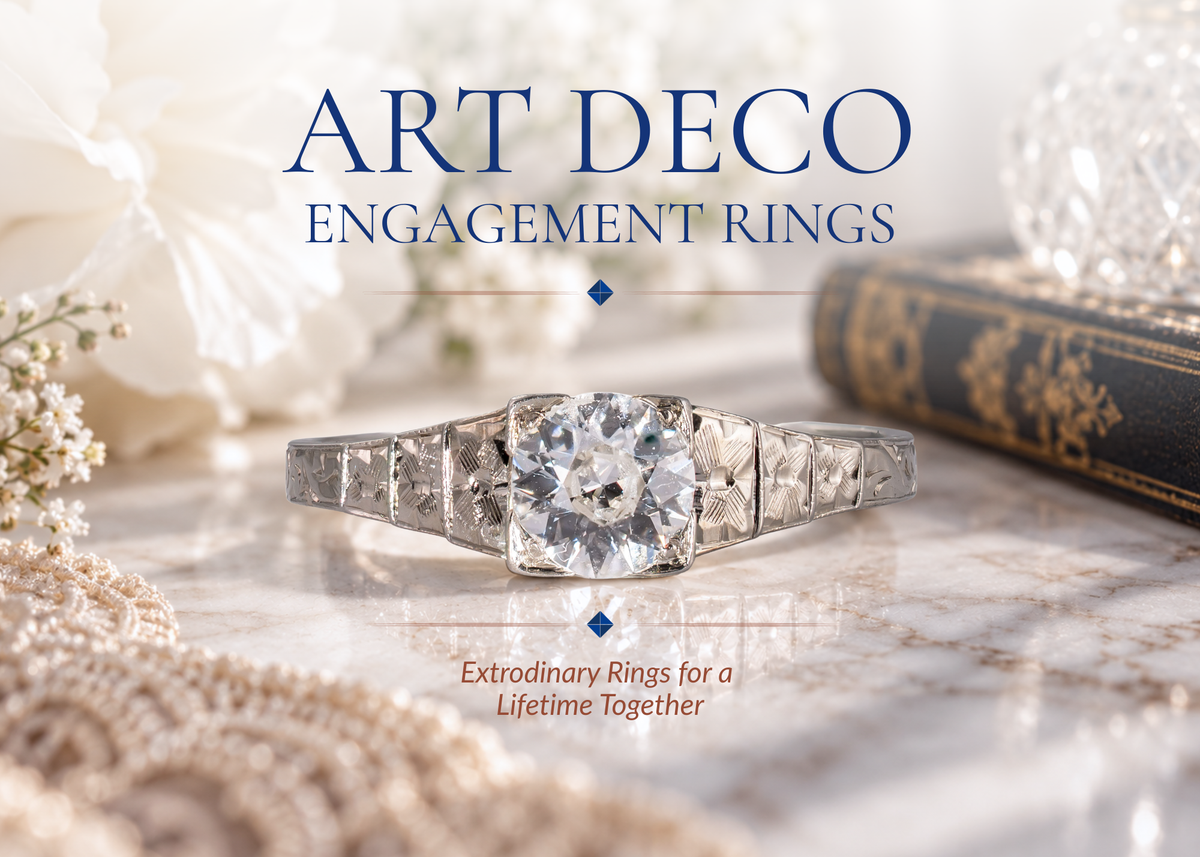
An authentic Art Deco engagement ring (circa 1920–1935) is defined by architectural geometry, hand-pierced filigree, fine milgrain work, and period diamond cuts such as Old European or transitional cuts. Unlike modern solitaires focused strictly on center carat weight, an authentic 1920s ring functions as a complete piece of wearable art where platinum or white gold mountings and geometric gemstone borders share equal prominence with the diamond.
Contents
In This Guide
- Why Choose an Antique Art Deco Engagement Ring?
- What Makes an Engagement Ring Art Deco?
- How I Determine Whether an Art Deco Ring Is Really Art Deco
- Antique Jewelry Is Perfectly Imperfect
- Turn the Ring Over: Why the Undergallery Matters
- Art Deco Diamonds: Personality Over Perfection
- Sapphires, Emeralds, and Rubies in Art Deco Engagement Rings
- Platinum, White Gold, and the Architecture of Art Deco
- Can You Wear a 100-Year-Old Art Deco Engagement Ring Every Day?
- Can an Art Deco Engagement Ring Be Resized?
- Alternative Art Deco Engagement Rings
- Choosing a Wedding Band for an Art Deco Engagement Ring
- Caring for an Antique Art Deco Engagement Ring
- What Are You Actually Buying for $2,000–$3,000?
- How I Choose Art Deco Engagement Rings for The TERA Collection
- Frequently Asked Questions About Art Deco Engagement Rings
There is nothing wrong with a classic diamond solitaire. It became a classic for a reason. But walk into almost any jewelry store today and you will see variations of the same basic idea: a relatively simple setting designed to put as much attention as possible on the center diamond.
For some people, that is exactly what they want.
For others, an engagement ring should feel more personal.
That is where antique engagement rings—and Art Deco rings in particular—offer something very different. In a genuine 1920s Art Deco engagement ring, the diamond is only part of the design. The setting, proportions, engraving, filigree, milgrain, openwork, and even the architecture beneath the diamond all contribute to the finished piece.
I often think about it this way: imagine attending a wedding with 300 guests wearing a conventional modern engagement ring. There is a reasonable chance that several other rings in the room will look remarkably similar.
Walk into that same room wearing an authentic 100-year-old Art Deco ring, and the chances of seeing another one just like it are almost nonexistent.
That individuality is one of the things that first drew me to antique jewelry.
But buying a genuine antique ring requires a different approach than buying a new engagement ring. A seller calling something “Art Deco” doesn’t necessarily make it Art Deco. Age alone doesn’t make a ring valuable. Filigree alone doesn’t make a ring authentic. And a ring being 100 years old certainly doesn’t mean it is too fragile to wear.
This guide is about what I actually look for when buying Art Deco rings for The TERA Collection—and what I think you should understand before choosing one as your engagement ring.
Why Choose an Antique Art Deco Engagement Ring?
When I look at an Art Deco ring, the first thing that gets my attention isn’t necessarily the size of the diamond.
It’s the design.
I look for symmetry, balance, and detail. I want the different elements of the ring to work together rather than compete with one another.
That is something I think many modern interpretations of Art Deco jewelry get wrong.
There are plenty of new rings described as “Art Deco style,” but too often the designer seems to have taken every recognizable Art Deco element—filigree, milgrain, geometric shapes, engraving, halos—and tried to fit all of them into a single ring.
They have the vocabulary of Art Deco without understanding its design language.
Great Art Deco jewelry can be incredibly elaborate, but the best pieces still have discipline. There is a reason for every line. Symmetry gives the eye somewhere to rest. The center stone works with the mounting rather than fighting against it.
And sometimes the most compelling antique Art Deco engagement rings aren’t particularly elaborate at all.
A beautifully proportioned 1920s filigree solitaire can have a single diamond, delicate openwork through the shoulders, and subtle hand engraving. It may look relatively simple at first glance. Look closer, however, and you begin to see why it could be difficult to reproduce properly today.
That is what I mean by design.
It isn’t about adding more.
It is about making everything belong.

What Makes an Engagement Ring Art Deco?
The Art Deco period is generally associated with the 1920s and 1930s, although jewelry design did not suddenly change when the calendar reached 1920.
There was a transition.
Classic Edwardian engagement rings could be delicate, airy, and almost lace-like. As tastes changed, those ideas increasingly met the stronger geometry, symmetry, and architectural forms we associate with Art Deco.
That transition produced some of my favorite rings.
Antique engagement rings from the 1920s can incorporate delicate pierced work inherited from Edwardian jewelry while introducing stronger geometric shoulders, structured borders, or a more architectural presentation of the center diamond.
Common characteristics can include:
- Platinum and white-gold construction
- Pierced openwork and filigree
- Fine milgrain borders
- Hand engraving
- Geometric and highly symmetrical layouts
- Octagonal, square, rectangular, shield, and navette forms
- Stepped shoulders
- Low-profile diamond settings
- Old European Cut and transitional diamonds
- French-cut or calibré colored-stone accents
But this is where buyers need to be careful.
Finding one of these characteristics does not make a ring Art Deco.
A modern reproduction can have filigree. A 1950s ring can have engraving. A modern ring can have an octagonal halo.
I never identify an antique ring from one feature.
I look at the ring in its entirety and ask whether all of its parts tell the same story.
How I Determine Whether an Art Deco Ring Is Really Art Deco
I buy quite a bit of jewelry through online auctions and estate sources, and I learned very quickly not to accept a seller’s description as fact.
If an auction calls a ring “Art Deco,” that is a starting point—not a conclusion.
I usually start with the diamond.
Does the stone make sense for the period?
In an original Art Deco diamond ring, I would expect to encounter Old European Cut diamonds, transitional cuts, and other period-appropriate stones depending on exactly when the ring was made.
If I see an obvious modern round brilliant sitting in what is supposed to be an untouched 1920s ring, I immediately start asking questions.
That doesn’t necessarily mean the mounting isn’t antique. Stones get lost. Engagement rings get damaged. Diamonds get replaced. Jewelry has lives.
But now the diamond and the mounting aren’t telling me the same story.
Occasionally I will buy a ring like that if I believe I can source an appropriate antique diamond and restore the integrity of the piece. Often, however, the economics simply don’t make sense.
Then I look at the design.
Does the architecture make sense for the claimed period?
I look at proportions, symmetry, shoulders, engraving, filigree, and the relationship between the center stone and mounting.
Only then do individual decorative elements become meaningful.
This is an important distinction because it is very easy to recognize filigree and think Art Deco. That same filigree could appear on a modern reproduction.
The question isn’t simply:
Does this ring have Art Deco details?
The better question is:
Does this ring make sense as a complete piece of Art Deco jewelry?
To see the full authentication checklist, hallmarks, and testing methods I use, explore our complete guide on how to identify authentic Art Deco jewelry.

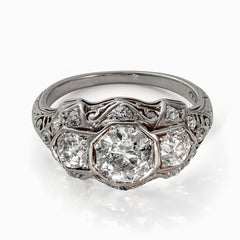
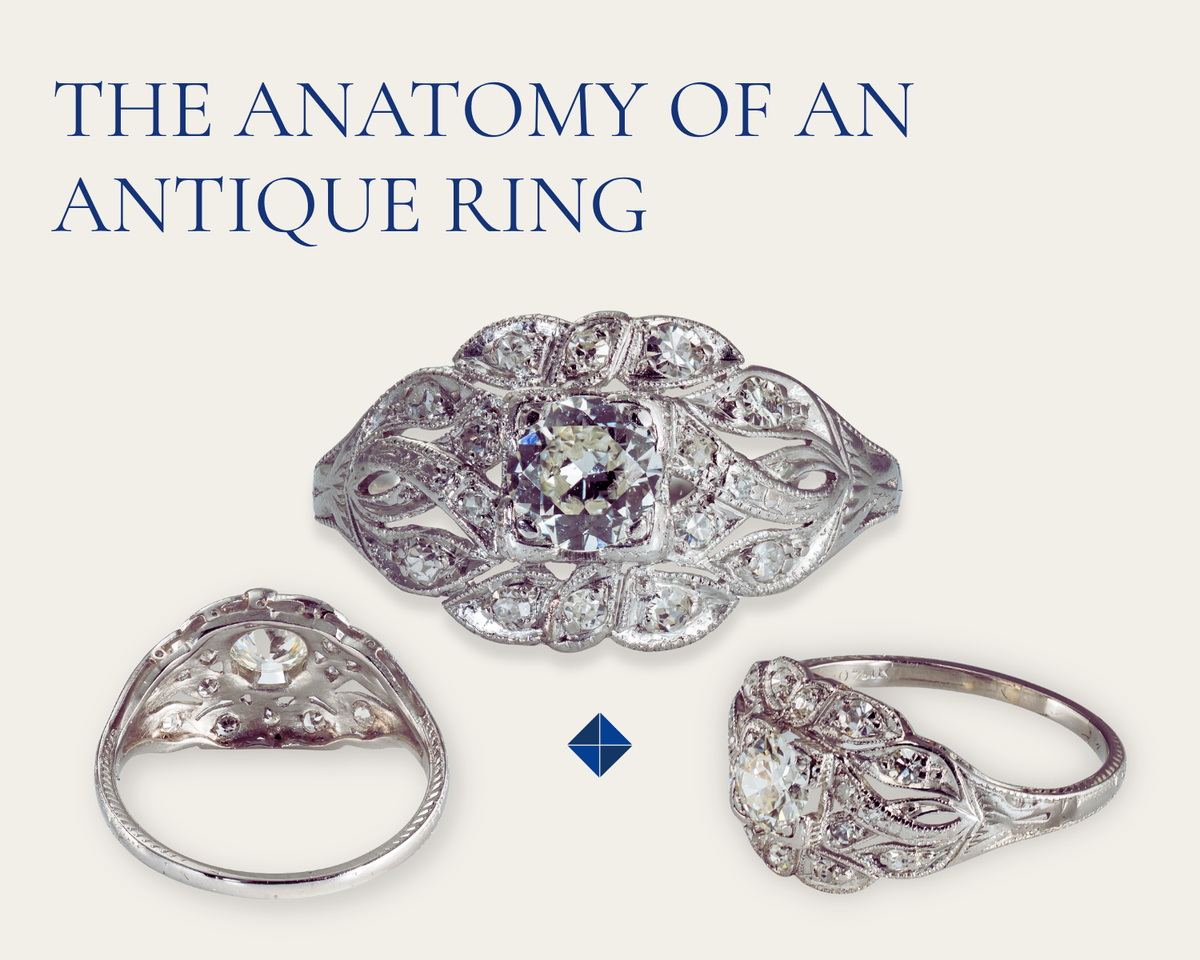
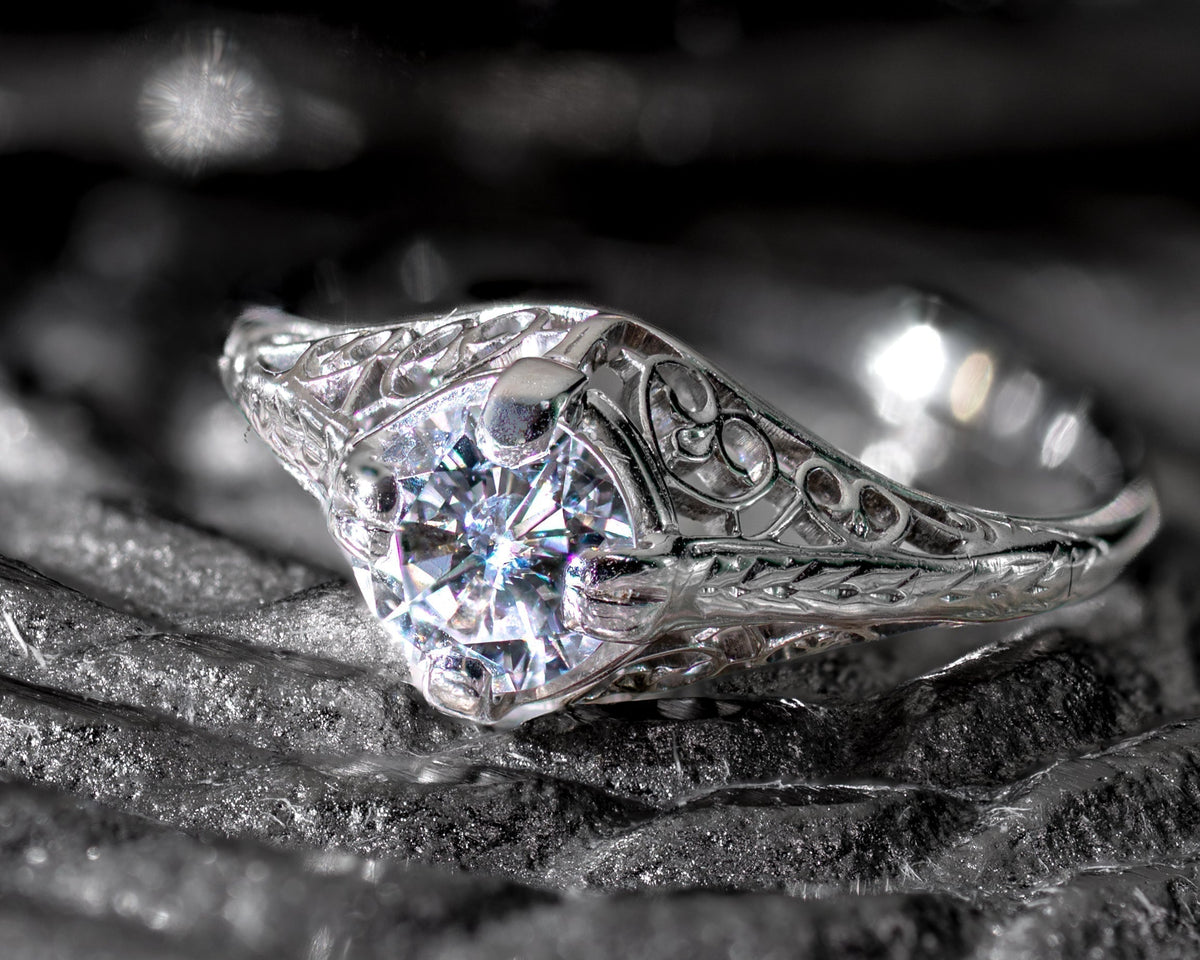
Rather than letting the center stone stand alone, this 1920s Art Deco engagement rings setting makes the mounting an equal part of the jewel—balancing architectural geometry with airy, hand-pierced openwork.
Antique Jewelry Is Perfectly Imperfect
One of my favorite expressions when examining antique jewelry is perfectly imperfect.
Early jewelry required an extraordinary amount of skilled handwork. When you examine genuine period pieces closely, that human involvement often reveals itself.
Openings in pierced work may not be perfectly identical. One scroll may differ subtly from its partner. Tiny holes aren’t necessarily perfectly round. Milgrain may wander slightly. Filigree that appears beautifully symmetrical to the naked eye can reveal subtle differences from one side to the other under magnification.
Those aren’t necessarily defects.
They can be evidence of how the ring was made.
By comparison, a modern cast reproduction can sometimes be too perfect—or display the softer, rounded character that casting can impart to details that should appear crisp.
That doesn’t mean imperfection proves age, either.
This is where people can get themselves into trouble when identifying antique jewelry. No single clue authenticates a ring.
Perfectly imperfect workmanship is evidence. The diamond is evidence. The design is evidence. Construction is evidence. The undergallery is evidence. Hallmarks can be evidence.
They all have to be considered together.
Turn the Ring Over: Why the Undergallery Matters
One of the first things I do when examining an antique ring is turn it over.
The top tells you what the designer wanted you to see.
The underside can tell you how the jeweler got there.
The undergallery is one of the most revealing areas of an antique ring because it can expose details of construction that are less obvious from the face-up view.
I’m looking closely at the crispness of the work.
Hand-pierced or die-cut openings can have a different character from cast reproductions. Under magnification, I look for the same perfectly imperfect qualities I see elsewhere: openings that aren’t absolutely identical, slight variations from side to side, crisp edges, and evidence that somebody actually worked and finished the metal.
A modern reproduction may imitate the appearance of antique openwork from the top.
It is much harder for it to imitate the entire story of how an antique ring was constructed.
Again, the undergallery doesn’t date the ring by itself.
It becomes another chapter in the same story.

Art Deco Diamonds: Personality Over Perfection
The thing I love most about antique diamonds is personality.
Old diamonds weren’t laser-cut to proportions calculated by a computer. A cutter worked with an individual piece of rough and made decisions about that particular stone.
As a result, two antique diamonds of approximately the same diameter and weight can behave very differently.
You may encounter differences in:
- Table size
- Crown height
- Culet size and position
- Facet shape
- Symmetry
- Depth
- Overall outline
- Light return and facet pattern
Those variations are part of their charm.
Old European Cut Diamonds
The Old European Cut, or OEC, is one of the stones most closely associated with late antique and early 20th-century jewelry.
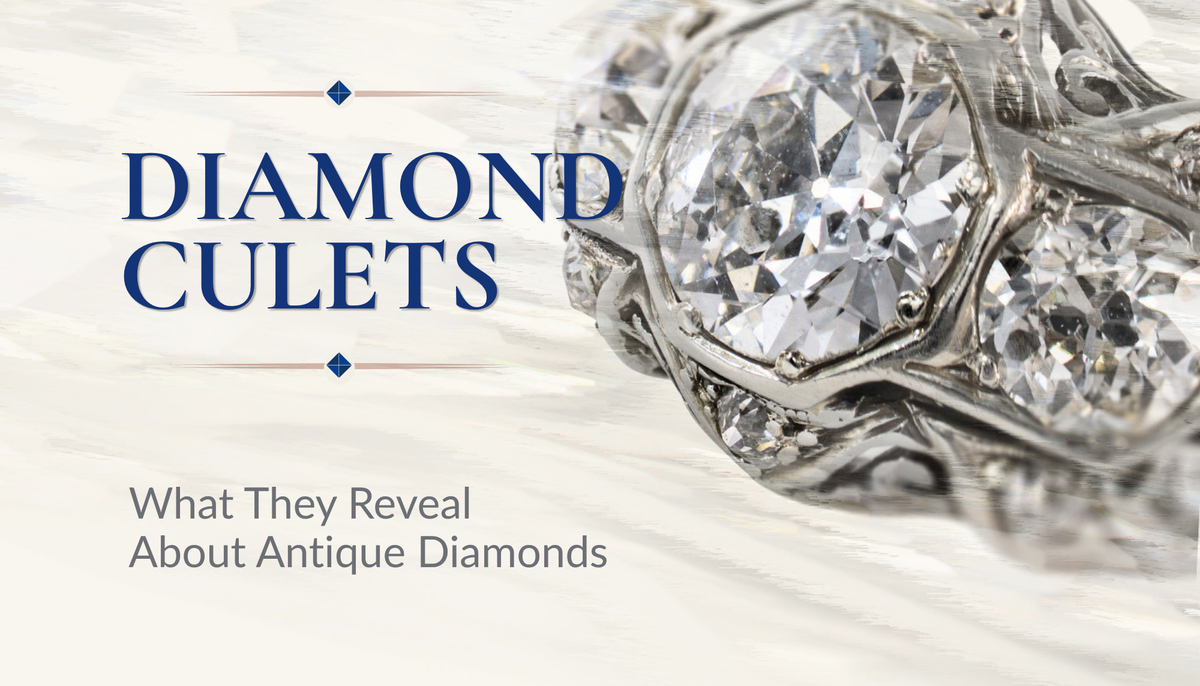
Rather than the splintery appearance you can see in some modern brilliant cuts, a beautiful OEC can produce broad, chunky flashes of light. Many have smaller tables, higher crowns, and visible open culets.
I particularly enjoy stones where the facet pattern develops almost a floral quality around the culet.
Transitional Cut Diamonds
Transitional diamonds are especially important when evaluating vintage engagement rings from the 1920s.
Diamond cutting didn’t move directly from Old European to modern brilliant overnight. It evolved. Cutters developed the Transitional Cut diamond as proportions evolved toward the modern brilliant.
Transitional stones occupy that fascinating territory where cutters experimented with proportions and facet relationships that would eventually lead to the modern round brilliant.
Some look OEC predominantly. Others look considerably more modern.
That variation is precisely why I don’t date a ring from the diamond alone.
Antique Diamonds and the 4Cs
The modern 4Cs still apply to antique diamonds. Color, clarity, cut, and carat weight are useful information.
But they don’t tell the entire story.
An antique diamond might have warmer color, imperfect symmetry, an off-center culet, or proportions that would not be considered ideal by modern round-brilliant standards.
That doesn’t necessarily make it a lesser diamond.
Sometimes those characteristics are exactly what give the stone its personality.
For an antique engagement ring, I am interested in what the diamond does inside the ring, not simply how impressive its specifications look on paper.
Natural Antique Diamonds in a Lab-Grown World
Lab-grown diamonds have changed the modern engagement-ring market dramatically. They allow buyers to purchase substantially more diamond for their money, and for someone whose priority is size, that can be very appealing.
But that’s almost the opposite of what attracts me to antique jewelry.
A natural antique diamond is finite.
The stone was mined, cut by an individual craftsman generations ago, set into a piece of jewelry, and survived to reach us today.
There isn’t a production line making another batch of them.
To me, an antique diamond can be as individual as the person who chooses it.
That doesn’t mean everybody should prefer an antique natural diamond. But if rarity, history, and individuality matter to you, comparing antique diamonds purely on carat size misses much of what you’re buying.

The tall, symmetrical crown of the Old European Cut made it the defining diamond of the Art Deco era. The gap between it and the modern brilliant was bridged by transitional cut diamonds, which gradually lowered the crown as cutting techniques evolved.
Sapphires, Emeralds, and Rubies in Art Deco Engagement Rings
Diamonds weren’t the only stones used to create extraordinary Art Deco jewelry.
Sapphires, emeralds, and rubies could provide dramatic contrast against platinum and diamonds. French-cut and calibré colored stones were particularly well suited to the geometric vocabulary of Art Deco design and can be found fitted into borders, channels, and other architectural elements.
You will also encounter Art Deco rings with colored gemstones as their primary stones.
An Art Deco emerald ring, for example, can make a spectacular alternative engagement ring, particularly when the emerald is integrated into a geometric platinum-and-diamond mounting.
Sapphire and ruby rings can be equally compelling, whether the colored gemstone dominates the design or provides contrast around an antique diamond.
There is another important point for antique buyers:
A synthetic colored gemstone does not automatically mean a ring is a modern reproduction.
Synthetic rubies and sapphires existed during the Art Deco period and were used in genuine period jewelry. The presence of a synthetic stone therefore has to be considered alongside the construction, design, and other evidence—just like everything else.
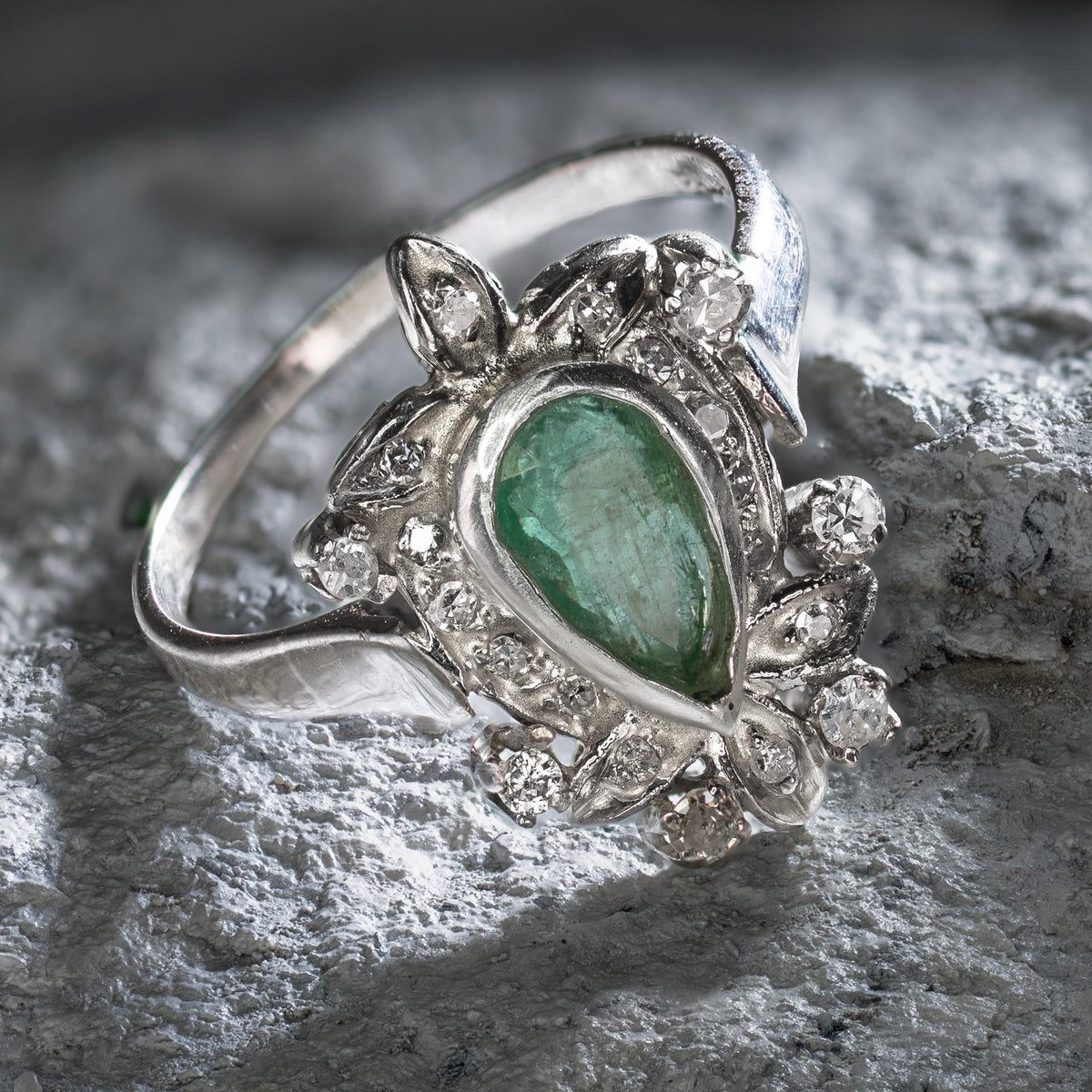
A striking alternative to diamonds: this 1920s Art Deco engagement ring balances a deep blue sapphire with intricate, lace-like openwork pierced through the undergallery and shoulders.
Platinum, White Gold, and the Architecture of Art Deco
Platinum was ideally suited to the fine, architectural jewelry of the Art Deco period.
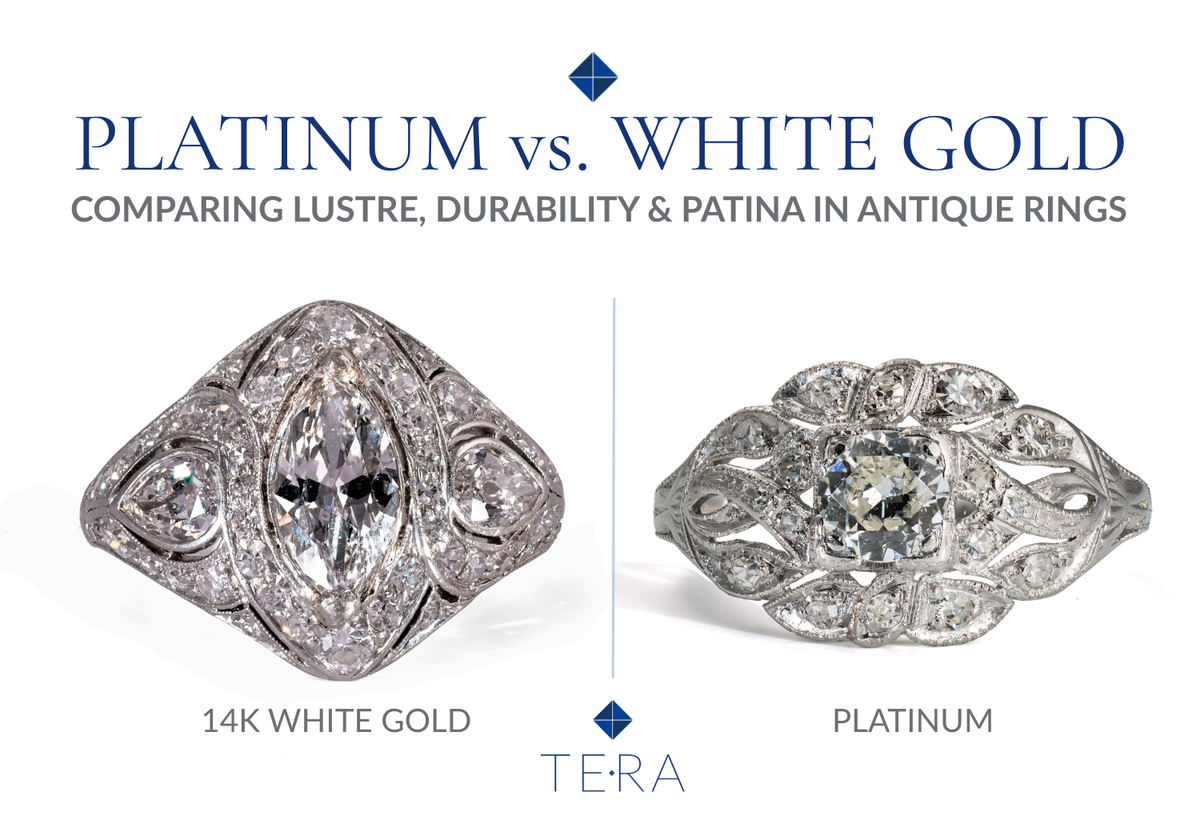
Its strength allowed jewelers to create surprisingly delicate structures while securely holding diamonds and gemstones. Fine pierced galleries, narrow milgrain borders, and intricate openwork could give an Art Deco platinum diamond ring tremendous visual presence without requiring a massive amount of metal.
White gold also became increasingly important during the period and appears in many beautiful Deco rings.
While yellow gold is strongly associated with earlier Victorian jewelry, antique gold engagement rings from the early 20th century can appear in white gold as well as yellow gold, and the metal itself becomes another clue when evaluating a piece.
This is another reason I encourage buyers to look beyond carat weight.
A relatively modest center diamond can look spectacular when it is incorporated into a beautifully proportioned architectural setting.
The setting isn’t merely there to hold the diamond.
The setting is part of the jewel.
Can You Wear a 100-Year-Old Art Deco Engagement Ring Every Day?
Absolutely—if you buy the right ring in the right condition.
I have handled Victorian rings that are 150 years old or more and still look amazing on the hand.
People sometimes assume that antique automatically means fragile. I don’t think that’s a useful way to look at it.
Condition matters much more than age.
A prong can loosen on a ring made in 1925, and a prong can loosen on a ring made in 2025. A stone can shift. A ring can take a hard hit against a countertop. Metal can bend. Impact damage does not care how old the ring is.
In other words, the basic risks of wearing an engagement ring every day are not unique to antique jewelry.
What matters is whether the ring is structurally sound when you buy it, whether the stones are secure, whether previous repairs were done properly, and whether you continue to have the ring inspected over time.
A well-preserved 100-year-old ring with healthy prongs and a sound shank may be a far better everyday-wear candidate than a newer ring with poor construction or neglected maintenance.
The important thing is knowing what you’re buying—and taking care of it once it is yours.
What I Inspect Before Offering an Antique Ring for Sale
My jewelry photography is extremely detailed. I use highly focused macro photographs that can reveal imperfections you would never notice while wearing the ring.
That’s intentional.
A century of tiny scratches can look dramatic under extreme magnification while being virtually invisible on the finger.
I care much more about structural condition.
The Shank
The bottom of the shank is one of the first places I look for wear because it has spent decades rubbing against everything the wearer touched.
A thin shank isn’t necessarily fatal. A portion of the shank can sometimes be replaced properly.
Prongs and Stone Security
This is more important.
If I have any question about the prongs or security of a stone, the ring goes to my bench jeweler for inspection.
Losing an antique diamond because somebody ignored a worn prong is an avoidable problem.
Filigree and Openwork
Cracked, distorted, or previously damaged filigree can become expensive very quickly.
I once bought a ring that turned out to have cracked filigree that was out of alignment, along with two previous poor repairs that needed to be redone. The auction photographs weren’t good enough to reveal the extent of the problem.
A talented bench jeweler can perform remarkable restoration work.
But restoration has economics too.
Sometimes a ring can be saved beautifully. Sometimes previous repairs have compromised the piece enough that I would rather walk away.
Previous Alterations
A replaced head or major alteration makes me look much more carefully at a ring.
Jewelry has been repaired for centuries, so evidence of repair doesn’t automatically disqualify a piece. What matters is what was done, how well it was done, and whether the repair preserved or damaged the original architecture.
For The TERA Collection, my goal is to offer antique and vintage rings that can actually be worn. I would rather absorb the cost of an unexpected repair—even when it leaves very little profit in the ring—than knowingly pass that repair along to the buyer.
Can an Art Deco Engagement Ring Be Resized?
This is one of the questions I receive where the most accurate answer is:
It depends on both the ring and the jeweler.
Not all bench jewelers are created equal.
I work with a bench jeweler who can do things with antique jewelry that many jewelers simply wouldn’t attempt. I’ve had an elaborate platinum ring with openwork successfully increased approximately three sizes.
I’ve also purchased an extremely elaborate size 3 ring after discussing it with him first. He was confident he could bring it to approximately a size 7 while preserving the integrity of the design.
I would not assume that every jeweler could—or should—attempt that job.
One or Two Sizes?
For many antique rings, moving approximately one size should be relatively straightforward for a jeweler experienced with antique jewelry. Two sizes may also be very reasonable depending upon the construction.
Beyond that, I want an experienced bench jeweler’s opinion.
The shoulders are particularly important.
When the circumference of the ring changes substantially, the shoulders may need to be reworked so the design remains balanced. Elaborate filigree, engraving, or gemstones extending down the shoulders can make the job considerably more complicated.
Simply making the ring physically larger isn’t enough.
The ring still has to look right when the work is finished.
If you fall in love with an antique ring that isn’t your size, don’t automatically assume it can’t work. Talk to someone who understands antique jewelry.
With rings in The TERA Collection, I’m always willing to have that conversation. If necessary, I’ll get my bench jeweler’s opinion, and when appropriate, I can arrange sizing at cost.
Alternative Art Deco Engagement Rings
One of the freedoms of choosing an antique engagement ring is that you don’t have to choose something that was originally marketed as an engagement ring.
Consider a long three-stone Art Deco navette ring.
It may have been sold as a dinner ring or simply a diamond ring in its own time. Today, it can make an extraordinary alternative engagement ring.
And this is where carat weight becomes almost irrelevant to understanding the design.
Look at a beautifully executed navette and the diamonds are only part of what you’re seeing. The elongated outline, pierced filigree, engraving, milgrain, negative space, and diamonds work together to create the visual impact.
Remove those diamonds and put them into three ordinary settings and you haven’t recreated the ring.
You have removed the very thing that made it special.
That is why antique and vintage engagement-ring styles are particularly interesting for someone who doesn’t want a conventional solitaire.
Your engagement ring doesn’t have to look like everybody else’s engagement ring.
It has to look like yours.
 |
 |
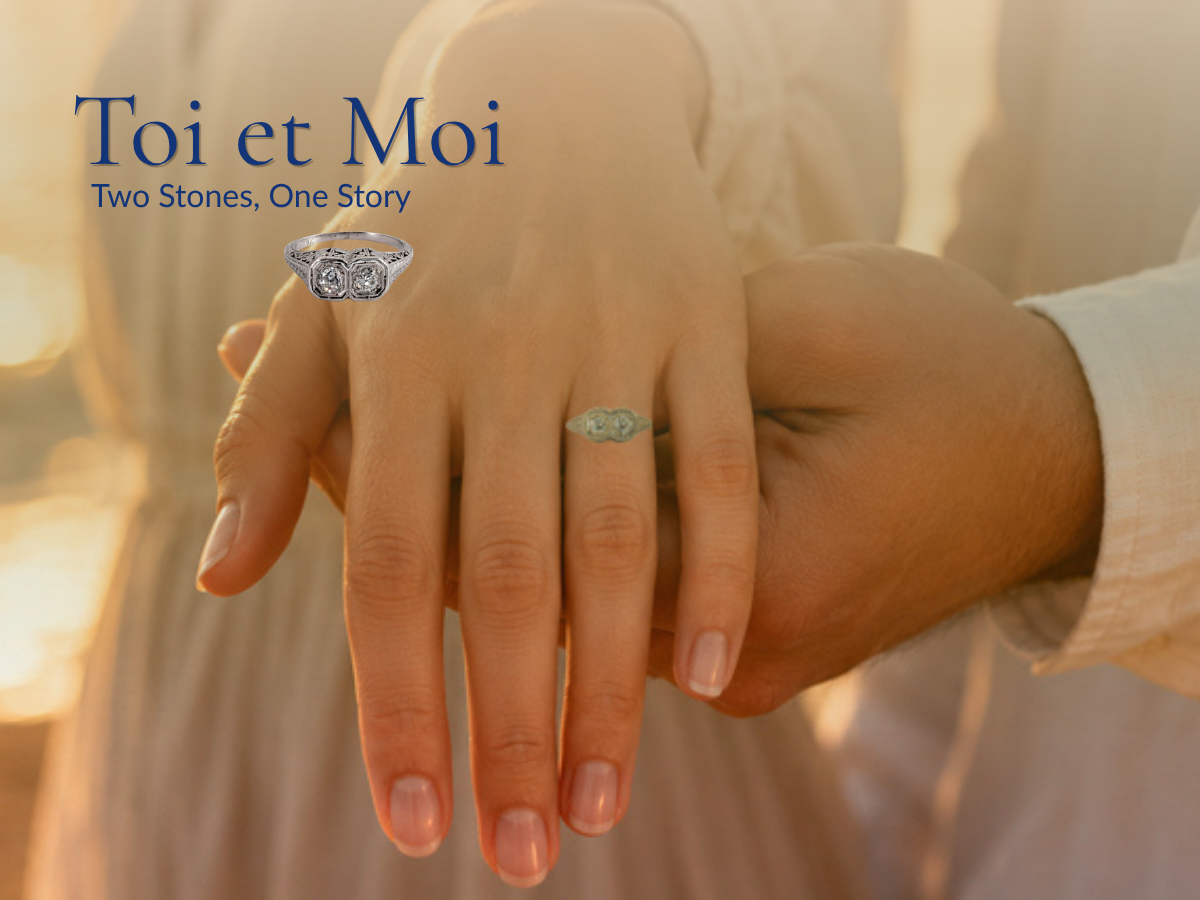
Beyond the classic solitaire: elongated navette rings and domed cluster plaques offer striking alternatives for the Art Deco bride seeking a unique engagement ring. Instead of relying on a single towering prong setting, these 1920s silhouettes disperse diamonds across the finger in a low-profile, hand-detailed design that pairs major visual presence with effortless everyday wear.
Choosing a Wedding Band for an Art Deco Engagement Ring
Pairing an antique engagement ring with a wedding band requires a little thought.
Some Art Deco rings will sit beautifully beside a straight band. Others have low galleries, projecting shoulders, or unusual outlines that create a gap.
That isn’t necessarily a problem.
Period engraved bands, slender platinum or gold bands, curved bands, and antique wedding rings can all work depending on the engagement ring.
When creating an Art Deco wedding ring set, I wouldn’t automatically force a modern straight band against an intricate antique mounting simply because the two rings are expected to sit perfectly flush.
I prefer to consider the engagement ring’s architecture first.
Also pay attention to where the two rings make contact. A harder edge repeatedly rubbing against delicate engraving, filigree, or gemstone settings can cause unnecessary wear over time.
The goal should be the same as the goal of the engagement ring itself:
Balance.
Caring for an Antique Art Deco Engagement Ring
Antique jewelry doesn’t need to live in a safe.
It does need sensible care.
For routine home cleaning, gentle methods are generally preferable: warm water, mild dish soap, and a very soft brush, provided the gemstones themselves are appropriate for that treatment.
I would not automatically put an antique ring into an ultrasonic cleaner simply because the machine is available. The appropriate cleaning method depends on the gemstones, settings, condition, and any previous repairs.
More importantly, establish a relationship with a good bench jeweler.
Routine inspection matters whether your engagement ring is antique or brand new.
Whether your engagement ring is new or antique, have it inspected periodically. Ask the jeweler to check the prongs, stone security, and overall condition while cleaning it.
Head off problems before they become repairs.
What Are You Actually Buying for $2,000–$3,000?
This may be the most important question in this entire guide.
The modern engagement-ring market increasingly allows someone with a few thousand dollars to buy a very large diamond, particularly if they choose lab-grown.
If your priority is maximizing carat weight, that is difficult for an antique ring to compete with.
But that isn’t the competition I’m interested in.
With a genuine antique Art Deco engagement ring, you’re buying the entire piece.
You’re buying a natural diamond with its own personality.
You’re buying handwork.
You’re buying the slight variations left behind by craftsmen.
You’re buying engraving and filigree that have survived generations.
You’re buying an object from a particular moment in design history.
You’re buying something that can’t simply be ordered again in another size next Tuesday.
Most importantly, you’re buying design.
A beautiful antique ring doesn’t need a huge diamond to have presence because the jeweler wasn’t relying on the diamond to do all the work.
The stone and the setting were designed to work together.
That difference is fundamental.
How I Choose Art Deco Engagement Rings for The TERA Collection
I don’t buy a ring simply because someone tells me it’s Art Deco.
I don’t buy it simply because it has an Old European Cut diamond.
And I certainly don’t buy it simply because it has filigree.
I look at the entire piece.
Does the design have balance?
Does the stone make sense?
Does the construction support the proposed age?
What does the undergallery tell me?
Does the handwork have the character I expect?
Have there been repairs?
Are the stones secure?
Is the shank healthy?
Can the ring realistically be worn?
And finally:
Would I be excited to put this ring on someone’s hand?
That’s ultimately what The TERA Collection is about for me.
There are plenty of old rings.
I am looking for the ones that still have something to say.
Frequently Asked Questions About Art Deco Engagement Rings
What years are considered Art Deco for engagement rings?
Art Deco jewelry is primarily associated with the 1920s and 1930s, but jewelry styles evolved gradually. Transitional pieces can combine the delicacy of late Edwardian jewelry with increasingly geometric Art Deco design.
How can you tell if an Art Deco engagement ring is authentic?
Don’t rely on a single characteristic. Examine the diamond, overall design, construction, filigree, engraving, milgrain, undergallery, and evidence of hand finishing together. Hallmarks can provide useful supporting information, but I would never authenticate or date a ring from a hallmark alone.
What diamond cuts are found in Art Deco engagement rings?
Old European Cut and transitional diamonds are commonly encountered, along with other period cuts. The appropriate diamond depends on when the ring was made. An obvious modern brilliant in an otherwise antique mounting may indicate a later replacement.
Are Art Deco engagement rings durable enough for everyday wear?
Many are. Condition matters more than age alone. Prongs can loosen, stones can shift, and impact damage can happen to a brand-new ring just as it can to an antique one. Prongs, bezels, shank thickness, filigree, and previous repairs should all be inspected before an antique ring is relied upon for everyday wear.
Can Art Deco engagement rings be resized?
Many can. Approximately one size is often relatively straightforward, and two may be possible depending on the ring. More substantial changes can sometimes be accomplished by a highly skilled bench jeweler, but elaborate shoulders, filigree, engraving, and gemstone placement make resizing increasingly complex.
Are all Art Deco rings made from platinum?
No. Platinum is strongly associated with Art Deco jewelry, but beautiful period rings were also made in white gold and other precious metals.
Can an Art Deco ring contain synthetic gemstones and still be antique?
Yes. Period synthetic sapphires and rubies existed and were used in genuine antique jewelry. A synthetic colored stone alone does not prove that a ring is a modern reproduction.
Are antique Art Deco rings more expensive than modern engagement rings?
Not necessarily. Antique rings exist across a broad range of prices.
More importantly, the comparison isn’t always apples to apples. With an antique ring, a substantial portion of the value may lie in the period craftsmanship, rarity, design, and complete jewel rather than simply the center stone’s carat weight.
Find an Art Deco Engagement Ring That Doesn’t Look Like Everyone Else’s
An engagement ring is one of the few pieces of jewelry someone may wear virtually every day for the rest of her life.
I think it's worth looking at.
For some people, that will always mean a beautiful modern solitaire.
For others, it means finding a ring made generations ago—one with a natural antique diamond, hand-worked details, a little perfectly imperfect craftsmanship, and an architecture unlikely to ever be repeated exactly.
That’s what makes authentic antique engagement rings from the Art Deco era so compelling.
You aren’t choosing a reproduction of the past.
You’re choosing an original that survived it.


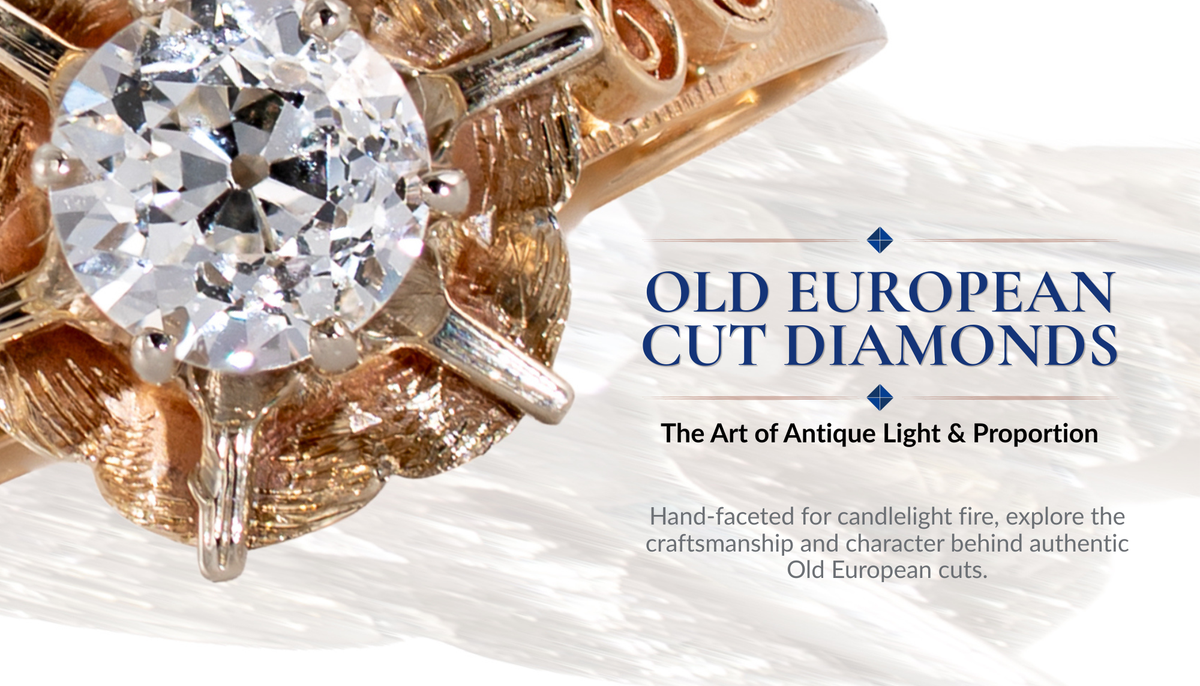
An Old Mine Cut diamond is a hand-cut antique diamond developed in the late 18th century and remained one of the most popular diamond cuts throughout much of the 19th century. It is recognized by its cushion-shaped outline, high crown, small table, deep pavilion, large open culet, and broad, chunky facets. As one of the earliest brilliant-style diamond cuts, it represents an important milestone in the evolution of diamond cutting.
A late Victorian Ring featuring an Old Mine Cut Diamond
Unlike modern diamonds, which are cut to mathematically precise proportions using advanced technology, every authentic Old Mine Cut was fashioned entirely by hand. Diamond cutters worked with the natural shape of each rough crystal, balancing beauty, durability, and weight retention rather than pursuing perfect symmetry. The result was a diamond with remarkable individuality—no two authentic Old Mine Cut diamonds are exactly alike.
Those subtle differences in symmetry, proportions, and facet arrangement are not imperfections. They are evidence of the individual craftsman who shaped the stone, giving each diamond a character that modern precision cutting cannot reproduce. More than two centuries later, that handcrafted quality continues to attract collectors, antique jewelry enthusiasts, and anyone who appreciates the artistry of historic jewelry.
Authentic Old Mine Cut diamonds have also become increasingly scarce. During the late 19th and 20th centuries, many were recut into Old European Cuts and, later, modern round brilliant diamonds to satisfy changing tastes and improve light performance. While modern cutters continue to produce diamonds inspired by the Old Mine Cut, every authentic antique example represents a finite piece of jewelry history.
Old Mine Cut Diamonds at a Glance
Before exploring the history and identifying characteristics in greater detail, here's a quick overview of the features that define an Old Mine Cut diamond. While every authentic example is unique, most share these recognizable characteristics.
Defining characteristics of an Old Mine Cut Diamond include a small table and a large irregular culet.
While no two Old Mine Cut diamonds are identical, these characteristics provide a useful starting point for identification. Because each stone was cut by hand rather than to standardized proportions, slight variations in shape, symmetry, and facet arrangement are expected. Those subtle differences are part of what gives authentic Old Mine Cut diamonds their enduring charm and individuality.
Why Is It Called an Old Mine Cut?
Interestingly, the jewelers who originally fashioned these diamonds never referred to them as Old Mine Cuts. The name became popular much later, after major diamond discoveries in South Africa transformed the jewelry industry during the late 19th century.
Before those discoveries, most of the world's diamonds came from the historic mines of India and, later, Brazil. As newer sources of rough diamonds entered the market and cutting styles continued to evolve, jewelers needed a way to distinguish the older hand-cut stones from the more modern brilliant cuts that were beginning to appear.
The term Old Mine Cut simply referred to diamonds cut from material that originated from the "old mines." Over time, the name became associated not with the source of the rough diamond, but with the distinctive cutting style itself. Today, it describes one of the most recognizable and historically important antique diamond cuts.
When Were Old Mine Cut Diamonds Popular?
Old Mine Cut diamonds rose to prominence during the late Georgian period in the late 18th century and remained the dominant diamond cut throughout much of the Victorian era. Their popularity lasted for well over a century, making them one of the defining features of antique jewelry from this period.
During the late 19th century, advances in diamond-cutting techniques produced stones with greater symmetry and improved light performance. This gradual evolution led to the development of the Old European Cut, which became the preferred style during the Edwardian and Art Deco periods before eventually evolving into the modern round brilliant.
Many Old Mine Cut diamonds did not survive this transition. As fashions changed, countless stones were recut into newer shapes to increase their brilliance, often sacrificing carat weight and permanently erasing the features that made them unique. That is why well-preserved Old Mine Cut diamonds—especially those that remain in their original period mountings—have become increasingly desirable among collectors and lovers of antique jewelry.
How Can You Identify an Old Mine Cut Diamond?
Identifying an Old Mine Cut diamond becomes much easier once you know what to look for. While no two examples are identical, authentic Old Mine Cuts share several defining characteristics that separate them from modern diamonds and even other antique cuts. Being able to identify an Old Mine Cut stone is also a strong indicator of authentic antique jewelry.
Unlike today's precision-cut diamonds, Old Mine Cuts were fashioned entirely by hand. Diamond cutters relied on experience rather than mathematical formulas, working with the natural shape of the rough crystal instead of forcing it into perfect proportions. The result is a diamond with individuality and character—qualities that collectors often value just as much as brilliance.
The easiest way to identify an Old Mine Cut is to look at its overall shape and proportions. Most examples feature a softly rounded cushion outline, a noticeably high crown, a small table, a deep pavilion, and a large open culet that is often visible when looking straight through the stone. Combined with broad, chunky facets, these features produce the bold flashes of light that have made Old Mine Cuts favorites among antique jewelry enthusiasts for generations.
Rather than relying on just one characteristic, it's best to evaluate the diamond as a whole. The more of these features you find, the more likely you are looking at a genuine Old Mine Cut.
The Defining Characteristics of an Old Mine Cut Diamond
The Cushion Shape
Perhaps the easiest feature to recognize is the overall outline of the diamond.
Unlike a modern round brilliant, an Old Mine Cut is typically cushion-shaped, with softly rounded corners and gently curved sides. Some examples appear almost square, while others are slightly rectangular, but perfectly round stones are uncommon.
This shape wasn't chosen for fashion alone. Early diamond cutters tried to preserve as much of the original crystal as possible, removing only enough material to create a pleasing appearance while retaining valuable carat weight. As a result, the finished diamond often reflected the natural shape of the rough crystal rather than an idealized geometric form.
Because every diamond was cut individually, you'll rarely find two Old Mine Cuts with exactly the same outline. That subtle variation is one of the qualities many collectors appreciate most.
The High Crown
Old Mine Cut diamonds are known for their noticeably high crowns.
The crown is the upper portion of the diamond that sits above the girdle. Compared to most modern diamonds, the crown of an Old Mine Cut rises much higher, giving the stone greater depth and a more dramatic profile when viewed from the side.
This high crown contributes significantly to the diamond's personality. It creates larger flashes of light and helps produce the colorful fire that antique diamonds are known for. It also gives Old Mine Cuts a sense of depth that many people find difficult to capture in photographs but striking when viewed in person.
The Small Table
The table is the large flat facet at the top of a diamond.
One of the defining characteristics of an Old Mine Cut is its relatively small table. While modern round brilliant diamonds typically feature much larger tables to maximize light return, Old Mine Cuts retain a smaller opening that emphasizes the height of the crown.
A small table changes the way light enters and exits the diamond. Rather than producing countless tiny flashes of brilliance, it encourages broader reflections and more noticeable fire, especially in lower, warmer lighting conditions.
When comparing an Old Mine Cut to a modern diamond side by side, the smaller table is often one of the first differences you'll notice.
The Deep Pavilion
Beneath the girdle lies the pavilion, the lower portion of the diamond.
Old Mine Cut diamonds typically have a much deeper pavilion than modern diamonds. This greater depth was partly a result of early cutting methods and partly a practical way to retain weight from the original rough crystal.
The deep pavilion also influences the diamond's appearance. Instead of the bright, evenly distributed brilliance of a modern round brilliant, an Old Mine Cut produces larger, slower flashes of light that many collectors describe as warm and romantic.
The Large Open Culet
Perhaps no feature is more closely associated with an Old Mine Cut than its large open culet.
The culet is the tiny facet—or point—at the very bottom of the diamond. Modern diamonds usually have either a microscopic culet or none at all, making the point appear sharp.
Old Mine Cuts are different.
To reduce the risk of chipping during hand cutting and everyday wear, lapidaries often polished a flat facet at the tip of the pavilion. When viewed through the table, this open culet can appear as a small circle or octagonal shape near the center of the stone.
Many first-time buyers mistake the culet for a flaw or even a hole drilled through the diamond. In reality, it is one of the strongest indicators that you're looking at an authentic antique cut.
Large, Chunky Facets
Unlike the many small facets found on a modern round brilliant, an Old Mine Cut features fewer but much larger facets.
These broad facets don't create the rapid "pinfire" sparkle that modern diamonds are famous for. Instead, they produce slower, bolder flashes of white light and colorful fire as the diamond moves.
This type of light performance is one of the defining characteristics of antique diamonds and one of the reasons many enthusiasts prefer them over their modern counterparts.
Hand-Cut Symmetry
If you're accustomed to modern diamonds, an Old Mine Cut may initially appear imperfect.
The outline may not be perfectly symmetrical. The culet may be slightly off-center. Individual facets may vary in size or alignment.
These characteristics are not signs of poor workmanship.
They are evidence that the diamond was fashioned entirely by hand, often using simple tools and natural light. Long before lasers and computer-guided polishing machines existed, every decision was made by an individual craftsman working to reveal the beauty hidden within the rough crystal.
For many collectors, these subtle irregularities are among the most appealing features of an authentic Old Mine Cut.
The Kozibe Effect
One of the most fascinating optical characteristics found in many Old Mine Cut diamonds is something collectors call the Kozibe effect.
When viewed face-up under magnification—or sometimes even with the naked eye—you may notice a repeating pattern of reflections surrounding the open culet. Rather than seeing a single culet, the pavilion facets create multiple mirrored images that appear to radiate around the center of the stone.
Far from being a defect, the Kozibe effect is a hallmark of many antique brilliant cuts with large open culets. Some collectors actively seek it because it highlights the unique optical character of hand-cut diamonds and cannot be replicated in the same way by modern precision-cut stones with tiny or nonexistent culets.
Once you learn to recognize it, the Kozibe effect becomes one of the most charming and distinctive features of an Old Mine Cut.
How to Tell if an Old Mine Cut Diamond Is Authentic
While no single characteristic proves a diamond is an authentic Old Mine Cut, examining several features together can provide a strong indication.
Look for this checklist:
If a diamond displays most or all of these characteristics, there's a good chance you're looking at a genuine Old Mine Cut. In the next section, we'll compare Old Mine Cuts to Rose Cuts, Old European Cuts, modern cushion cuts, and round brilliant diamonds so you can easily distinguish one from another.
Victorian ring with 8 Mine Cut diamonds. The side view shows some classic characteristics including a small table, large chunky facets, and a high crown.
How Does an Old Mine Cut Compare to Other Diamond Cuts?
Why Do Old Mine Cut Diamonds Sparkle Differently?
One of the first things people notice about an Old Mine Cut diamond is that it doesn't sparkle like a modern round brilliant. Instead of producing countless tiny flashes of white light, an Old Mine Cut creates larger, slower flashes that many collectors describe as warm, bold, and full of personality.
That difference isn't the result of poor cutting—it's the result of a completely different approach to diamond cutting.
Modern round brilliant diamonds are engineered using precise mathematical formulas that maximize light return. Every facet is carefully positioned to bounce light back toward the viewer, creating the intense brilliance most people associate with today's diamonds.
Old Mine Cut diamonds were developed more than a century before those calculations existed. Each diamond was shaped entirely by hand, with cutters balancing beauty, durability, and weight retention rather than chasing perfect optical performance.
The result is a diamond that interacts with light in a unique way. Instead of pinfire scintillation, an Old Mine Cut produces broad flashes of white light and colorful fire that many antique jewelry enthusiasts find more natural and expressive than the highly uniform sparkle of modern diamonds.
Were Old Mine Cut Diamonds Designed for Candlelight?
Yes—but not exclusively.
Unlike Rose Cut diamonds, which were developed specifically for a world illuminated by candles, Old Mine Cut diamonds appeared during a period when lighting itself was beginning to change.
Throughout the late Georgian period, candles remained the primary source of indoor light. During the Victorian era, however, gas lighting became increasingly common in homes, businesses, and public buildings. These brighter interiors encouraged diamond cutters to experiment with deeper pavilions, higher crowns, and facet arrangements that reflected more light than earlier cuts.
The Old Mine Cut represents an important step in that evolution.
It offered noticeably greater brilliance than the Rose Cut while retaining the handcrafted character of earlier diamonds. Rather than replacing one lighting environment with another overnight, it bridged two eras, performing beautifully in both candlelight and the brighter gas lighting that became common during the 19th century.
How Diamond Cutting Evolved
Each major antique diamond cut reflects the technology and lighting of its time. As cutting techniques improved and homes became brighter, lapidaries continually refined the way diamonds interacted with light.
Rather than viewing antique diamond cuts as primitive versions of modern diamonds, it's more accurate to see them as milestones in the evolution of diamond cutting. Each reflects the tools, lighting, and aesthetic preferences of its own time.
Old Mine Cut vs. Rose Cut
Although both are antique diamond cuts, the Rose Cut and Old Mine Cut are remarkably different.
A Rose Cut diamond has a flat base and no pavilion. Its triangular facets rise to a single point, producing a soft, romantic glow that was perfectly suited to candlelight.
An Old Mine Cut introduced a deep pavilion, a high crown, and a small table. These changes dramatically increased the amount of light reflected back through the top of the diamond, creating greater brilliance while preserving the handcrafted appearance that defines antique jewelry.
The Old Mine Cut wasn't intended to replace the beauty of the Rose Cut. It represented the next stage in the evolution of diamond cutting.
Old Mine Cut vs. Old European Cut
The Old European Cut evolved directly from the Old Mine Cut during the late 19th century.
While both cuts feature high crowns, small tables, deep pavilions, and open culets, the Old European Cut became noticeably rounder and more symmetrical as cutting techniques improved.
This increased symmetry allowed for more consistent light return and marked another important step toward the modern round brilliant.
If an Old Mine Cut feels organic and handcrafted, an Old European Cut feels more refined while still retaining the charm of an antique diamond.
Old Mine Cut vs. Modern Cushion Cut
Because they share a cushion-shaped outline, Old Mine Cuts are often confused with modern cushion-cut diamonds.
The similarities, however, are mostly limited to their overall shape.
Modern cushion cuts are produced using computer-guided technology and precise mathematical proportions. They typically feature smaller culets—or none at all—and many contain additional facets designed to increase brilliance. Depending on the style, modern cushions may also display a "crushed ice" appearance created by numerous small facets.
An authentic Old Mine Cut is much easier to recognize once you know what to look for. Its higher crown, smaller table, larger open culet, chunky facet pattern, and subtle asymmetry immediately distinguish it from modern cushion cuts.
Old Mine Cut vs. Modern Round Brilliant
Comparing an Old Mine Cut to a modern round brilliant is a comparison of two completely different philosophies of diamond cutting.
Modern round brilliants are designed to maximize brilliance above all else. Every angle and proportion has been optimized to produce the greatest possible light return.
Old Mine Cuts tell a different story.
Rather than pursuing optical perfection, the craftsmen who shaped these diamonds worked with simple tools, natural rough crystals, and the lighting available at the time. Their goal was to create a beautiful diamond while preserving valuable carat weight and respecting the limitations of hand cutting.
For collectors of antique jewelry, those differences are part of the appeal. An Old Mine Cut carries visible evidence of the person who fashioned it centuries ago, something no modern diamond—no matter how perfectly cut—can replicate.
Why Antique Jewelry Enthusiasts Love Old Mine Cut Diamonds
For many people, the appeal of an Old Mine Cut diamond extends far beyond its sparkle.
Each stone was cut by hand at a time when every facet reflected the judgment and skill of an individual craftsman. Slight differences in shape, symmetry, and proportions are reminders that these diamonds were created long before lasers, computer modeling, or standardized cutting formulas existed.
When I evaluate an antique ring, I rarely focus on the diamond by itself. I look at how the entire piece comes together. The handcrafted setting, the engraving, the metalwork, and the Old Mine Cut diamond were designed as a complete work of art. Appreciating one without the others misses much of what makes antique jewelry so special.
That is why I believe an Old Mine Cut should never be compared to a modern diamond solely on brilliance. Its greatest value lies in its craftsmanship, individuality, and history. Every authentic example has survived changing fashions, evolving technology, and generations of recutting to remain exactly what it was intended to be—a remarkable piece of jewelry history.
Value, Buying, and Frequently Asked Questions
Are Old Mine Cut Diamonds Rare?
Yes, authentic antique Old Mine Cut diamonds have become increasingly rare.
While modern diamond cutters continue to produce diamonds inspired by the Old Mine Cut, no new antique Old Mine Cut diamonds are being created. Every authentic example available today was fashioned by hand more than a century ago, making them a finite part of jewelry history.
Their numbers have declined steadily over the years. As diamond-cutting techniques improved during the late 19th and 20th centuries, countless Old Mine Cut diamonds were recut into Old European Cuts and, later, modern round brilliant diamonds. Although these recuts often increased brilliance, they permanently removed carat weight and erased the characteristics that made the original stones unique.
For collectors, originality is especially important. An Old Mine Cut that remains in its original Georgian or Victorian setting is often more desirable than a loose stone or one that has been heavily altered, preserving both the craftsmanship of the diamond and the history of the jewelry itself.
Are Old Mine Cut Diamonds Valuable?
Yes, but they are valued somewhat differently than modern diamonds.
Traditional factors such as carat weight, color, clarity, and condition remain important, but collectors frequently place just as much emphasis on originality, craftsmanship, rarity, and historical significance.
Several factors influence the value of an Old Mine Cut diamond.
Unlike modern diamonds, Old Mine Cuts are rarely judged by laboratory specifications alone. Their individuality and historical integrity often contribute just as much to their appeal.
Antique Old Mine Cut vs. Modern Old Mine Cut
One of the biggest misconceptions today is that every Old Mine Cut diamond is an antique.
That's no longer the case.
As interest in antique jewelry has grown, modern diamond cutters have begun producing newly cut diamonds that intentionally recreate the appearance of historic Old Mine Cuts. These diamonds feature many of the same characteristics—high crowns, small tables, cushion outlines, chunky facets, and open culets—but they are fashioned using modern cutting equipment and contemporary techniques.
Both have their place in today's market.
Modern Old Mine Cuts appeal to buyers who love the antique aesthetic but prefer a newly cut diamond. Authentic antique Old Mine Cuts offer something modern diamonds cannot: genuine history. Every antique example was cut by hand during the Georgian or Victorian era and has survived generations of changing fashion and evolving technology.
Neither is inherently better. The right choice depends on what you value most.
If you're searching for a piece of history, an authentic antique Old Mine Cut is irreplaceable. If you're drawn primarily to the appearance of the cut, a modern interpretation may be an excellent alternative.
Do Old Mine Cut Diamonds Look Larger Than Modern Diamonds?
Often, they do.
Old Mine Cuts typically have high crowns and deep pavilions, so they don't always maximize face-up size the way some modern cuts do. However, their cushion-shaped outline, broad facets, and distinctive pattern of light can create the impression of a larger stone, particularly in handcrafted antique settings.
More importantly, they attract attention differently. Rather than producing countless tiny flashes of light, Old Mine Cuts create bold, colorful flashes that many people find more dramatic and expressive.
Are Old Mine Cut Diamonds Good for Engagement Rings?
Absolutely, provided you appreciate them for what they are.
An Old Mine Cut engagement ring offers something few modern rings can: individuality. Every authentic antique stone was shaped by hand, and no two are exactly alike. Combined with a handcrafted Georgian or Victorian setting, the result is a ring with character, history, and craftsmanship that cannot be mass-produced.
They are also practical for everyday wear when properly set and cared for. Many have already survived well over a century of regular use, demonstrating both the durability of diamonds and the quality of the jewelers who created them.
Choosing an Old Mine Cut engagement ring isn't simply about owning an antique diamond. It's about becoming the next steward of a remarkable piece of jewelry history.
Should You Buy an Antique or Modern Old Mine Cut?
This ultimately comes down to what you value most.
If your priority is owning a diamond with genuine historical significance, an authentic antique Old Mine Cut is difficult to surpass. Every stone was fashioned by hand, carries the subtle marks of its maker, and represents an important chapter in the evolution of diamond cutting.
If, however, you love the appearance of an Old Mine Cut but prefer the consistency of a newly cut diamond, modern Old Mine-style diamonds can be an excellent choice. They capture much of the antique aesthetic while offering the precision and predictability of contemporary cutting.
Personally, if given the choice, I'll almost always gravitate toward the antique example. I appreciate the craftsmanship and history as much as I appreciate the diamond itself. To me, an authentic Old Mine Cut is more than a beautiful gemstone—it's a survivor that has passed through generations while retaining the character its original craftsman intended.
Can GIA Grade an Old Mine Cut Diamond?
Yes.
The Gemological Institute of America (GIA) issues grading reports for Old Mine Cut diamonds. These reports evaluate important characteristics such as carat weight, color, clarity, and measurements. However, antique diamonds are not assigned the same cut grades used for modern round brilliant diamonds because they were never designed to conform to today's mathematical cutting standards.
For many collectors, authenticity, craftsmanship, and historical significance are every bit as important as laboratory grading.
Frequently Asked Questions About Old Mine Cut Diamonds
Are Old Mine Cut diamonds real diamonds?
Yes. An Old Mine Cut refers to the style in which a natural diamond has been cut. It is not a different type of gemstone.
Are all Old Mine Cut diamonds antique?
No. Authentic Old Mine Cut diamonds were cut by hand during the late Georgian and Victorian eras. Today, modern cutters also produce diamonds inspired by the Old Mine Cut style, so not every Old Mine Cut on the market is an antique.
Why do Old Mine Cut diamonds have a large culet?
The open culet helped protect the point of the diamond from chipping during hand cutting and everyday wear. Today, it is one of the defining characteristics of an authentic Old Mine Cut.
Why aren't Old Mine Cut diamonds perfectly symmetrical?
Because they were cut entirely by hand. Slight variations in shape and facet placement are expected and are considered part of their charm.
Can Old Mine Cut diamonds be GIA certified?
Yes. GIA grades Old Mine Cut diamonds, although they are not assigned modern cut grades.
Are Old Mine Cut diamonds more valuable than modern diamonds?
Not necessarily. Value depends on many factors, including size, condition, rarity, color, clarity, craftsmanship, and whether the diamond remains in its original period setting.
Can Old Mine Cut diamonds sparkle as much as modern diamonds?
They sparkle differently. Rather than producing countless tiny flashes of light, they create larger, broader flashes and colorful fire that many collectors find equally beautiful.
How can I tell if my diamond is an Old Mine Cut?
Look for a cushion-shaped outline, a high crown, a small table, a deep pavilion, a large open culet, and broad hand-cut facets. While no single feature confirms the identification, these characteristics together strongly suggest an authentic Old Mine Cut.
Are Old Mine Cut diamonds still being made?
Yes. Modern cutters continue to produce diamonds inspired by the Old Mine Cut style. However, no new antique Old Mine Cut diamonds are being created. Every authentic antique example was fashioned by hand more than a century ago.
The Enduring Appeal of Old Mine Cut Diamonds
More than two centuries after they first appeared, Old Mine Cut diamonds continue to captivate collectors, antique jewelry enthusiasts, and anyone who appreciates craftsmanship over perfection.
They were created during a time when every facet reflected the skill of an individual lapidary, not the calculations of a computer. Their broad flashes of light, distinctive cushion shape, and visible hand craftsmanship remind us that beauty is not always found in perfect symmetry. Sometimes it is found in character, individuality, and the marks of the human hand.
When I evaluate an antique ring, I don't begin with the diamond alone. I look at the entire piece—the setting, the engraving, the proportions, and the craftsmanship that brought everything together. An Old Mine Cut was never intended to stand apart from the ring that surrounds it. It was created to complement the artistry of the jeweler who designed the piece as a whole.
While modern cutters continue to produce diamonds inspired by the Old Mine Cut, every authentic antique Old Mine Cut represents a finite piece of jewelry history. Each one has survived changing fashions, recutting, and generations of ownership to preserve the character envisioned by the craftsman who first shaped it by hand.
Owning an authentic antique Old Mine Cut diamond isn't simply about wearing a beautiful gemstone. It's about preserving a remarkable chapter in the history of jewelry and becoming the next steward of a piece that has already inspired generations.